Rooted field guides · General index · Edition 01

A community that can keep itself.

A sustainability guide for an a-technological community — one that meets its core needs with local materials, hand tools, shared knowledge and time.

This index joins the crop library and the building and energy manual into one working whole: soil and food, shelter and fire, water and fibre, records and repair. It is written for a group of roughly eight to thirty people who intend to stay.

  • Hand tools
  • Local materials
  • Small-group scale
  • Built for the bad year
Core guides
37Twenty-one crop guides, fifteen building and energy recipes, and one beekeeping guide.
Domains
06Food, shelter, energy, water, fibre and knowledge.
Scale
8–30People working with hand tools, local materials and shared skills.
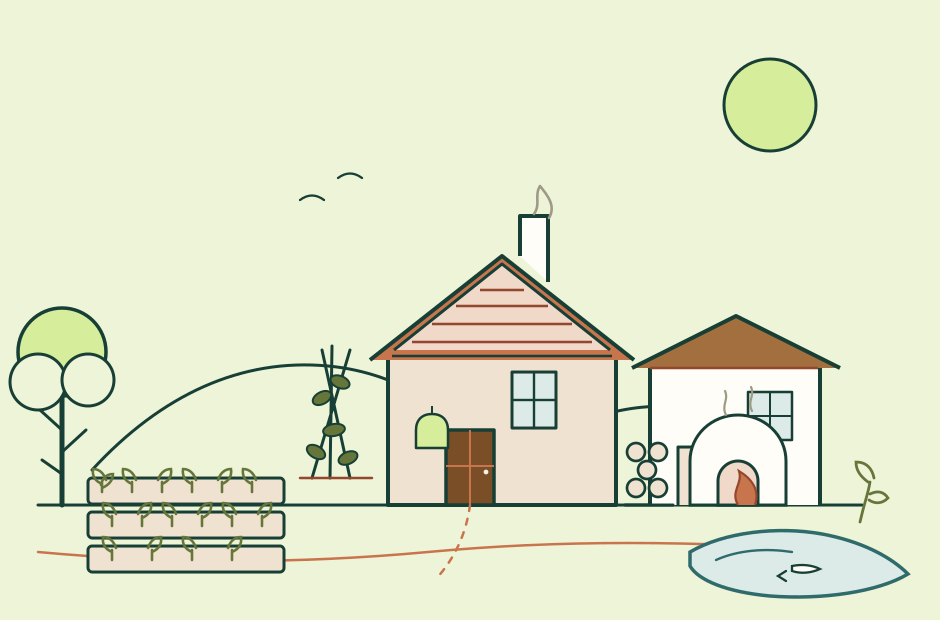
Line drawing of a small settlement with vegetable beds, bean poles, an earth house, a workshop, a lime kiln, a woodpile, a tree and a fish pond.
Food, shelter, fire, water, fibre and knowledge in one working landscape — none of them separate from the others.

Read this first

Not a return to the past. A choice about dependence.

“A-technological” is not a measure of how old a tool looks. It is a test of whether a community can keep its essential systems working through a bad year.

Working definition

a-technological adjective

Using tools and methods that can be understood, maintained, repaired and largely reproduced from local materials and shared knowledge. It is not the absence of technology; it is the absence of helplessness.

A steel axe, a glass bottle, a vaccine or a printed book can all belong in an a-technological community. What cannot belong is a system that stops working when a truck, a grid or a distant specialist disappears.

This is not isolation. Trade is sensible, and some things are better bought. The discipline is to know which imports are luxuries, which are tools, and which are dependencies that could hollow out the settlement in a bad year.

Sustainability, here, is not a list of green products. It is the ability to keep the things you depend on working — and to teach the next person to do the same.

  1. Can we repair it?

    If it breaks, is there someone here with the skill, the tools and the spare material to bring it back? A thing that can only be replaced is not really owned.

  2. Can we make it?

    Not everything, and not immediately. But the core should be reproducible from local clay, stone, wood, fibre, fire and human labour, with a realistic amount of time.

  3. Can we live without it?

    The bad-year test. If the answer is no, the dependency needs a store, a spare, a second skill or a plan. A single point of failure is a design warning.

The settlement as a system

Six domains, one working whole

Each domain has its own materials, skills and failure modes. None is optional, and none works for long at the expense of another. Start where your weakest store is.

Food and stewardship · Standalone guide

Beekeeping begins with forage and colony care.

Honey and wax are useful harvests, but the continuing work is to site hives lawfully, protect forage and water, inspect colonies and respond to pests, disease and seasonal dearth.

A year-round responsibility

Learn with an experienced local beekeeper before acquiring a colony. Choose a suitable site away from paths and livestock areas, obtain protective equipment and healthy locally adapted bees, and plan for inspection, swarms and winter stores before the first hive arrives.

Monitor varroa and brood health with local guidance, avoid contaminating honey with unapproved treatments, and harvest only capped surplus while leaving adequate stores. Keep honey away from infants under twelve months and follow local labeling rules.

The shelf

Two libraries and an atlas, one settlement

The crop library and the building manual were written separately. This is where they meet: a complete index of the guides that currently exist. The site atlas shows where both apply — what a given piece of ground offers for building and growing.

Library 01 · Food

The crop library

Potatoes, common beans, kale, spinach, Swiss chard, beetroot, carrots, cabbage, broccoli, sweet potatoes, winter squash, peas, lentils, chickpeas, tomatoes, peppers, grapes, corn, wheat and buckwheat, with harvest windows, regional growing calendars, nutrition, variety notes and practical field articles. Cultivated mushrooms add technique-based guidance for fungi grown on substrates rather than another soil-region crop.

84field guides and crop notes

Atlas · Land

Lay of the Land

A map of Romania and Bulgaria for choosing and reading a site: hot springs, rock type, soil, forest cover and tree ranges. Click any point for a land report that names the building materials underfoot, rates the six crops for that soil and altitude, and links to the matching guides. Works offline.

115hot springs mapped, with a land report for any point

Grow and eat

Shelter

Fire, metal and warmth

Fibre, water and craft

Land and boundaries

People and place

Tools and records

Reference

A sequence, not a calendar

A first year, in four moves

Climate and land set the real timetable. The order below is about dependency: secure the things that keep you alive before investing in the things that make life better.

  1. Read the ground

    Test soil, water, sun and local materials. Measure what you already have. Make one brick, one sheet, one small fire — not a season’s worth.

  2. Secure the core

    Get water to hold, the roof to shed, food to store and seed to keep. Repair the weakest room before building a new one.

  3. Build the working kit

    Add lime, a kiln, a better oven, a charcoal supply and the first iron tools. Each step should reduce a dependency, not add one.

  4. Teach and repair

    Write down what failed. Train a second person for every critical task. Keep a spare, a patch and a next season’s plan.

What to count

Measures that matter

A settlement is not sustainable because it feels simple. It is sustainable because its stores hold, its skills reproduce and its failures are survivable.

Choose a few measures and record them every season. The point is not a score; it is to notice a shrinking store before it becomes a crisis.

Six measures worth keeping in the settlement notebook.
Measure A good sign Start with
Food days stored Staple calories and seed are set aside before the hungry season, not after it. Crop library
Soil cover and organic matter Ground stays covered, water soaks in, worms and roots are present, rills are rare. Growing notes
Water held and clean The pond holds through the dry season; the spillway is clear; the catchment is not manured or sprayed. Pond and fish
Fuel per meal and warm room Less wood does more work; one room is warm without heating the whole building. Warmth
Repair hours and local spares Broken tools, roofs and containers are fixed with what is on site, by people who live there. Iron
Skills taught At least two people can do each critical task, and a third is learning. Paper and records
Dependence on the road You know which imports are essential, how long the store lasts, and what you would do without them. Order of works

Working principles

Six habits of a settlement that lasts

These are not slogans. They are reminders of where to look when a system starts to fail.

  1. Catch and store

    Water, heat, seed, fodder, fuel and knowledge are only useful if they are held through the season when they are scarce.

  2. Feed the soil first

    Every harvest is a withdrawal. Return fibre, dung, ash and compost; keep the ground covered; do not mistake yield for fertility.

  3. Build small, dry and repairable

    A modest building with a good roof, a raised floor and a breathable wall will outlast a grand one that traps water.

  4. Make fire work hard

    Dry fuel, a hot fire and a well-designed stove do more with less. Heat one room well; use the oven’s stored heat; never waste charcoal on an open blaze.

  5. Keep fibre moving

    Cloth, cord, paper and nets are the quiet infrastructure of daily life. Repair, reuse and make more before the old supply is gone.

  6. Measure dependence, not purity

    The goal is not to own nothing modern. It is to know what you rely on, how long it lasts and what you would do if it disappeared.

Scope and honesty

This is a map, not a certificate.

Every guide here describes general methods, not a stamped design or a guarantee. Climate, soil, law, culture and skill change what is possible. Local advice comes first.

Before you build, dam, burn or stock anything, check the rules and the risks:

  • Land tenure, planning permission and building codes.
  • Water rights, flood risk, protected habitats and fish-stocking law.
  • Fire restrictions, chimney clearances and carbon-monoxide safety.
  • Structural engineering for roofs, walls, dams and anything people sleep under.
  • Medical care for burns, eye injuries, poisoning and waterborne disease.

Work with people who have done it before, start at small scale, and keep a margin for failure. The workshop safety code and the crop library’s context notes apply across this whole guide.

Start with one store and one skill.

You do not need to build a village in a season. Test the soil, mend the roof, cook one meal with less wood, make one sheet of paper — and write down what you learned.