Two familiar classes, one chickpea species
Desi and kabuli chickpeas are both forms of Cicer arietinum. The names describe broad market and plant types, not separate species, and neither name guarantees a particular country of origin. Chickpea, garbanzo bean, gram, and chana are among the crop’s everyday names; the same food may be sold under different names depending on language, processing, and local custom.
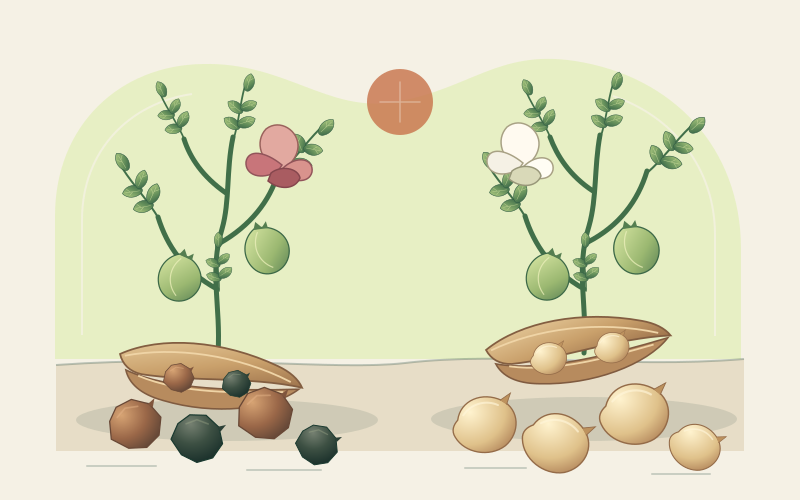
The classic distinction is visible in the mature seed. Desi types generally have small, angular seeds with a thicker, pigmented coat. Kabuli types generally have larger, rounder seeds with a thinner, pale cream or beige coat. These are useful tendencies rather than perfect boundaries: seed dimensions form a range, colour varies, and some intermediate or locally selected types do not fit a simple large-versus-small description.
Both classes grow the characteristic small chickpea pods, commonly containing one or two seeds. Neither is a climbing bean, and seed colour does not tell you whether the plant needs support. Growing instructions on the packet remain more useful than the class name alone.
Compare the visible seed and plant traits
| Trait | Desi type | Kabuli type |
|---|---|---|
| Mature seed | Usually smaller and more angular or irregular | Usually larger, plumper, and more rounded |
| Seed coat | Commonly thicker and pigmented tan, brown, reddish, green, or nearly black | Commonly thinner and white, cream, or beige |
| Flower | Often purple or pink | Often white |
| Common kitchen form | Whole seed, split seed, or flour in varied regional dishes | Often cooked whole or used in purees and salads |
| What it does not prove | Not automatically earlier, hardier, or more nutritious | Not automatically later, milder, or better quality |
Desi: colour and a substantial seed coat
Desi seeds can be brown, tan, reddish, green, yellow, or black, often with a rougher-looking, angular outline. Removing or splitting the pigmented outer coat reveals the lighter cotyledons inside. Split desi chickpeas are familiar as chana dal, while milled chickpeas are used for besan or gram flour. Those processing terms should not be confused with cultivar names, and products labelled simply “gram” may need closer reading.
Desi plants often have pigmented pink or purple flowers associated with their coloured coats. Many breeding programmes and local farming systems have selected diverse desi cultivars, so there is no single desi height, maturity date, flavour, or disease response. Dark seed colour is an identification clue, not a nutritional ranking.
Kabuli: pale coats across a size range
Kabuli seeds are the familiar pale chickpeas in many whole-seed dishes. Their rounded shape may show a small projecting “beak”, and their coats are generally thinner than those of desi types. Kabuli seed size still varies considerably: suppliers may distinguish small, medium, large, and very large grades. A larger grade is a physical description, not evidence of better flavour or agronomic performance.
Kabuli plants commonly bear white flowers. Some cultivars have simple or unifoliate leaves rather than the more familiar fern-like compound foliage; that is another plant trait, not a third seed class. Pale seed and white flower are typical clues, but a full cultivar description is more reliable than either alone.
Leave room for intermediate and local forms
Seed catalogues may offer green, black, reddish, or unusually large chickpeas without consistently using desi or kabuli terminology. Regional selections can combine traits, and commercial classifications differ by market. A seed that looks intermediate is not mislabelled merely because it fails to match one textbook picture. Read the botanical name, seed description, and supplier’s class rather than forcing every packet into two boxes.
Processing changes appearance too. Splitting, polishing, or removing a dark coat can make desi-derived food look pale, while roasting changes both colour and shape. Conversely, soil staining or poor storage can darken seed without making it a different variety. For seed selection, compare clean, mature, unprocessed seeds and use flower or leaf descriptions only as supporting evidence.
Let local adaptation make the final choice
A class label does not tell you whether a cultivar will finish in your climate. Start with the locally appropriate sowing season, expected days to maturity, and the weather likely during flowering and dry-down. Chickpeas need a suitable mild-to-warm growing period and benefit from dry weather as pods mature. Large-seeded kabuli cultivars have often matured later than desi cultivars in some regions, but breeding has changed that picture; do not turn a historical tendency into a rule.
Next, ask which diseases recur nearby. Ascochyta blight is a major concern in many chickpea-growing areas, while wilts and root rots matter in particular soils. Resistance is specific to the named disease and sometimes to particular pathogen strains; it is not immunity. Favour cultivars with current local trial results and use healthy seed from a reputable supplier. Advice developed for commercial fields still needs local interpretation for a garden.
| Check | Question to answer |
|---|---|
| Species and class | Is it Cicer arietinum, and is desi, kabuli, or another class stated? |
| Maturity | Can it produce your intended green or dry harvest within the local season? |
| Plant habit | Do its mature height and spread fit the available space? |
| Disease | Are resistance claims relevant to problems actually found locally? |
| Kitchen use | Do you want whole pale seeds, coloured seeds, splitting stock, or flour? |
If space permits, trial two suitable cultivars side by side. Record emergence, flowering, pod maturity, seed size, eating quality, and symptoms rather than judging yield alone. Repeat promising trials before relying on them. Our growing guide covers direct sowing and the dry finish that both classes need.
Save seed only from a healthy, understood crop
For seed saving, begin with a cultivar whose traits and any supplier restrictions you understand. Chickpeas are largely self-pollinating, but that does not make every saved lot genetically uniform or true to a label. Keep different plantings and stored lots clearly identified, and select well-filled pods from vigorous plants that represent the desired type.
Never build next year’s seed supply from plants with seed-borne or residue-borne disease symptoms. Dry mature seeds thoroughly before airtight storage, label the cultivar and year, and inspect for mould or insects. Keep planting seed separate from a spiced or salted cooking jar, and cook chickpeas intended for food thoroughly rather than tasting them raw.