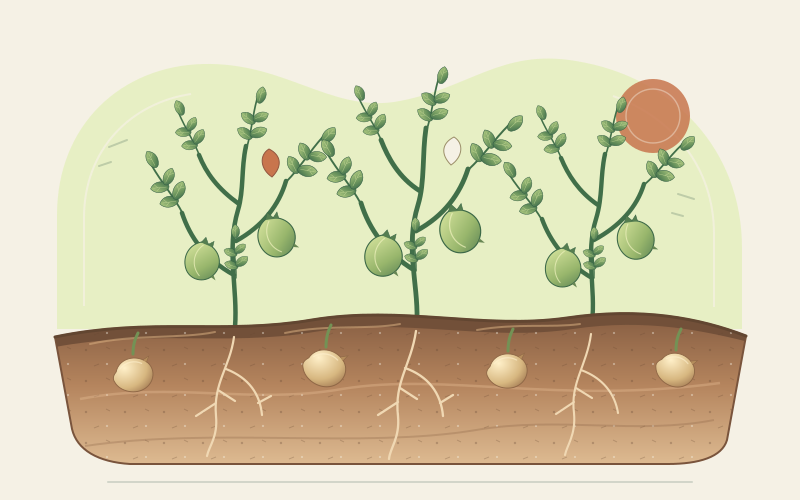
Know the plant and fit the season to your climate
Chickpea, garbanzo bean, or gram is Cicer arietinum, an annual pulse in the legume family. It is not a common bean or a garden pea. The plant usually grows as a low, upright bush with primary and secondary branches, compound leaves, and inflated oval pods that commonly hold just one or two seeds. Desi and kabuli are useful seed classes within this same species; our chickpea types guide explains their differences.
There is no single worldwide chickpea sowing date. Depending on the region, the crop may occupy a mild winter and spring, or a spring-to-summer slot. Direct sow into the locally recommended growing season, when soil is workable and not cold and saturated, aiming for mild to warm growing weather followed by a reasonably dry ripening period. Do not interpret “warm season” as a demand for extreme heat, or assume frost tolerance makes wet soil safe.
Rooted uses 90–120 days as a general sowing-to-harvest window, not a promise. Cultivar, seasonal temperatures, moisture, and whether you pick green or dry pods change the timing. Indeterminate plants can keep flowering while earlier pods ripen, and cool, wet weather can delay maturity. Choose a locally proven cultivar that can finish before damaging heat, prolonged rain, or frost becomes likely.
Direct sow and preserve an open plant canopy
-
Start with sun and drainage
Choose a sunny bed with soil that sheds excess water. Chickpeas are quickly injured by waterlogging, so a permanently damp hollow or heavily compacted patch is a poor choice. Loosen compaction and address drainage before sowing; a raised bed may help where it suits the site. Avoid working sticky soil into hard clods. A soil test, rather than routine fertiliser, is the best guide to pH and nutrient deficiencies.
-
Sow seed where it will grow
Chickpeas are normally direct sown rather than transplanted. As a general garden starting point, place seeds about 3–5 cm deep and 10–15 cm apart, with enough room between rows to weed and inspect plants. Small desi and large kabuli seeds may warrant different depths and spacing, so the packet and local guidance take priority. Sow into moisture, water gently if needed, and do not leave the seedbed saturated.
-
Expect sparse branching, not a dense vine
Young plants can grow slowly and the canopy often remains open. They do not need a trellis, and close planting will not turn them into a solid hedge. Thin severe overcrowding and remove weeds while they are small, taking care around shallow surface roots and branches. A few twigs may keep a sprawling plant off the soil, but routine pruning or pinching is unnecessary. Allow enough space for the cultivar’s mature spread.
-
Keep nitrogen modest
Avoid heavy nitrogen fertiliser, fresh manure, and repeatedly rich feeding, which can encourage vegetation and delay a useful dry harvest. Where compatible root-nodule bacteria are active, they can supply part of the crop’s nitrogen. Chickpea requires a Cicer-compatible inoculant, not an arbitrary bean or pea product. On ground new to chickpeas, a fresh appropriate inoculant may be useful; follow its label and do not treat it as a substitute for drainage or suitable temperatures.
-
Water by need, especially before ripening
Check moisture below the surface rather than following a rigid calendar. Supply water when needed for establishment, flowering, and pod filling, directing it to the soil and allowing excess to drain. Drought adaptation does not mean seedlings or filling seeds never need water. Equally, frequent sprinkling and wet foliage are unhelpful in humid weather. As mature pods approach dry harvest, avoid late irrigation that keeps producing fresh growth or delays drying.
Make local disease advice part of the plan
Begin with sound, reputable seed and cultivars recommended for local disease pressures. Rotate away from chickpeas where advised, manage weeds, space plants for airflow, and avoid handling wet foliage. Rotation and clean tools reduce some risks but cannot stop spores arriving from elsewhere. Inspect leaves, stems, and pods regularly, especially after rain or prolonged humidity.
Ascochyta blight can cause lesions on leaves, stems, and pods, sometimes with tiny dark fruiting bodies, and infected stems may break. Fusarium wilt, root rots, seedling damping-off, and other problems occur in particular soils and regions. Wilting or spots alone do not identify the cause. Do not save seed from diseased plants, and do not assume a home compost heap will destroy infected residue.
Contact local extension or a plant clinic for identification and current resistant-cultivar and residue-management advice. If treatment is recommended, use only a legally available product whose label matches the crop, problem, and setting; agricultural fungicide programmes cannot simply be scaled down into improvised garden remedies.
Pick green pods promptly or let dry seeds mature
| Harvest | Ready when | Handle next |
|---|---|---|
| Green | Pods and seeds are full-sized but still green and tender | Shell, refrigerate, and cook soon |
| Fresh mature | Seeds are filled out but have not become dry and hard | Use promptly as a perishable fresh pulse |
| Dry | Pods are straw-coloured to brown and dry; seeds are mature and hard | Shell, finish drying, inspect, and seal |
For green chickpeas, pluck individual pods before they begin to yellow and toughen. For a storage crop, allow seeds to mature fully and pods to dry, gathering them before prolonged wet weather causes sprouting, staining, or mould. Indeterminate branching means pods on one plant may not all finish together; select ripe pods or harvest the plant when most have reached the desired stage.
If rain threatens mature pods, cut or lift plants and dry them under cover with strong airflow, spread thinly rather than heaped. Once pods are brittle, shell by hand or thresh gently in a clean sack, then winnow away chaff. Spread seeds on trays until thoroughly hard and dry, with no cool damp feel. Discard mouldy, insect-damaged, or doubtful seeds.
Store thoroughly dry chickpeas in clean airtight containers in a cool, dark, dry place. Label the type and year, leave space to inspect the contents, and check periodically for condensation or insects. Drying is not cooking: home-grown dry chickpeas still need proper soaking or other preparation and thorough cooking, as described in the kitchen guide.