Winter describes the harvest, not cold tolerance
Winter squash are botanically fruits, grown for mature flesh and seeds that can be cooked and often stored. Butternut, acorn, and kabocha-type squashes belong to different groups within Cucurbita moschata, C. pepo, and C. maxima. Unlike tender-skinned summer squash picked young, a keeping squash remains on the plant until its rind and stem mature. All of these plants are frost-sensitive annuals.
Rooted’s 80–120 day window is an indicative interval from sowing to mature fruit under suitable warm conditions. Cultivar, transplant age, temperature, water, and the length of the frost-free season shift it. A short-season garden needs an appropriately early cultivar; a late planting cannot be hurried into a sound storage crop by cutting immature fruit.
Choose full sun and fertile, moisture-retentive but well-drained soil. Use a soil test to guide pH and fertiliser corrections. Avoid waterlogging and excessive nitrogen, which can favour leaves over timely fruiting. Rotation away from other cucurbits helps manage some soil-borne diseases but does not exclude airborne spores or flying insects.
Sow or transplant into real warmth
-
Work back from the local frost-free season
Direct sow only after frost danger has passed and the soil has warmed, when the remaining season can accommodate the packet’s maturity window. In a short or cool season, start seed indoors roughly two to four weeks before planting out rather than sowing very early into cold ground. Local extension dates are more useful than a national calendar.
-
Use direct sowing where the season allows
Prepare a moist planting site and sow at the depth and spacing on the packet; about 2.5 cm deep is a common starting point. Two or three seeds per station allow a choice of seedlings, after which thin to the strongest plant. Protect emergence from drying out and from locally troublesome slugs or other animals without leaving the soil saturated.
-
Raise compact transplants without root disturbance
For an early start, sow one seed on its side in a deep module or small pot of suitable growing medium. Provide warmth for germination, then bright light so seedlings stay sturdy. Do not let plants become old and rootbound. Harden them off gradually, transplant after frost with the root ball intact, firm gently, and water in. Use temporary cover only when appropriate and ventilate it in warm weather.
-
Allocate space to the mature vine
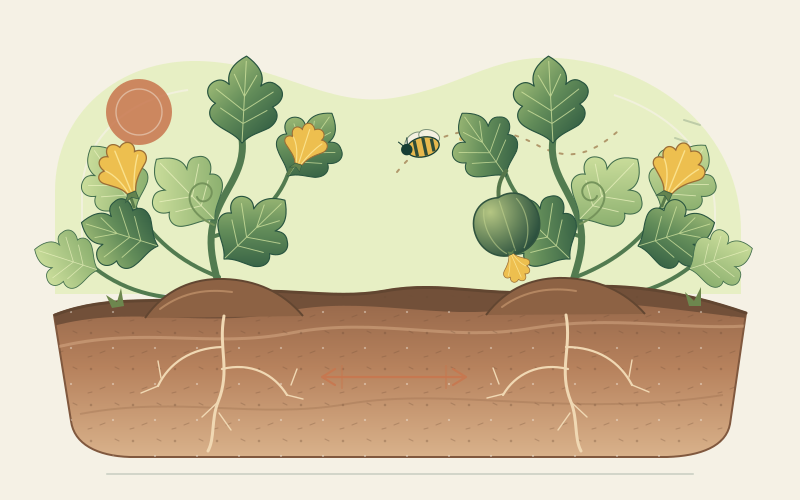
A bush plant is not necessarily tiny, and a trailing cultivar can run for several metres. As general guidance, allow about 90 cm between compact planting stations and at least 1.5 m between trailing ones, following the packet where it requires more. Mark the root zone before foliage hides it. Guide stray vines rather than repeatedly moving them once fruit has set.
-
Trellis only with support for fruit as well as stems
Vertical growth can save ground space, but the structure must carry vigorous vines in wind and rain. Smaller-fruited cultivars are the practical choice. Tie loosely as stems grow and support individual fruit with a well-secured sling where needed; a developing squash should not hang from its stem. Never improvise a tall support that is unsafe to reach for inspection or harvest.
-
Water the root zone and conserve moisture
Check below the surface and water thoroughly when required, particularly during establishment, flowering, and fruit swelling. Uneven supply and drought stress can restrict growth, while persistent saturation damages roots. Direct water to the soil rather than routinely wetting foliage. Mulch around established plants to slow evaporation and suppress weeds, keeping damp material clear of the stem.
-
Protect flowers without blocking pollinators
Each plant bears separate male and female flowers. Male flowers have a plain stalk; female flowers have a small immature fruit behind the petals. Bees and other insects normally transfer pollen between them. Early female flowers may drop when few male flowers are open, and heat or plant stress can also reduce set. Avoid broad-spectrum insecticide use around flowering plants and follow any product label precisely.
If pollinators are scarce or an insect cover must be used before pests arrive, open it for flowering or hand-pollinate. On a dry morning, transfer pollen from a freshly opened male flower onto the stigma inside a freshly opened female flower. Use a flower from the same cultivar when seed is not being saved; crossing affects saved seed, not the flesh of the current fruit. Replace protective covers only if their pest-management purpose still justifies the extra work.
Harvest a mature rind, then cure and inspect
Leave storage fruit on the vine while the plant remains healthy and frost stays away. Maturity cues include the cultivar’s expected full colour, a hard rind that is difficult to mark with a thumbnail, and a dry, firm stem. Size and days to maturity are supporting clues, not substitutes for these signs. Immature fruit may be edible immediately but will not develop the same keeping quality.
Harvest before damaging frost. Cut the vine cleanly, leaving roughly 5–10 cm of stem where the cultivar forms one, and avoid cutting into the fruit. Do not carry squash by the stem: a broken handle creates a wound. Bruised, cracked, or stemless fruit should be separated for prompt use rather than mixed into long-term storage.
Cure sound fruit in a warm, dry, ventilated, frost-free place for about one to two weeks to dry the surface and harden the rind, following cultivar-specific advice. Acorn types generally have a shorter storage life than good keeping butternuts and should not be kept indefinitely. After curing, store squash at about 10–15°C with air circulation, ideally not touching. Refrigeration of intact squash is unnecessary; cut squash and cooked leftovers are perishable and belong in the refrigerator.
Inspect stored fruit regularly for soft patches, mould, leakage, or shrivelling, and remove doubtful specimens. Storage life varies by species, cultivar, maturity, damage, and conditions, so no single number of months is guaranteed. The hard rind is a protective feature, not permission to ignore decay.
Prevent powdery mildew and identify local pests
Powdery mildew produces pale, powdery growth on leaves and can weaken plants prematurely. Choose locally resistant cultivars where available, give plants sun and space, maintain root-zone moisture, and avoid overcrowding. These measures reduce risk rather than guaranteeing freedom from disease. Remove badly affected leaves only where local guidance supports it, and do not compost diseased material unless your composting system is known to handle it.
Squash bugs, squash vine borers, cucumber beetles, aphids, slugs, and other pests matter in different places; not every garden has all of them. Inspect leaf undersides, stems, and developing fruit regularly and identify the actual culprit. Hand removal, sanitation, crop rotation where useful, and correctly timed barriers are preferable to automatic spraying. Covers must be secured before infestation and managed for pollination. For diagnosis or treatment, use local extension advice and never improvise pesticide doses.