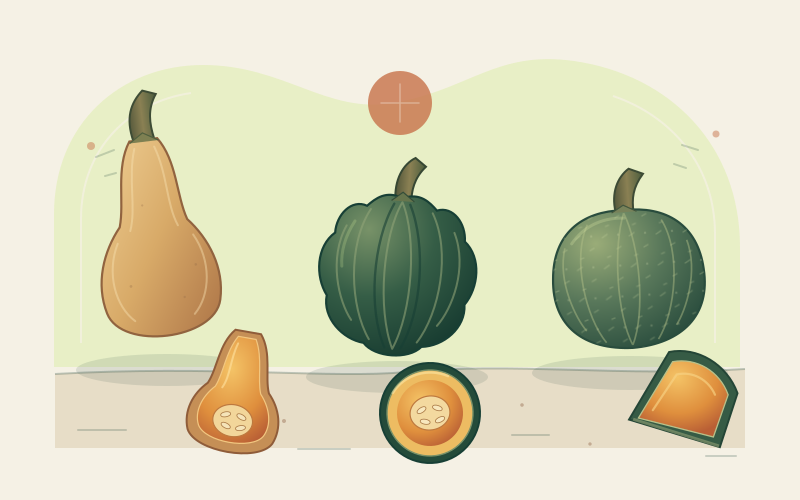
Kitchen types and botanical species are different systems
“Winter squash” describes mature fruit with a firm rind, generally harvested for cooking and often storage. It is not one botanical species, and it does not mean the plant survives winter. Butternuts are usually Cucurbita moschata, acorn squashes C. pepo, and kabocha-type squashes generally C. maxima. Cultivars and occasional interspecific hybrids complicate broad labels, so check the packet or seed supplier’s botanical information.
Summer and winter are use categories too. C. pepo includes tender-skinned courgettes and summer squash as well as mature acorn types and many pumpkins. Planting an acorn beside a courgette therefore does not isolate their seed: they share a species and can cross. Conversely, a different species is not a promise of absolute isolation, because some interspecific crosses are possible.
Rooted uses an indicative 80–120 days from sowing for mature winter squash. Actual timing depends on cultivar, transplanting, warmth, water, and season length. Fruit size, external colour, vine habit, flesh texture, and storage life all vary within a type. Treat a cultivar name as more specific than a supermarket category, and use local trials rather than a universal “best” list.
Three useful forms for garden and kitchen
Butternut: tan skin and a long, seed-sparse neck
Butternut squash typically have smooth tan skin, orange flesh, and a bulbous seed cavity below a long solid neck. That neck yields convenient slices or cubes with relatively little scooping. Fruit weight, neck length, skin colour, and sweetness vary among cultivars. Waltham is a familiar example, while compact and smaller-fruited selections have been bred for different spaces and portions.
Most butternuts are vigorous trailing C. moschata plants, not naturally compact bushes simply because the fruit is medium-sized. Give them the vine space stated by the supplier. Sound, fully mature fruit of suitable cultivars often keep well after proper curing, but maturity and handling remain decisive. Butternut flesh is commonly roasted, mashed, or added to soups and stews; none of those uses requires a health claim.
Acorn: small ribbed fruit for manageable portions
Acorn-type squash have a rounded, tapered, often ribbed form, with dark green, orange, cream, or variegated skin depending on cultivar. Their central cavity holds seeds and fibres, and their size makes halving and stuffing convenient. Flesh is commonly yellow to orange, but colour intensity and texture vary. Table Queen is a longstanding name; modern cultivars may be selected for compact growth, different colouring, or earlier maturity.
Many acorn cultivars have a less sprawling habit than large pumpkins, though “bush” plants still need substantial room. They are generally better used within a shorter storage period than long-keeping butternuts. Choose sound mature fruit and inspect stored stock rather than assuming every hard-skinned squash keeps all winter. Because acorns belong to C. pepo, their seed-saving neighbours include other pepo squashes that look quite different.
Kabocha-type: squat shape and dense, dry-textured flesh
Kabocha-type squash are usually squat or flattened globes with dark green, grey-green, or sometimes orange skin. The name is used across cultivars with different sizes and surface textures. Flesh is often deep yellow to orange and valued for a relatively dry, dense texture when cooked. That texture is a culinary tendency, not a guarantee for every fruit or growing season.
These types are generally associated with C. maxima, a species that also includes many large pumpkins, Hubbard squash, and banana squash. Some modern seed offerings can involve interspecific parentage, making supplier information important for seed saving. Vines can be vigorous and fruit heavy; ground culture or a very strong, carefully managed support is more realistic than a small container. Select a size suited to the meal and the season rather than pursuing the largest possible fruit.
| Type | Usual species | Useful feature | Keep in mind |
|---|---|---|---|
| Butternut | C. moschata | Long solid neck; convenient orange flesh | Often vigorous vines; storage needs maturity and curing |
| Acorn | C. pepo | Small ribbed fruit suited to halves | Usually shorter keeping; crosses with other pepo types |
| Kabocha-type | Generally C. maxima | Dense flesh and squat fruit form | Check cultivar parentage, vigour, and fruit weight |
Choose for the actual plot and meal
Start with season length. A large late cultivar is a poor gamble where the frost-free interval is short, even if its fruit looks appealing. Check days to maturity, local performance, and any independently supported disease resistance. Then measure available space at adult size. A trailing cultivar may be guided along a boundary or up a suitable support, but neither technique removes the need for water, inspection, pollination, and safe fruit support.
Consider storage and kitchen use together. Small acorns reduce leftover portions; butternut necks are efficient for cubes; kabocha-type flesh suits cooks who prefer a drier texture. A mixed planting can broaden choice but creates different harvest dates and keeping lives. Retain labels and record emergence, vine spread, first fruit, maturity, flavour, and condition after storage. Our seed-to-storage guide covers the shared cultivation method.
Save seed with species and breeding in mind
Squash flowers are insect-pollinated, and cultivars of the same species can cross even when their fruit look unrelated. Pollen carried between an acorn and a courgette, for example, does not change that season’s fruit flesh, but the seeds inside can produce mixed offspring. Different Cucurbita species generally cross less readily, yet species difference alone is not a rigorous isolation plan. Follow a specialist seed-saving guide for distances, barriers, hand-pollination, and population size.
Also distinguish open-pollinated cultivars from F1 hybrids. Seed from an open-pollinated cultivar can remain reasonably consistent when properly isolated and selected; seed from an F1 normally segregates into varied offspring and should not be expected to reproduce the parent. Saving seed from a supermarket fruit adds uncertainty about cultivar, crossing, maturity, and local adaptation.
For a deliberate home seed crop, begin with known open-pollinated seed, grow enough healthy plants for the method recommended by your seed-saving reference, and control pollination rather than relying on appearance. Harvest fully mature fruit and use the recommended after-ripening period where applicable. Clean and thoroughly dry seed before cool, dry storage, label species and cultivar, and test germination before relying on it. Never sow seed from a mouldy or decayed fruit.