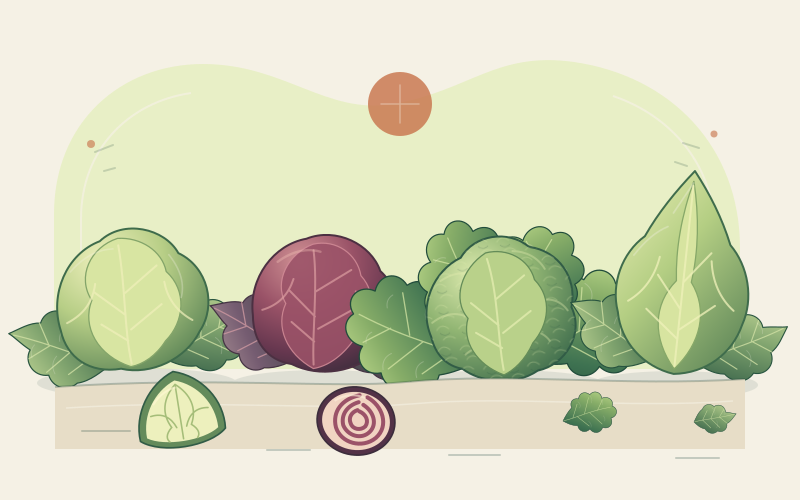
Head form and harvest season are separate choices
Heading cabbage belongs to Brassica oleracea, the remarkably varied species that also includes kale, broccoli, cauliflower, Brussels sprouts, and kohlrabi. Garden descriptions usually group cabbages by colour, leaf texture, or head shape. These are useful practical categories, not rigid botanical divisions, and one cultivar can belong to more than one: a red cabbage can be pointed, while a savoy is defined chiefly by its crinkled leaves.
Seed catalogues also use spring, summer, autumn, and winter labels. These describe the intended sowing and harvest pattern, not simply the colour on the packet. A compact early cultivar and a large late storage cultivar need different timing. Check whether listed days run from sowing or transplanting, and use local experience to translate a broad season label into actual dates.
Rooted gives cabbage an indicative 70–120 days to maturity from transplanting. That range does not include the weeks spent raising the young plant. Baby or loose-leaf harvests may be earlier, while a keeping head may stand longer in suitable cool weather. Use packet guidance and head condition together rather than expecting all four forms to mature at once.
Four familiar cabbage forms
Green: smooth leaves and wide-ranging uses
Green or white cabbage is the familiar smooth-leaved type. Outer leaves may be blue-green or deep green, while tightly enclosed inner leaves are much paler. Heads can be round, flattened, small, or very large. Early fresh-market selections often have tender leaves; late Danish-type or other storage selections are typically dense and firm. “Green” alone therefore says little about maturity, hardness, or storage life.
Use green cabbage shredded in slaws, sliced into stir-fries, simmered in soups, or cooked as wedges. A compact cultivar suits a small household because a cut head must be used progressively. For extended storage, choose a cultivar explicitly bred and locally recommended for that purpose rather than leaving an early type in the ground and hoping it becomes a keeper.
Red: purple-red leaves and a dense cut surface
Red cabbage ranges from reddish purple to deep violet, with contrasting pale veins. Many cultivars form solid round heads, although pointed forms exist. The pigment can stain a board and tint cooking liquid or neighbouring ingredients. Acidic ingredients often shift the colour towards brighter red, while alkaline conditions can push it towards blue; this is a kitchen reaction, not a freshness test.
Red cabbage works raw when finely shredded, and can be braised, steamed, pickled, or added to mixed vegetable dishes. Its firm texture suits slow cooking, but “red” does not guarantee longer storage. Check the cultivar description. If a recipe depends on distinct colours, prepare and cook red cabbage separately before combining it with pale beans, grains, or other vegetables.
Savoy: crinkled leaves and flexible texture
Savoy cabbage has conspicuously blistered, crinkled leaves, usually in rich green shades with a paler centre. Its leaves are often more pliable than those of a smooth storage cabbage, making them convenient for wraps and stuffed leaves. Heads vary from relatively loose to dense, and from compact to large. The textured surface can trap soil, so separate or unfold leaves as needed when washing.
Savoy types are often associated with autumn and winter harvests, and some have good cold tolerance. That does not make every savoy hardy in every climate. Follow the packet’s season and protection advice. While savoy leaves are well suited to quick cooking, stuffing, and soups, storage varies considerably: select a named keeping cultivar if that is your goal.
Pointed: conical hearts for an early, compact harvest
Pointed, conical, or sweetheart cabbage narrows towards the top rather than forming a globe. Many selections are compact, early, and relatively loose-hearted, with tender leaves and a small core. Greyhound and Early Jersey Wakefield are familiar examples of the form, not universal recommendations. Their size can suit close spacing and smaller meals, but the mature cultivar’s dimensions still govern the final distance between plants.
Use pointed cabbage fresh in salads, lightly cooked ribbons, or quick sautés. It is generally a fresh-harvest choice rather than the default for months of storage. Some spring cultivars can be cut young as greens or allowed to heart; thinning alternate plants gives both. For a continuous supply, sow a few plants in succession rather than expecting one early head to stand indefinitely.
| Form | Recognise it by | Kitchen use | Selection note |
|---|---|---|---|
| Green | Smooth green outer leaves, pale centre | Slaw, soup, wedges, stir-fries | Early and storage types differ greatly |
| Red | Purple-red head with pale veins | Shredding, braising, pickling | Colour can transfer during preparation |
| Savoy | Deeply crinkled green leaves | Quick cooking, wraps, stuffed leaves | Cold tolerance and keeping vary |
| Pointed | Conical, often compact head | Fresh salads and light cooking | Usually chosen for early fresh use |
Read the season label before buying seed
RHS cultivation guidance separates spring, summer, autumn, and winter cabbages by sowing and harvest time. Spring types may be sown in summer and overwintered where conditions permit, then picked as greens or allowed to heart. Summer types are generally sown earlier for warm-season harvest. Autumn and winter types often need a longer run and more space, with savoy, red, and smooth storage forms all represented.
These calendars are not universal. In a hot summer, an early or autumn-maturing crop may avoid the most stressful period. In a short season, a compact cultivar may be more realistic than a giant late head. Where winters are severe, an “overwintering” label still depends on local hardiness, drainage, and protection. Local extension trials and experienced nearby growers can clarify what a supplier’s broad label means.
Storage is another independent trait. Suitable late cabbages are dense, mature, and sound at harvest. Early pointed heads and many tender fresh types deteriorate sooner. No colour or shape compensates for damage, splitting, or a warm dry store. The harvest and storage guide explains handling after the cultivar has done its part.
Make a short list from your plot and plate
Start with the harvest window, then choose head size, form, and intended use. Check days from transplanting, final spacing, disease resistance, and whether the cultivar is intended for fresh use or storage. Resistance is specific, not blanket immunity: clubroot resistance can depend on the pathogen strain, and a resistant plant still needs sound rotation and hygiene.
For a small first trial, grow one early pointed or compact green cultivar beside a later red or savoy suited to your season. Keep labels and record establishment, heading date, size, flavour, and storage. This gives a fair comparison without producing a glut of identical heads. Buy fresh seed or clean transplants from a reputable supplier, and reject transplants with swollen, distorted roots.
Do not confuse these heading cabbages with Chinese cabbage, which belongs to Brassica rapa, or with non-heading kale and collards. They share pests and rotation considerations but have different growth habits and maturity guidance. Choose the crop named in the recipe and the seed description rather than substituting by the word “cabbage” alone.