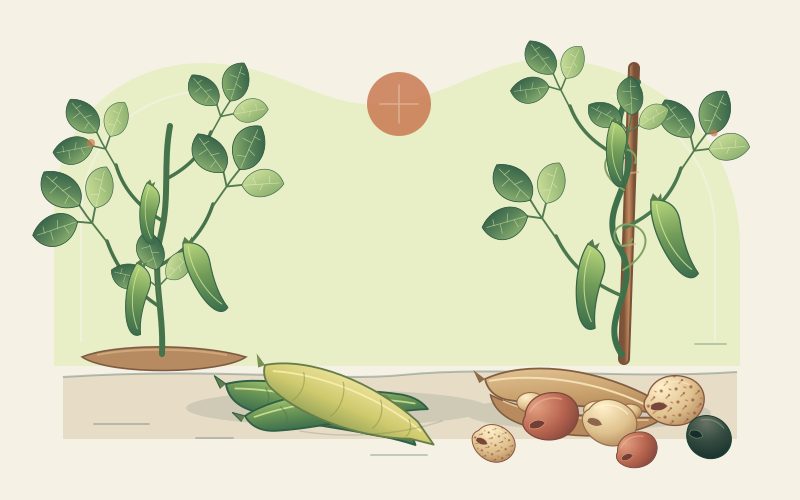
Start with the common bean
Green beans, French beans, snap beans, string beans, kidney beans, pintos, borlotti, navy beans, and black beans can all be forms of the same species, Phaseolus vulgaris—the common bean. The names may describe pod shape, mature seed appearance, regional tradition, or intended use rather than separate botanical groups. This diversity is useful, but it makes seed catalogues easy to misread.
Begin with two independent choices. First, do you want to eat the whole young pod, the fresh shelled seed, or fully mature dry seed? Second, will a compact plant or a climbing plant fit your space and season? Colour and cultivar come after those practical decisions.
Snap, filet, shelling, and dry are harvest types
Snap and filet: the pod is the crop
Snap beans are harvested while the entire pod is tender and the seeds inside are still small. The name recalls the clean break of a crisp young pod. Older “string bean” cultivars developed a fibrous strand along the pod seam that cooks removed; many modern cultivars are described as stringless, although pods left too long can still become tough. Pods may be round, oval, or flat, depending on cultivar.
Filet beans are slender snap beans, usually picked when especially young and narrow. “Filet” describes a style and harvest stage, not another species. Their fine shape is lost if pods remain on the plant and fill out. Frequent picking is therefore part of growing them well, not merely a way to increase yield.
Shelling: fresh seeds without the pod
Shelling beans are removed from the pod when the seeds are full-sized but still soft, moist, and quick-cooking compared with dry beans. Some cultivars are selected for this stage; borlotti types are familiar examples. Fresh shelled beans are perishable and need prompt refrigeration and cooking. A snap cultivar may have edible immature seeds too, but that does not make every snap bean a good shelling variety.
Dry: mature seed for storage
Dry beans stay on the plant until seeds are mature and pods begin to dry. The shelled seeds are dried thoroughly before storage. Kidney-shaped red or white seeds, speckled pintos and borlotti, round navy beans, and shiny black beans describe useful seed types within P. vulgaris, not a complete list of cultivars. Many dual-purpose cultivars can be eaten young as snap beans or left for seed, but a long season may be needed for the dry harvest.
Bush and pole describe growth habit
Bush beans, also called dwarf beans, branch into a relatively compact plant. They generally need no tall support, fit rows and containers readily, and often provide a concentrated flush of pods. Succession sowing can spread a fresh harvest. Low pods may need protection from soil splash, and a heavy plant can still benefit from short twiggy supports.
Pole beans produce long twining stems and need a secure trellis, canes, or netting. They use vertical space and commonly yield over a longer period once they begin. Supports must carry the mature plant’s weight and withstand wind; put them in place before sowing. “Half-runner” and other intermediate habits also occur, so read the supplier’s mature-height and support advice.
Habit and harvest type are separate. There are bush and pole snap beans, and bush and pole dry beans. A purple pod does not signal a climber, and a climbing plant is not automatically intended for drying. The table shows the independent labels to look for.
| Question | Useful label | What it tells you |
|---|---|---|
| What will I eat? | Snap, filet, shelling, dry | Harvest stage and plant part |
| How does it grow? | Bush, pole, intermediate | Space and support needs |
| What does the pod look like? | Green, yellow, purple, striped | Appearance and visibility when picking |
| Will it finish here? | Maturity and local trial notes | Likely fit with season and conditions |
Pod colour is useful, but not a promise
Green is the familiar chlorophyll-rich pod. Yellow or “wax” pods lack the usual green masking colour; “wax” does not mean their surface or cooked texture is waxy. Purple pods contain anthocyanin pigments and can be easier to spot among leaves. Their colour commonly changes towards green during cooking as those pigments respond to heat and the cooking environment. Striped or mottled pods, such as many borlotti types, often lose some contrast when cooked too.
Pod colour says little by itself about sweetness, tenderness, yield, or nutritional superiority. Do not confuse pod colour with mature seed colour: a green pod can conceal white, black, red, or speckled dry seeds. For snap beans, tenderness depends strongly on cultivar, picking stage, water supply, and time between harvest and cooking.
Familiar cultivars as starting points
These examples illustrate catalogue language rather than universal recommendations. Named forms and availability differ among suppliers, and “Blue Lake” or “Borlotto” may appear in several selections. Check the full description instead of buying on a famous name alone.
| Cultivar | Usual habit | Typical use | Distinguishing feature |
|---|---|---|---|
| Provider | Bush | Snap | Round green pods; widely offered for fresh harvest |
| Blue Lake | Bush or pole selections | Snap | Round to oval green pods; name covers distinct forms |
| Cobra | Pole | Snap | Long, flat green pods over a climbing season |
| Golden Gate | Pole | Snap | Large, flat yellow pods |
| Purple Teepee | Bush | Snap | Purple pods carried visibly above the foliage |
| Borlotto Lingua di Fuoco | Bush or climbing forms | Shelling or dry | Red-streaked pods and mottled seeds |
| Jacob’s Cattle | Bush | Shelling or dry | White seeds patterned with dark red |
Let your plot make the final selection
A “days to harvest” figure is a relative guide measured under particular conditions, not an appointment. Cool soil, heat waves, water supply, sowing date, and daylight can alter performance; some bean cultivars are more sensitive to day length than others. Dry types need enough frost-free time to mature and then dry. Hot conditions can interfere with flowering or pod set even where the species grows well overall.
Ask local growers or extension which cultivars reliably finish and which diseases recur. Resistance claims apply only to named problems and sometimes specific pathogen strains; they are not immunity. If space permits, trial two cultivars side by side, record emergence, first useful harvest, eating quality, and disease, and repeat promising choices before relying on them. Our growing guide covers sowing and harvest in detail.
Not every bean is a common bean
These crops share the broad legume family or an everyday name, but they are different species with different climate preferences, growth habits, and kitchen uses. Do not transfer common-bean sowing or preparation instructions to them automatically.
- Lima bean (Phaseolus lunatus): grown for its seed, not as a snap-pod common bean.
- Fava or broad bean (Vicia faba): generally a different seasonal fit from warmth-loving common beans.
- Soybean (Glycine max): harvested as fresh edamame or mature seed, with its own cultivars and handling.
- Cowpea or black-eyed pea (Vigna unguiculata): a distinct species, including pod and dry-seed types.
- Runner bean (Phaseolus coccineus): a climbing relative, but not P. vulgaris.