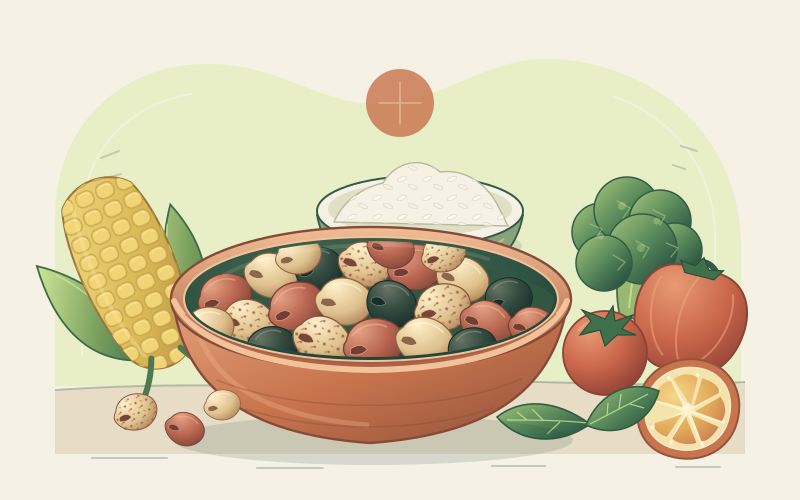
Amino acids are the useful pieces of protein
Digestion breaks food proteins into amino acids and small peptides. The body absorbs these and uses amino acids to build and repair its own proteins, including muscle, enzymes, transporters, and immune molecules. Nine amino acids are described as essential or indispensable because the body cannot make them in sufficient amounts, so the diet must supply them. “Essential” describes that dietary requirement, not a ranking of importance.
Foods differ in total protein and in the proportions of amino acids they provide. An amino acid is called limiting when its amount is low relative to the body’s needs compared with the others; it does not mean the food contains none. The familiar labels “complete” and “incomplete protein” can obscure this point. Most beans and grains contain all the essential amino acids, but their patterns differ, and digestibility and portion size also matter.
Common beans and other legumes generally provide proportionally more lysine than cereal grains. Grains generally provide proportionally more methionine, one of the sulfur-containing amino acids, than legumes. These are broad tendencies, not identical profiles for every species, cultivar, or recipe. When both food groups contribute to a varied diet, their patterns can complement one another.
There is no mandatory same-meal combining rule
You do not need to combine beans and grains in the same mouthful or at the same meal. The body draws on a circulating supply of amino acids rather than resetting a nutritional ledger after each plate. Eating a variety of protein-containing plant foods across the day can supply the essential amino acids without deliberate food-pair arithmetic.
That conclusion comes with an important condition: variety is not a licence to ignore overall intake. A dietary pattern still needs enough energy and enough total protein, alongside other nutrients. Needs vary with age, growth, pregnancy, illness, and activity. Someone with a restricted diet, a medical condition, or concerns about protein should seek individual advice from a qualified health professional rather than relying on a generic menu formula.
So why serve beans with grains? Because the combination is satisfying, affordable, culturally rooted, and nutritionally useful. A shared meal is a practical option, not a physiological deadline. Beans at lunch and grain at an evening meal still contribute to the day’s amino-acid supply. Nuts, seeds, vegetables, and other foods also add protein and nutrients to the wider pattern.
Three grains, many workable meals
The examples below use common beans, Phaseolus vulgaris, but their exact amino-acid and nutrient content varies. Treat them as flexible meal patterns rather than prescriptions or claims that one combination is nutritionally perfect.
| Grain | Bean example | A colourful addition |
|---|---|---|
| Maize | Black or pinto beans with corn tortillas; bean stew beside polenta | Tomato salsa, sweet peppers, or shredded cabbage |
| Rice | Kidney-bean rajma with rice; red beans and rice; black beans with rice | Broccoli, tomatoes, citrus, or a pepper salad |
| Wheat | Beans on wholegrain toast; white-bean soup with bread; beans with bulgur | Tomatoes, steamed greens, or fruit afterwards |
Beans and maize might appear as tacos, tortillas and beans, or a spoonful of beans over polenta. Beans and rice include dishes such as rajma chawal and many regional red-bean, black-bean, and rice preparations. Beans and wheat can be as simple as toast and beans or as substantial as bean stew with bread. Whole grains can add fibre and other nutrients, but refined grains also contain protein; enrichment and fortification rules differ by place and product.
None of these dishes must contain both foods to count towards the day’s variety. Nor does pairing erase what else is on the plate: cooking fat, salt, portion size, vegetables, and the rest of the diet all shape the meal.
Vitamin C supports absorption of non-heme iron
Beans and grains contain non-heme iron, the form found in plant foods and fortified products. Its absorption varies with the rest of the meal and with a person’s iron status. Vitamin C can enhance non-heme iron absorption, making a vitamin-C-rich vegetable or fruit a useful part of a bean meal. Unlike amino-acid complementation, this is a reason to include that vitamin C source in the same eating occasion.
Add peppers or broccoli to beans and rice, serve tomato salsa with bean tortillas, stir cabbage into a bean stew, or finish with citrus or strawberries. The food does not need to be raw, although cooking and storage can reduce vitamin C; use a varied mix of vegetables and fruits rather than chasing an exact dose. Tea and some other meal components can inhibit non-heme iron absorption, but there is no universal rule that everyone must separate every drink from every meal.
Vitamin C changes absorption; it does not create iron or guarantee prevention of deficiency. People with diagnosed iron deficiency, persistent symptoms, pregnancy-related needs, or conditions affecting absorption should follow professional advice. Self-prescribing iron supplements can be harmful.
Prepare dried and red kidney beans safely
Raw or undercooked beans can contain phytohaemagglutinin, a naturally occurring lectin. Red kidney beans are a particular concern because some contain high levels. Eating inadequately prepared beans can cause nausea, severe vomiting, and diarrhoea. Soaking alone is not cooking, and a low-temperature slow cooker must not be relied upon for the initial destruction of this toxin.
-
Sort, rinse, and soak
Spread out the dried common beans, remove stones and debris, and discard mouldy or doubtful seeds. Rinse them, then soak in plenty of water for at least five hours; a longer cool soak is commonly used. Follow specific instructions on commercially packaged beans if they provide a validated method. Drain the beans, discard the soaking water, and rinse again.
-
Boil rapidly in fresh water
Put the drained beans in a pan with fresh water. Bring them to a vigorous boil and maintain a rapid boil for at least 30 minutes, following the FDA’s precaution for kidney beans. Keep enough water in the pan and do not shorten this step because the beans look softened. This is especially important for red kidney beans.
-
Cook until fully tender
After the rapid boil, reduce the heat and simmer until the beans are completely tender and ready for the recipe; cooking time varies with bean type, age, and soaking. They can then be added to a stew or other dish. Do not taste crunchy or undercooked beans to check progress, and do not treat soaking, gentle warming, or a slow-cooker-only method as an equivalent safety step.
Commercially canned beans are already cooked and are not the same safety problem as raw dried kidney beans. Use them according to the label, refrigerate leftovers promptly, and use clean utensils. Home-grown and shop-bought dried beans both require thorough preparation; a garden origin does not change the lectin risk.
Keep the whole pattern in view
Beans contribute protein and fibre along with varying amounts of folate, iron, potassium, and other nutrients. Grains bring their own mix of carbohydrate, protein, fibre, vitamins, and minerals, shaped by species, processing, and fortification. No single pairing or editorial “density” label can rank every meal. Actual nutrient values depend on the food and cooked portion, and individual absorption and needs differ.
The practical approach is reassuringly ordinary: cook beans safely, choose grains you enjoy, include vegetables and fruits, and vary protein sources across the day. Familiar dishes already do much of this work without a same-meal rule.
Sources and specialist references
- California State University: Dietary sources of protein and protein complementation
- NIH Office of Dietary Supplements: Iron fact sheet for consumers
- US Food and Drug Administration: Natural toxins in food, including phytohaemagglutinin in beans
- US Food and Drug Administration: Bad Bug Book, second edition