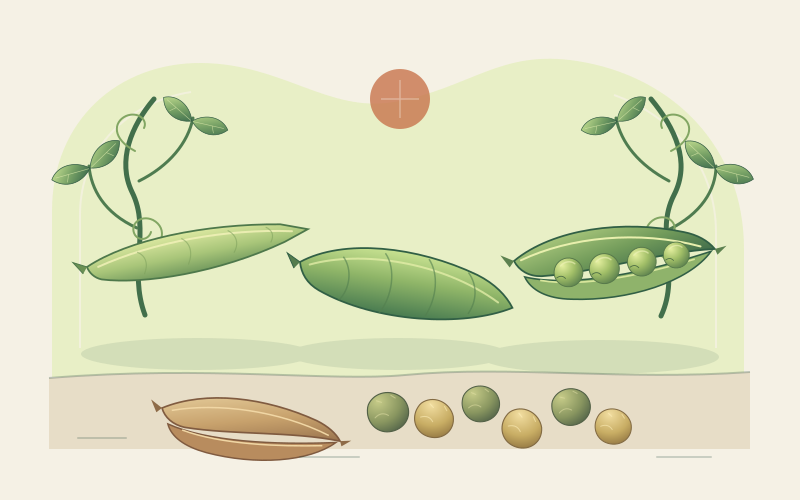
One garden species, four useful harvests
Most garden peas, snow peas, snap peas, petit pois, and marrowfat peas are selections of Pisum sativum. Their names describe intended harvest, seed character, or culinary use rather than separate species. A cultivar may be especially good at one stage and disappointing at another, so begin by deciding whether you want a whole edible pod, tender shelled seeds, or mature dry peas.
Then check growth habit and maturity. Dwarf and tall forms exist across several harvest types, and first-earlier cultivars differ from later maincrops. Rooted uses an indicative 55–80 days to a first fresh harvest under suitable conditions; a packet’s timing and local experience are more specific. Dry seed requires additional time on the plant. The pea growing guide covers sowing and supports.
Snow, snap, shelling, and dry are not synonyms
Snow peas: flat, edible pods
Snow peas, also called mangetout, are picked while the pod is still flat or only beginning to fill. The pod wall is tender and the whole pod is eaten. Waiting for large, round seeds defeats the purpose: the pod can become fibrous and lose the delicate texture for which these cultivars were selected. Some snow types have yellow or purple pods, but colour does not change the basic harvest rule.
Snap peas: crisp, filled, edible pods
Snap peas have a thicker, fleshy edible pod and are picked after the peas inside have started to swell. The result is rounder and juicier than a snow pea, yet the pod remains crisp rather than becoming a tough shell. Some cultivars need strings removed from the seam; others are sold as stringless. Both snow and snap peas can become tough if left too long, but snap pods are intentionally harvested at a fuller stage.
Shelling peas: the seeds are the crop
Shelling or garden peas are removed from their generally fibrous pods when the seeds are full-sized but still tender. Petit pois are small-seeded selections, not immature cowpeas or a different species. Smooth-seeded peas are often used for early sowing because of their hardiness, while wrinkled-seeded types are widely associated with sweeter fresh flavour. These are useful catalogue tendencies, not a substitute for the cultivar description or your own taste test.
Dry peas: mature seed for the cupboard
Dry-pea cultivars are allowed to mature fully before the hard seeds are shelled and dried. Marrowfat types are large-seeded peas used for dishes such as mushy peas; soup peas may be green or yellow. Field peas grown for grain, forage, or cover cropping also belong to the same broad species complex, but a field cultivar is not automatically the best choice for tender fresh pods. A shelling cultivar can leave mature seed, yet a named dry type usually offers a more reliable storage harvest.
Habit and leaf form change the support
Dwarf peas may reach only about 45–75 cm, depending on cultivar and conditions. They suit smaller beds and some large containers, though short twiggy branches still help keep growth orderly. Tall climbing peas can reach roughly 1.5–2 m and need secure netting, wire, or another support. They offer a vertical harvest but also catch more wind. Neither height nor pod type predicts yield on its own.
Some modern cultivars are described as semi-leafless: much of the leaf area is replaced by tendrils. Plants in a close row can support one another to a degree, but they are not magically self-supporting in every garden. Conventional leafy types, semi-leafless forms, purple-flowering ornamentals, and peas grown for shoots all have distinct uses. Read mature height and support advice rather than buying on appearance alone.
| Label | Examples | Decision it informs |
|---|---|---|
| Harvest type | Snow, snap, shelling, dry | When and what to pick |
| Growth habit | Dwarf, medium, tall | Space and support |
| Maturity | First early, second early, maincrop | Succession and seasonal fit |
| Specific resistance | Powdery mildew or named root disease | Known local disease pressure |
Cultivars illustrate the differences
The examples below describe common catalogue roles, not universal recommendations. Selections and availability vary, so compare the full supplier description, local trial results, and days to harvest. A famous name does not guarantee the same performance in every climate.
| Cultivar | Harvest | Usual distinction |
|---|---|---|
| Oregon Sugar Pod II | Snow | Relatively short vines; broad, flat edible pods |
| Golden Sweet | Snow | Tall vines, purple flowers, and yellow pods |
| Sugar Ann | Snap | Early, compact vines with sweet edible pods |
| Sugar Snap | Snap | Tall climbing vines and full, crisp pods |
| Kelvedon Wonder | Shelling | Early, relatively short plants with wrinkled seeds |
| Green Arrow | Shelling | Long pods, commonly with numerous small peas |
| Carouby de Maussane | Snow | Tall plants, purple flowers, and broad pods |
Resistance descriptions deserve equal care. A cultivar described as resistant to powdery mildew may be useful where that disease recurs, but resistance is not immunity and does not cover every pea disease. Root rots, viruses, and other problems require different choices and cultural practices. Ask local growers or extension which diseases actually occur before paying for a label that addresses an irrelevant one.
Garden peas are not cowpeas
The garden pea is Pisum sativum, a cool-season crop. The cowpea, including black-eyed pea, crowder pea, and southern pea types, is Vigna unguiculata. Cowpeas are legumes too, but they are more closely aligned with warm-season growing and include cultivars used for fresh pods, fresh seed, or dry seed. Their sowing temperature, pests, inoculant group, and harvest advice cannot simply be copied from garden peas.
Chickpeas (Cicer arietinum), pigeon peas (Cajanus cajan), and sweet peas (Lathyrus odoratus) are different again. Ornamental sweet peas are not the edible garden crop. Confirm the botanical name before sowing or eating an unfamiliar seed packet, especially when an everyday name ends only in “pea”.