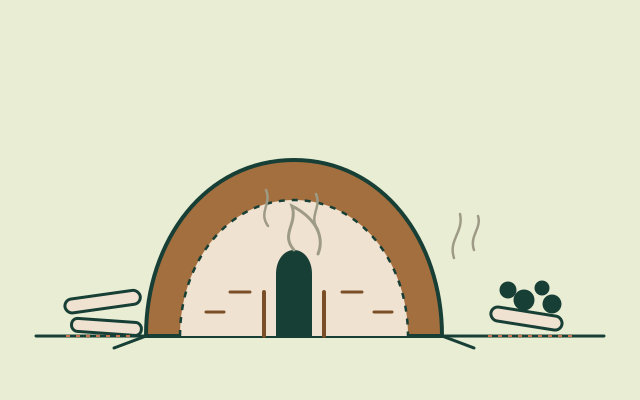
Charcoal is wood with most of its water and volatile matter driven off, leaving carbon and ash. It burns hotter and cleaner than the wood it came from, weighs a fraction as much, and does not spoil. That is why every pre-industrial metalworker, potter and baker wanted it — and why making it well is a foundational skill.
Why charcoal, and what it costs
Wood contains cellulose, lignin, water and volatile compounds. Heat it in the absence of air and those volatiles distil away; what remains is a porous carbon skeleton. The process is pyrolysis, not combustion. If too much air reaches the wood, it simply burns to ash. The char-maker’s whole art is to keep the heap hot enough to drive off volatiles while starving it of the oxygen that would consume the carbon.
A well-run earth mound converts about 20–30% of the dry wood’s mass into charcoal. The rest leaves as gases, tars and water. That sounds wasteful, and by modern retort standards it is; but the charcoal contains roughly twice the energy per unit mass of dry wood, burns without the smoke and tars that ruin a forge fire, and can be stored for a year if kept dry.
Charcoal is not the same as ash. Ash is the mineral residue left after complete burning; charcoal is the black carbonised fuel. Good charcoal should be mostly carbon, with a small ash fraction that depends on the wood and bark.
Choose and prepare the wood
Dense hardwoods make the best charcoal: oak, beech, hornbeam, maple, ash, birch and fruitwoods. Softwoods work but are lighter and burn faster. Avoid wood that is painted, treated, glued, resinous in excess, or contaminated with salt or chemicals. Do not use poison ivy, oleander or other toxic plants; the smoke and ash are hazardous.
Season the wood until it is below about 20% moisture. Green wood wastes heat boiling off water and produces a steamy, smoky burn. Split logs into pieces roughly 5–15 cm across so heat can penetrate evenly. Long, thick logs char on the outside and stay raw in the middle. Keep bark on; it is part of the fuel, though very thick bark adds ash.
Materials
- Dry, clean hardwood
- Leaves, grass or straw for the cover
- Earth or turf to seal the mound
- Kindling and a light source
- Water and sand for emergencies
Tools
- Axes, saws and wedges
- Spade, rake and buckets
- Long pole or rake for tending
- Gloves, goggles and boots
- Respirator for dust when bagging
Site
- Level, firm ground
- Clear of trees, buildings and dry grass
- Sheltered from strong wind
- Water source nearby
- Legal permission and fire permit
Build and burn an earth mound
An earth mound is the classic method: a stack of wood covered with vegetation and soil, lit at the top, with vents at the base to control the air. It can be any size, but a first mound of 1.5–2 m diameter and 1–1.5 m high is manageable. Larger mounds are more efficient but harder to control and much harder to put out if things go wrong.
-
Prepare the ground
Clear a circle about 1 m wider than the mound. Level it and remove roots and dry grass. Dig a shallow ring ditch for the earth you will use, and keep water and sand within reach. If the ground is wet, lay a base of stones or logs to keep the mound off the mud.
-
Set the chimney
Drive three or four stakes into the centre, leaving a vertical shaft about 15–25 cm across. This will be the chimney and the ignition path. The stakes are pulled out once the mound is lit, or left as a permanent vent if you prefer.
-
Stack the wood
Stand the split wood vertically or lay it in a dense, interlocking stack around the chimney, with the thicker pieces at the bottom. Keep the stack tight enough to limit air but open enough for heat to move. Build up in a dome or cone, leaving the chimney clear at the top.
-
Cover with vegetation
Cover the wood with a thick layer of leaves, grass, bracken or straw. This protects the earth cover from collapsing into the gaps and helps the mound seal. Leave the top of the chimney open, and leave a few temporary openings around the base for air.
-
Add earth
Cover the vegetation with 15–25 cm of fine earth or turf, working from the base upward. Pat it firm but do not make it airtight yet. Leave the base vents and the chimney open. The mound should look like a low, slightly flattened dome.
-
Light from the top
Drop burning kindling down the chimney and keep feeding it until the fire is established. Once the chimney is alight, partly close the top so the fire is drawn down through the mound rather than blazing upward. The mound will settle and may crack; patch cracks with earth, but keep the base vents open.
-
Control the burn
For the first day, the mound gives off white steam and thick smoke. As the volatiles burn, the smoke turns thin and blue-grey, and the mound becomes hot to the hand. Open or close the base vents to keep an even burn: too much air and the wood burns to ash; too little and the fire goes out, leaving raw wood. A 2 m mound typically takes 3–6 days.
-
Seal and cool
When the smoke thins and the mound has shrunk, close all vents and the chimney with earth. This starves the fire and lets the charcoal cool. Do not open it for at least 24–48 hours; hot charcoal exposed to air flares and can burn you. Open one side carefully, test for heat, then unload with a long-handled tool.
-
Sort and store
Shake off earth and ash. Good charcoal is black, lightweight, and rings or clinks when struck. Reject unburnt wood (brown, heavy, splintery) and “ash” (grey, powdery). Store in a dry, ventilated place, away from sparks and damp. Charcoal absorbs moisture and can spontaneously heat if wet and piled deep, so keep it dry and spread out if it gets wet.
Pit and retort variations
A pit burn is dug into a bank or shallow pit and works on the same principle. It is less visible and more sheltered from wind, but groundwater can flood it and the earth walls make it harder to control. A trench with a chimney at one end is a useful middle ground.
A retort is a sealed vessel heated from outside, so the volatiles can be burned as fuel rather than escaping. A reclaimed steel drum with a lid and a few controlled holes can be used, but a drum is a modern item and can fail dangerously when hot. If you use one, remove all paint and lining, never seal it completely, and keep it outdoors. The earth mound is slower but needs no supply chain.
Do not try to make charcoal in a closed stove or a domestic oven. The volatiles are flammable and toxic, and the fire can run away inside a sealed appliance.
Quality and yield
Weigh your wood and your finished charcoal. A yield below about 15% usually means too much air or too short a burn; above about 35% may mean the charcoal still contains volatiles and will smoke in use. Weigh a dry sample before and after a test burn to learn your own wood’s yield.
Quality tests are simple. Good charcoal is black and has a metallic or porcelain-like ring when struck. It should not crumble into dust in your hand, and it should not show brown, unburnt cores. When lit, it should glow without thick smoke or flames; a little flame at first is normal as residual volatiles burn off.
For a forge, use dense, well-carbonised charcoal in pieces of 2–5 cm. For an oven, a mix of sizes is fine. For filtration or drawing, crush and sieve the charcoal, then rinse it; fresh charcoal dust is abrasive and can contain ash.
Safety
Carbon monoxide. Burning charcoal produces CO, which is invisible, odourless and lethal. Never burn charcoal indoors, in a tent, or in a sealed shed. Fire. Mounds can collapse, flare and spread sparks. Clear a wide area, keep water and sand, never leave a burning mound unattended, and check local fire restrictions. Burns. The mound surface is hot enough to burn through boots; use a long pole, gloves and eye protection. Dust. Bagging charcoal raises black dust; wear a respirator and eye protection. Storage. Keep dry charcoal away from flames and do not pile damp charcoal in a sealed container.
Sources and further reading
- FAO: Simple technologies for charcoal making — the classic practical manual for earth mounds, pits and kilns.
- Wikipedia: Charcoal — pyrolysis, properties and production methods.
- Appropedia: Charcoal — small-scale production notes and links.
- Wikipedia: Charcoal burner — historical woodland practice and mound types.