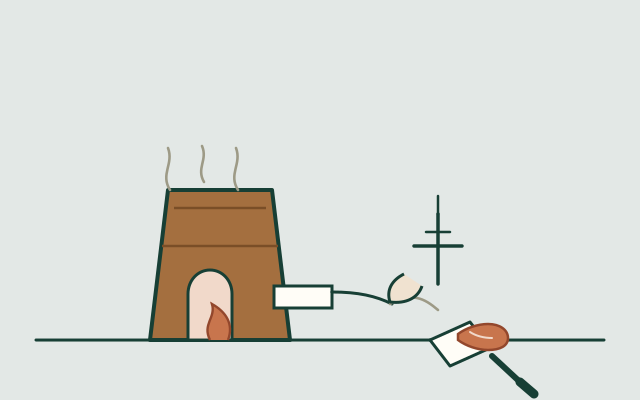
Smelting iron is the most demanding recipe in this manual, and the one with the most honest failure rate. A bloomery does not produce a river of molten metal. It produces a spongy, slag-filled lump called a bloom, which you then hammer and fold into wrought iron. It is slow, fuel-hungry and physical — and entirely possible with clay, charcoal, ore and a good bellows.
What a bloomery can and cannot do
A bloomery reduces iron ore to solid iron at temperatures around 1,100–1,300 °C, below the melting point of iron (1,538 °C). The ore is not melted; it is chemically reduced, and the iron particles coalesce into a bloom while the gangue forms a liquid slag that can be tapped or drained. The result is low-carbon wrought iron, often with slag inclusions. It can be forged, welded and worked, but it is not cast iron and it is not steel.
Cast iron requires temperatures above about 1,150–1,250 °C in a furnace that keeps the metal molten, plus a different furnace design and a lot more fuel. Steel requires controlled carbon content. Both are later technologies. Do not promise a group that a weekend bloomery will produce knives; it produces the raw material from which a smith can make them, after a lot of hammering.
FeO + CO → Fe + CO₂
CO is made by burning charcoal with a limited air supply.
Find and test surface ore
Surface ores are the easiest to find and the least rich. Look for rust-coloured seeps, bog iron in wet ground, black sands in streams, and ochreous crusts on rocks. Bog iron forms where iron-rich water meets oxygen; it is porous, brown to black, and often found in layers just below the surface of a marsh. Hematite is dense, red-brown to black with a red-brown streak. Limonite and goethite are yellow-brown. Magnetite is black, heavy and magnetic.
Use a streak test on unglazed porcelain, a magnet, and simple weight and hardness comparisons. Then roast a small sample in a fire: ore should redden, lose water and carbon dioxide, and become brittle. A sulphurous smell means sulphide minerals, which need a longer roast and may be better avoided for a first attempt. Do not use ore from mine spoil or industrial sites without testing for toxic metals.
| Ore | Field appearance | Streak | Notes |
|---|---|---|---|
| Bog iron | Porous brown-black crusts in wet ground | Yellow-brown | Low density, variable; roast gently |
| Hematite | Dense red-brown to black lumps | Red-brown | Rich, heavy; crush to small pieces |
| Limonite / goethite | Yellow-brown earthy or fibrous masses | Yellow-brown | Contains water; roast before smelting |
| Magnetite | Black, metallic, heavy grains or sand | Black | Magnetic; concentrate by panning |
| Siderite | Pale brown-grey carbonate nodules | White to pale brown | Roast to drive off CO₂; low grade |
Roast and crush the ore
Roasting does three jobs: it drives off water and carbon dioxide, oxidises sulphides, and makes the ore brittle enough to crush. Build a shallow hearth or a small kiln, spread the ore in a layer, and heat it to roughly 600–800 °C for several hours. Turn it so all sides are exposed. The colour will change to red or dark grey, and the ore will crack and become easier to break.
Crush the roasted ore to pieces of about 5–20 mm. Fines are acceptable in a bloomery; dust is not, because it blows out of the furnace. Sieve out the dust and use it in the next roast. Keep the ore dry. A pile of ore that has been rained on will cost fuel and may crack the furnace with steam.
Build the furnace
A bloomery is a clay shaft open at the top, with a tuyere (air pipe) near the base and a tap hole for slag. A practical small furnace is 60–100 cm tall, with an internal diameter of 25–35 cm and walls 5–10 cm thick. Build it from a mix of clay, sand and chopped straw, or from clay over a basket form. The lining must resist 1,200 °C; a fireclay-rich soil is better than a sandy one. If you have firebricks, use them for the hot zone.
Set the tuyere 10–20 cm above the furnace floor, angled slightly downward so the air blast hits the centre of the charge. The tap hole should be at the base, plugged with clay and opened with a rod. Build the furnace on a dry, level base, with a shallow pit in front for slag and a shelter from wind and rain. Let the clay dry slowly before firing; a wet furnace spalls and cracks.
You need a continuous air blast. A double-chamber bellows, a bag bellows or a water-powered blower can supply it. For a first smelt, two people on a bag bellows is enough for a 25 cm furnace. The blast must be steady, not a gust that blows the charge apart.
Smelt
-
Preheat the furnace
Fill the furnace with charcoal and light it from the top, with a gentle blast. Let it burn down until the furnace is glowing and the charcoal is well established. This may take 30–60 minutes.
-
Start charging
Add alternate layers of charcoal and roasted ore. A common starting ratio is roughly 1 part ore to 1–2 parts charcoal by volume, adjusted to the ore’s richness and the furnace’s behaviour. Keep the furnace full to the top; a full furnace is easier to control than a half-empty one.
-
Keep the blast steady
Maintain a strong, even blast. The furnace should roar, the top should glow, and the flame should be bright. If the top darkens, increase the air or add charcoal. If slag pours out of the tuyere, reduce the ore charge or tap the slag.
-
Tap the slag
Every 20–40 minutes, open the tap hole and let the liquid slag run into the pit. Slag is glassy, green-black or brown when cool. If it is thick and pasty, the furnace is too cool; increase the blast or reduce the ore. If it is watery and dark, the furnace is working well.
-
Watch for the bloom
After 3–6 hours, a bloom begins to form near the tuyere. The blast pressure may rise, the flame may change, and a spongy mass may appear when you probe the bottom with a rod. Do not pull it too early; a small, cold bloom is full of slag.
-
Extract the bloom
Stop charging and let the furnace burn down slightly. Break open the front of the furnace or reach through the tap hole with tongs, and pull out the bloom. It will be white-hot and covered in slag. Have a hammer, anvil and a clear area ready before you open the furnace.
-
Consolidate
Hammer the bloom while hot to squeeze out slag and weld the iron particles together. Reheat it in a forge and hammer again, folding and welding the surfaces. Repeat until the iron is coherent and the slag is mostly gone. This is hot, slow work, and it is where a bloom becomes a bar.
Forge and work the iron
You will need a forge hearth, a bellows, an anvil (a large stone or a block of scrap steel can serve), hammers, tongs and a quench tub. Heat the iron to a bright orange-yellow (roughly 900–1,100 °C), work it quickly, and reheat as soon as it dulls. Wrought iron is soft and welds readily at high temperature with a flux of sand or clay, but it is also fibrous and can split if worked cold.
For tools, start with simple items: a chisel, a punch, a wedge, a hook, a knife blade from a folded bloom. Low-carbon wrought iron will not harden like steel; it can be case-hardened by heating in charcoal, but that is a separate skill. Make the tools you need to make better tools — that is the real bootstrap.
Yield, fuel and realism
Ore grade determines everything. A rich hematite may contain 50–65% iron; bog iron may contain 20–50% iron and a lot of water and silica. A small bloomery might convert 10–30% of the ore’s mass into a bloom, with much of the rest leaving as slag. Charcoal consumption is high: expect 5–15 kg of charcoal per kg of iron in a small furnace, and possibly more on a first attempt.
That means a 10 kg bloom may require 50–150 kg of charcoal and a corresponding amount of wood. Plan the fuel before the ore. A group should practise the furnace, the bellows and the charge with a few small smelts before attempting a large one.
Troubleshooting
| Symptom | Likely cause | Fix |
|---|---|---|
| Furnace will not reach temperature | Wet fuel, weak blast, thin walls, too much ore | Dry charcoal, stronger steady blast, insulate, reduce ore |
| Thick pasty slag | Too cool, ore too siliceous, charge too rich | Increase blast, add a little lime or iron-rich ore, tap more often |
| No bloom after 6 hours | Ore too lean, charge too fine, temperature too low | Concentrate the ore, crush to 5–20 mm, increase air and fuel |
| Bloom is full of slag | Pulled too early; furnace too cool | Leave it longer, hammer and reheat more thoroughly |
| Furnace cracks or collapses | Wet clay, fast firing, weak wall | Dry slowly, use a sandier clay mix, build a thicker wall |
Safety
Carbon monoxide. A bloomery and forge produce lethal CO. Work outdoors or in a well-ventilated smithy with a flue; never in a closed room. Heat and light. White-hot iron, sparks and infrared glare: wear a face shield or goggles, leather gloves, a leather apron and closed boots. Heavy work. Blooms, anvils and hammers injure backs and hands; use two people for lifting and keep the anvil stable. Dust and fumes. Roasting ore can release sulphur dioxide and metal fumes; stay upwind and wear respiratory protection. Failure. A cracked furnace can spill hot charcoal; clear the area and keep water and sand nearby.
Sources and further reading
- Wikipedia: Bloomery — chemistry, furnace types and history.
- Wikipedia: Bog iron — formation, extraction and use.
- EXARC — experimental archaeology, including iron-smelting experiments.
- The Historical Metallurgy Society — research and practical resources on early metallurgy.