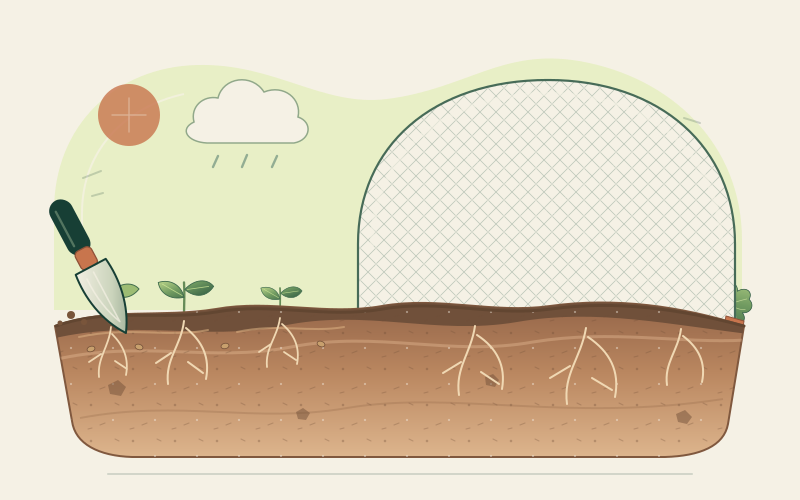
A cool-season crop with more than one harvest
Kale is grown for leaves rather than a single head or root. Most familiar curly and Tuscan kales belong to Brassica oleracea; Russian- and Siberian-type kales may be Brassica napus. Both are brassicas and share many bed mates, pests, and diseases. They can be picked young for salad or allowed to develop larger leaves for cooking. Our variety guide explains why the name on the front of a packet is only the beginning.
Cool conditions generally suit leafy growth. Depending on the local climate, sowing may be timed for spring, autumn, or winter harvests rather than for the hottest part of summer. Strong heat, dry soil, or a sudden cold spell can check growth; established plants eventually send up flower stems, commonly after overwintering. A packet’s sowing calendar is a starting point, not a date that transfers unchanged between regions.
Rooted’s 50–75 day window is an indicative interval to a first useful harvest of developed leaves under suitable conditions, not a promise of maturity. Baby leaves can be ready sooner, while cool, hot, dry, or crowded conditions can delay growth. Transplants change the calendar too. Kale offers no root or dry-seed storage crop here: leaves are a fresh harvest, and repeated picking extends the season rather than creating a storable bulk crop.
Sow, transplant, and care for the leaf bed
-
Choose the season and site
Use local sowing guidance to place active growth in mild weather. A sunny bed with some shelter suits many crops; light shade can be acceptable, especially where summer sun is intense. Avoid ground that stays waterlogged. For a small, continuous supply, sow a modest batch at a time instead of planting every seed at once. Leave room to reach plants for inspection and picking without compacting the bed.
-
Prepare firm, fertile, drained soil
Remove weeds and loosen severe compaction, but do not cultivate wet soil into clods. Mature compost can improve structure; a soil test is the best basis for correcting pH or nutrient deficiencies. Kale needs sufficient nitrogen and water to make leaves, but more fertiliser is not automatically better. Follow local soil-test recommendations, keep nutrients away from waterways, and firm the planting area enough to anchor what may become a tall plant.
-
Sow directly or raise young plants
A typical sowing depth is about 1 cm, with the packet taking priority. Direct sow thinly into moist, prepared soil, or sow in modules for an early start and easier protection from slugs. Keep the seedbed or compost evenly moist, not saturated, until emergence. Give indoor seedlings bright light so they do not become weak and leggy. Modules limit root disturbance and can be useful where early outdoor conditions are unreliable.
-
Harden off and plant at the final spacing
Gradually acclimatise raised plants to outdoor conditions before transplanting. Move them when they are sturdy and large enough to handle, keeping roots intact and watering them in well. Full-sized plants commonly need roughly 30–60 cm each way, depending on cultivar and the leaf size wanted; compact types and baby-leaf beds need less. Follow the supplier’s spacing, and allow wider access between rows where needed. Plant firmly so wind does not loosen the roots.
-
Keep moisture steady and weeds down
Check moisture below the surface rather than watering by rote. Young plants and containers need particularly regular checks; established crops may need deep watering during dry spells. Sudden lush growth followed by drought is less useful than even growth. Water at the soil level, avoid waterlogging, and use an organic mulch around established plants where practical to reduce evaporation and weeds. Keep mulch clear of stems and remove weeds while they are small.
Rotate brassicas and take clubroot seriously
Group kale with cabbage, broccoli, cauliflower, Brussels sprouts, and other brassicas when planning rotation. Where space permits, avoid returning any of them—including Russian types in a different Brassica species—to the same bed for several years. Rotation can reduce the build-up of some soil- and residue-borne problems, but it does not stop flying insects or wind-blown spores, and closely related weeds may also host pests.
Clubroot causes swollen, distorted roots and can leave plants wilting or stunted. Its resting spores can persist in soil for many years, so a short rotation is not an eradication programme. Do not move soil, contaminated tools, or infected transplants from an affected bed to clean ground. Improve drainage and seek local extension advice on pH management and resistant cultivars; liming without a soil test is not a universal cure. Clean containers and fresh growing medium offer an alternative for a small crop when soil is known to be infested.
Net early, inspect often, and identify the culprit
Cabbage-white butterflies and other insects lay eggs on brassicas, and their caterpillars can remove large areas of leaf. Inspect both leaf surfaces for eggs and young larvae, and hand-pick them where practical. Fine insect mesh supported on hoops is a preventive barrier: install it before egg-laying, keep it clear of the foliage, and secure the edges without leaving gaps. Check that caterpillars are not already enclosed. Remove or vent covers according to local weather and manufacturer guidance.
Pigeons and other birds can tear seedlings and mature leaves. Bird netting or a secure cage may be needed even where insect mesh is absent; choose a mesh and support that will not trap wildlife, and keep it taut. Aphids often cluster in curled growth and on leaf undersides. Small colonies may be dislodged with a firm water spray or pruned out, while avoiding unnecessary sprays that harm beneficial insects. Sticky, sooty growth, distorted leaves, and declining vigour justify closer identification. Slugs, flea beetles, and other regional pests may require different measures, so match any intervention to the observed damage and local advice.
Cut and come again, with winter caveats
For baby leaves, pick when they reach the size you want, taking a few leaves from several plants. For larger greens, begin with the older outer leaves and use a clean knife or a firm downward pull. Leave the central growing point and enough young leaves to keep the plant photosynthesising. Regular, moderate picking encourages continued production; stripping a plant bare does not. Remove yellowing or badly damaged leaves, and do not leave decaying harvests in the bed.
Use leaves promptly, or cool and refrigerate them in a clean bag or container. Washing and storage life depend on handling and temperature, so discard slimy or doubtful material rather than treating refrigeration as preservation. Leaves can be blanched and frozen using a reliable food-preservation recipe, but they do not become a shelf-stable crop simply by drying on the plant.
Many kales tolerate frost, and cool weather can change leaf flavour, but overwintering is not guaranteed. Cultivar, plant size, snow cover, wind, waterlogging, and the severity and duration of freezing all matter. Use cloches or other locally appropriate protection where worthwhile, without creating damp, unstable conditions. In spring, plants may flower as day length and temperature change; leaf quality and further production then vary. Plan a following sowing rather than relying on an old plant indefinitely.