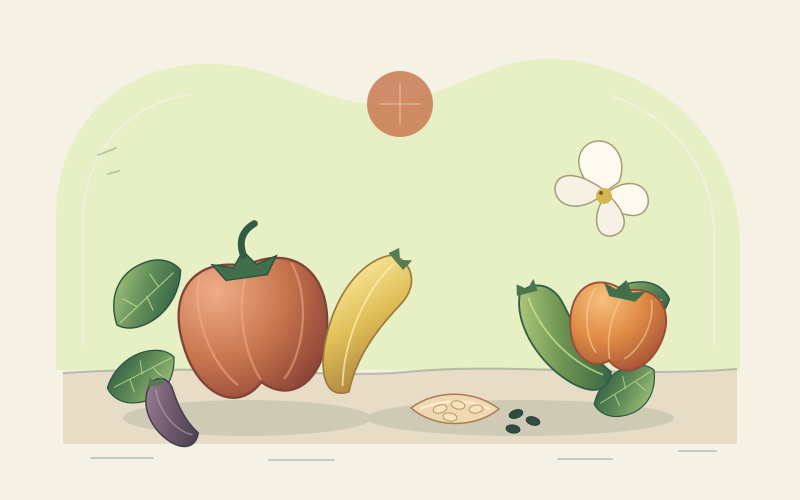
Start with Capsicum, not peppercorns
Sweet peppers and chillies are fruits of plants in the genus Capsicum, in the nightshade family, Solanaceae. They are unrelated to the black, white, and green peppercorns of Piper nigrum. “Pepper” therefore covers two separate botanical stories in the kitchen. Here it means Capsicum, whether the fruit is a thick-walled sweet bell or a pungent chilli used in small amounts.
Five domesticated species account for most garden peppers. Capsicum annuum is especially varied: it includes bells, many sweet frying types, jalapeños, cayennes, and numerous regional forms. The others are C. baccatum, C. chinense, C. frutescens, and C. pubescens. Species names help with identification and seed saving, but they do not by themselves predict exactly how a fruit will taste or perform.
Sweet does not have to mean bell-shaped
Sweet bell peppers usually have large, blocky fruit with three or four lobes, thick walls, and essentially no pungency. Their broad cavities make them useful for stuffing, while firm walls slice well for salads and cooking. Miniature bells carry the same general form at a smaller size. Lobes are not a reliable way to determine sweetness, yield, or seed count, and there is no useful gardening rule based on counting them.
Other sweet forms include long Italian frying or roasting peppers, tapered Cubanelles, thick-walled conical pimientos, rounded cherry types, and pale elongated sweet bananas. Some have thinner walls that cook quickly; others are meaty enough for roasting. Shape is a culinary clue, not a heat scale. A long pepper may be sweet or hot, and a bell-shaped hybrid can contain noticeable pungency. Read the cultivar description rather than judging by silhouette.
| Group | Usual form | Selection note |
|---|---|---|
| Bell | Blocky, often three or four lobes | Often sweet and thick-walled; hot bell forms also exist |
| Frying or roasting | Long, tapered, often thinner-walled | Check whether the named cultivar is sweet or pungent |
| Pimiento | Conical, thick-walled, commonly red when ripe | Typically sweet; useful for roasting |
| Cherry | Small and globe-shaped | Includes sweet and hot cultivars |
| Wax or banana | Elongated, often pale yellow-green when young | Ranges from sweet to distinctly hot |
Colour often records a stage of ripening
Many fruits begin green because chlorophyll masks other pigments, then turn red, yellow, or orange as they ripen. Green peppers are therefore often full-sized but not fully coloured, rather than a separate variety. They can be harvested at that stage; leaving them on the plant longer allows the cultivar’s ripe colour and flavour to develop. The change takes time and requires enough remaining warm weather.
Not every fruit starts the same green or finishes red. Some begin pale ivory or yellow-green, while ripe colours include yellow, orange, brown, and purple. Certain purple cultivars lose their anthocyanin colour as they mature, and purple areas can change during cooking. A named ripe colour is a better guide than the assumption that red is always the endpoint. Colour alone also cannot tell you heat or nutrient content; cultivar, ripeness, growing conditions, and preparation all matter.
Hot peppers span several cultivated species
Pungency comes principally from capsaicin and related compounds, not from a red colour, pointed tip, or small size. Within C. annuum, jalapeño, serrano, cayenne, poblano, and many ornamental peppers sit alongside sweet bells. That diversity is why the botanical name C. annuum is not a promise that a pepper will be mild.
- C. chinense includes habanero, Scotch bonnet, and many extremely hot cultivars, but also heatless or low-heat types selected for their fruity flavour.
- C. baccatum includes ají amarillo, lemon drop, bishop’s crown, and sweet piquanté forms. Flowers often have distinctive yellow-green markings.
- C. frutescens includes Tabasco and other often slender, upright, pungent fruit. Its name does not mean all its plants are shrubs.
- C. pubescens includes rocoto or locoto types, recognised by hairy vegetation and dark brown to black seeds; they can suit cool highland tropical conditions but still need frost protection.
Scoville values in catalogues are broad comparisons, not exact promises for a home harvest. Growing conditions and individual fruit vary, and named cultivars can fall outside an informal range. Handle unknown or very hot fruit cautiously: gloves, clean tools, and keeping hands away from the face are more useful than a shape-based guess.
Cross-pollination matters to saved seed, not this year’s flesh
Pepper flowers are self-fertile and commonly self-pollinate, but visiting insects can move pollen between plants. If a sweet C. annuum flower receives pollen from a hot compatible plant, the seeds inside may carry a new combination of parental traits. That pollen does not turn the current pepper’s surrounding flesh hot. Any unexpected pungency in fruit grown from those saved seeds belongs to the next generation.
Do not assume that every two Capsicum species are completely isolated or freely compatible. Crossing likelihood varies with the species and flowers involved, and the practical concern is greatest among compatible cultivars flowering near one another. For dependable seed, begin with an open-pollinated cultivar rather than an F1 hybrid, whose offspring can segregate even without outcrossing. Use locally recommended distance, insect-proof isolation cages, or another recognised seed-saving method, and label the parent plants.
Even careful seed saving does not make a mixed or unnamed population uniform. If you simply want sweet and hot peppers for this season’s meals, you can grow suitable plants in the same garden without expecting cross-pollination to alter their existing fruit. Isolate plants when genetic purity of the seed you save is the goal.
Let the season and kitchen make the choice
Check days to harvest and whether the count starts from sowing or transplanting. Early bells and chillies are useful where summers are short; some C. chinense, C. baccatum, and C. pubescens cultivars need a longer or more protected season. Rooted’s general 60–100 day window is only an indicative first-harvest range, not a substitute for the cultivar description. Fully coloured fruit takes longer than an early green pick.
Decide whether you want thick slices, roasting flesh, stuffing cavities, fresh heat, or fruit suited to drying. Trial a small number of locally recommended cultivars and record transplant date, first green and ripe harvests, plant health, and actual flavour. The growing guide covers the warm, drained conditions and steady care those choices need.