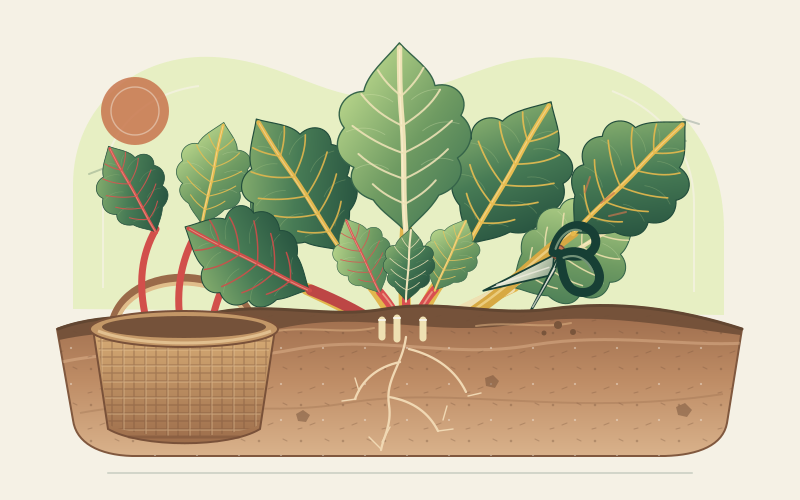
A leaf beet, usually grown as an annual
Swiss chard is a cultivated form of Beta vulgaris, the same species as beetroot and sugar beet. Leaf-beet selections put their garden value into edible blades, stalks, and broad midribs rather than a swollen storage root. The names silverbeet, spinach beet, and perpetual spinach also occur, but true spinach is a different species. Check the botanical name when a common name is ambiguous.
Botanically, chard is generally biennial: after sufficient cold and time, surviving plants flower and set seed in a later season. For eating, it is normally sown and harvested as an annual. This habit helps it keep making leaves through weather that sends true spinach to seed, although no plant is indestructible. Rooted’s 50–65 days is an indicative first-harvest window for usable leafy growth, not a fixed maturity date. Baby leaves can be picked earlier; large ribs take longer, and repeated harvests extend well beyond the first pick.
Sowing and care through the season
-
Choose a workable, fertile site
Full sun supports strong growth, while light partial shade can be useful in hot weather. Aim for moisture-retentive but well-drained soil, and avoid ground that stays waterlogged. Remove weeds and loosen compaction without cultivating wet soil. A soil test is the best basis for adjusting pH or nutrients; mature compost can improve structure where needed. Chard makes substantial foliage, but more nitrogen is not automatically better.
-
Direct sow or transplant carefully
Direct sow once soil is workable and local conditions suit the crop, making later sowings where the season allows. A general starting depth is about 1–2 cm, with the supplier’s packet taking priority. Alternatively, raise transplants in modules several weeks before planting out, moving them before they become crowded or root-bound. Disturb the roots as little as possible and water them in gently. In hot regions, spring and late-summer sowings may be more productive than one midsummer sowing.
-
Thin decisively, including clustered seedlings
Unless the packet specifies monogerm seed, a chard “seed” is usually a dry fruit containing several embryos. Several seedlings can therefore emerge from one sowing position. Thin them rather than letting a dense clump compete. Small leaves for baby harvest can remain closer; plants intended for large leaves and thick stems generally need roughly 20–30 cm each, adjusted to the cultivar and local guidance. Use small snips where pulling would disturb neighbours, and eat sound thinnings.
-
Keep moisture steady, not stagnant
Check moisture below the surface and water deeply when needed rather than following a rigid calendar. Uneven or inadequate water slows leaf production and can leave growth tough or stressed; saturated soil deprives roots of air. Direct water to the soil, especially where leaf spot is present, and mulch around established plants to reduce evaporation, weeds, and soil splash. Containers dry faster and need a sufficiently deep, free-draining growing medium.
-
Use its seasonal flexibility realistically
Chard tolerates more summer heat than many leafy greens and established plants can withstand light frost. Heat, drought, severe cold, and frozen ground still damage foliage or halt growth. Shade cloth can moderate heat, while horticultural fleece or another locally suitable cover can buffer light cold; neither makes the crop weatherproof. Remove damaged outer leaves, keep notes on bolting and regrowth, and choose sowing dates from local experience rather than a universal calendar.
Prevent slugs, leafminer, and leaf spot
Slugs and snails are most troublesome on tender seedlings and low, damp foliage. Inspect after dusk or early in the morning, remove weeds and unnecessary hiding places near the bed, and use barriers, traps, or hand collection where local experience supports them. Protecting the young stand is more useful than waiting for large holes. If a molluscicide is legally available and justified, follow its crop label and local guidance exactly.
Leafminers are fly larvae feeding between leaf surfaces, leaving pale winding tunnels or blotches. Inspect undersides for tiny eggs and remove badly mined leaves before larvae complete development. Fine insect mesh can exclude adult flies if installed before they arrive, with edges secured and no infested plants enclosed. Rotation and control of related weed hosts help, but cannot stop every flying adult. Do not assume a spotted or blistered leaf identifies leafminer without looking for the characteristic internal tunnel.
Cercospora leaf spot commonly produces small circular lesions with pale centres and reddish margins; spots can merge and destroy leaf area. Start with reputable healthy seed, space plants for airflow, avoid prolonged leaf wetness, and rotate away from chard, beetroot, spinach, and other host crops for two to three years where disease has been established. Remove volunteer hosts and manage infected residue according to local extension advice. Repeatedly taking leaves for regrowth from a diseased stand can maintain infection, so a once-over harvest or removal may be the better response. Similar-looking spots have other causes; seek identification before treatment.
Harvest the outside and preserve the growing centre
For cut-and-come-again harvest, take older outer leaves when they reach the size you want, cutting the stalk cleanly near the crown. Leave the central bud and several young leaves intact. Pick little and often, removing old or damaged leaves rather than stripping the plant bare. Baby leaves suit quick cooking or salads; mature blades and ribs generally need more cooking. Stop or reduce picking when heat, cold, or disease leaves too little healthy foliage for recovery.
Chard wilts readily. Cool it promptly, refrigerate clean, sound leaves in a suitable vented bag or container, and use them soon. Do not leave a warm harvest in a sealed, wet heap. For longer preservation, follow a tested freezing or cooking guide rather than treating raw garden leaves as a storage crop.
Seed saving is optional and requires more than leaving one plant alone. A seed crop must survive into its flowering year, and chard is wind-pollinated and can cross with flowering beets and other chard. Keep different flowering types adequately isolated using a locally proven seed-saving plan, save only from healthy plants, and dry and label seed thoroughly. For a small mixed garden, fresh seed from a reputable supplier is often the simpler choice.