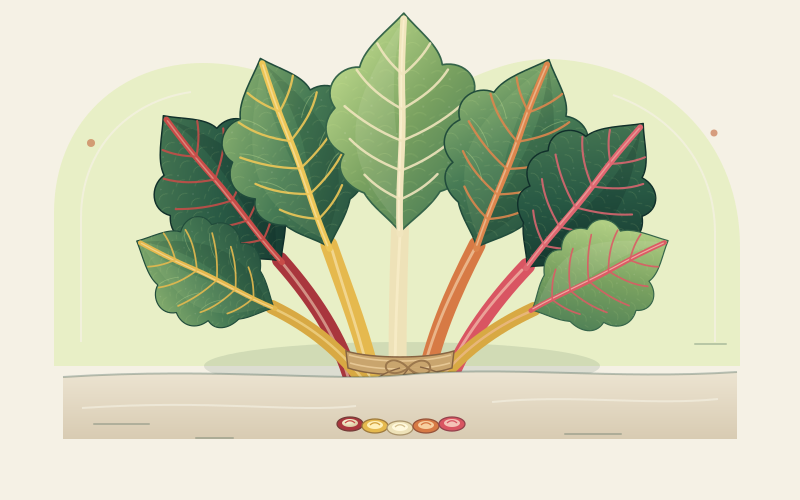
One species, selected for leaves and ribs
Swiss chard belongs to Beta vulgaris, alongside beetroot, sugar beet, and fodder beet. Chard and other leaf beets have been selected for their edible leaf blades, petioles or stalks, and midribs rather than an enlarged storage root. The botanical name is the reliable anchor among names such as silverbeet, spinach beet, seakale beet, and chard.
Catalogue descriptions are not perfectly standardised. A named cultivar is a maintained selection; a colour mixture is a packet containing several forms. “Swiss chard” is the broad crop name, not one uniform plant. Read the whole description for stem width, leaf texture, mature size, intended harvest, and disease resistance instead of treating the photograph as the specification.
White, yellow, red, and rainbow stalks
White- and pale-stemmed chard often has conspicuously broad ribs and dark green, blistered or savoyed leaves. ‘Fordhook Giant’ is a familiar example of this general form, though supplier selections can differ. Pale stalks show bruising readily, and broad ribs benefit from being separated from the leaf blade and cooked longer.
Yellow, gold, and orange stalks bring warm colour to the bed. ‘Bright Lights’ is widely associated with a mixture spanning yellow, orange, pink, red, and white, often with relatively slender stems. Individual plants within such a mix differ; one plant does not produce every colour. Orange or pink may be grouped loosely with yellow or red in another catalogue, so use the description rather than expecting exact colour boundaries.
Red and ruby stalks include selections sold as ‘Ruby’, ‘Rhubarb’, or red chard. Their ribs and veins contrast with green blades, which may look especially dark beside the red pigment. Colour can bleed into cooking water or neighbouring ingredients, and the cooked shade may differ from the raw stalk. Red ribs are not beetroot roots and do not imply a beetroot-flavoured storage crop below ground.
Rainbow chard usually describes a multicoloured seed mixture rather than a single genetically uniform variety. ‘Five Color Silverbeet’, ‘Bright Lights’, and various own-brand rainbow mixes may not have identical parentage or proportions. If you need even plants for a formal border or uniform stems for bunching, a single-colour cultivar is easier to assess. For a varied household harvest, the mixture is part of the appeal.
Green versus coloured ribs: appearance, not a ranking
Green or whitish ribs blend into the leaf, whereas red and yellow ribs create strong contrast. Leaf blades themselves remain predominantly green because their photosynthetic tissue contains chlorophyll, although shade, savoying, size, and vein colour vary. Some forms have smoother, thinner leaves and narrow stalks; others carry thick stems beneath heavily textured blades.
Colour alone does not guarantee tenderness, flavour, yield, pest resistance, or superior nutrition. Pigments differ, but that does not make one garden colour universally better. Stem thickness, harvest age, water supply, cooking, and the particular cultivar all affect eating quality. If stems are the part you enjoy most, choose a broad-stem selection; if you mainly want leafy greens, a narrower-stem leaf-beet type may waste less of the harvest.
| Name or form | Typical appearance | Selection point |
|---|---|---|
| Fordhook Giant | Broad pale ribs; large dark green leaves | Substantial stems and mature harvest |
| Lucullus | Pale ribs; light to medium green, textured leaves | A traditional pale-stem leaf form |
| Ruby or Rhubarb chard | Red stalks and veins with green blades | Strong colour; check the exact selection |
| Bright Lights | Mixed red, pink, orange, yellow, and pale stalks | Varied colour, often on narrower stems |
| Rainbow mixture | Several stalk colours in one packet | Diversity rather than plant-to-plant uniformity |
| Perpetual spinach type | Usually smaller, smoother leaves and narrower pale ribs | Leaf-focused harvest; not true spinach |
Read “leaf beet” and “perpetual spinach” carefully
Leaf beet is a useful botanical and horticultural umbrella for chard and related forms grown for foliage. Spinach beet and perpetual spinach are also applied to leaf-beet selections, commonly those with smaller leaves and less massive ribs than broad-stem Swiss chard. The exact boundary is not consistent across suppliers and countries. Some sellers place perpetual spinach and Swiss chard on separate pages even though both are B. vulgaris.
True spinach is Spinacia oleracea. Perpetual spinach is not a true-spinach cultivar, and “perpetual” does not promise endless cropping or immunity to bolting, frost, age, or exhaustion. It describes a leaf beet capable of repeated picking under suitable conditions. New Zealand spinach and Malabar spinach are different species again. Confirm the botanical name, expected leaf form, and final spacing before buying.
Let your kitchen and climate make the final choice
Start with the harvest. For baby leaves, look for fast, uniform leaf production and suitability for close spacing. For repeated mature bunches, compare leaf texture, rib width, plant size, and regrowth. Rooted’s indicative 50–65-day window refers to first usable harvest, not the end of cropping: baby leaves are earlier, thick mature ribs may take longer, and weather shifts every date.
Chard generally handles both warm and cool conditions, but selections differ and severe heat, drought, or freezing weather still cause losses. Where Cercospora leaf spot or another disease recurs, ask local extension or experienced growers about suitable cultivars. A resistance claim applies only to the named problem, and sometimes specified strains; it is not broad immunity. Check that a variety described as slow-bolting has been trialled under conditions resembling yours.
If space permits, grow two packets side by side and record emergence, first baby pick, first mature pick, regrowth, stem quality, disease, and flavour after your usual cooking method. Save notes with sowing dates and weather. Local evidence gathered over more than one season is more useful than a colour photograph or a universal “best variety” list. The chard growing guide covers spacing and repeated harvest in detail.