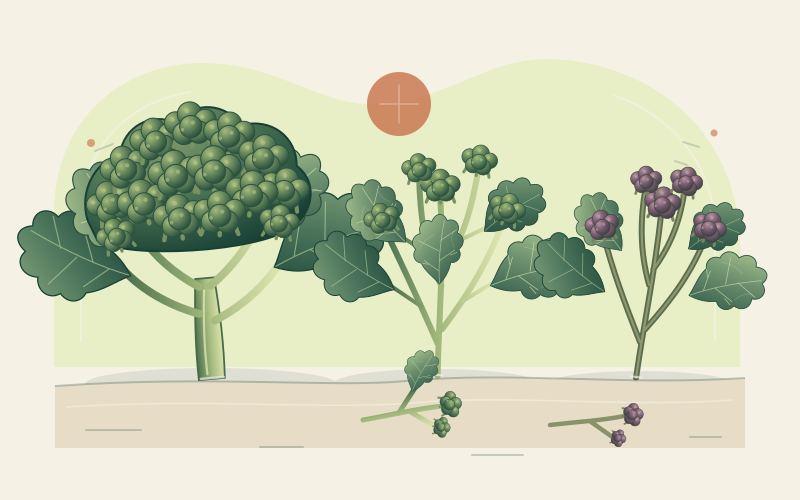
Shared species, different breeding and naming
Heading broccoli, calabrese, and purple or green sprouting broccoli are selections of Brassica oleracea, generally placed in the Italica Group. They are harvested for immature flower buds and tender stalks rather than for a root or a tightly folded cabbage leaf head. All are brassicas for rotation, pest-barrier, and clubroot-planning purposes.
Names are not used consistently. In North American gardening, “broccoli” usually means the large-headed green crop. In British gardening, that crop is often called calabrese, while “broccoli” may mean sprouting types. Some packets add “green sprouting” to an ordinary heading cultivar because it makes side shoots after the central cut. That phrase alone does not turn it into an overwintered purple-sprouting plant.
Rooted’s 60–100 day first-harvest window is an indicative range for heading broccoli in suitable conditions. Check whether a supplier counts from sowing or transplanting. Traditional sprouting cultivars can take much longer and are often timed to overwinter for harvest the following spring. Variety, temperature, plant stress, and local day length all alter the actual date.
Three practical garden forms
Heading broccoli: one central dome, then side shoots
This is the familiar thick-stemmed plant with a substantial green central head made of tightly packed buds. Modern cultivars vary in dome shape, bead size, stem length, plant width, and uniformity. Some are bred for a concentrated harvest, while others produce more numerous side shoots after the main head is removed. A large central head and a long side-shoot season are related traits, not guaranteed together.
Choose an early cultivar for a short spring window or a locally recommended type for autumn production. Descriptions such as heat tolerant, compact, or clubroot resistant apply within particular limits; none removes the need for sound timing and culture. Calabrese, Di Cicco, Belstar, and Green Magic appear in seed listings as examples of differing headings and habits, not universal recommendations. Use current local trials where available.
Calabrese: a regional name, not a separate species
Calabrese takes its name from Calabria in southern Italy. In many British catalogues it specifically describes the large green, domed crop harvested in summer and autumn. In a North American catalogue, essentially similar cultivars are usually labelled broccoli. There is no need to search for a different botanical species or growing method solely because the front of the packet changes.
The useful distinction is therefore between one main heading harvest with possible secondary shoots and a plant bred chiefly for many small spears. Read the head size, expected season, and side-shoot description. Our harvest guide shows why the central stalk is cut while the lower plant remains in place.
Sprouting broccoli: many small spears over a longer season
Sprouting types carry smaller bud clusters at the ends of leafy stems. Purple forms are especially familiar, but white and green selections exist. Colour can fade or change during cooking, and it says little by itself about maturity or nutrient value. The stems, buds, and tender young leaves can all be used when sound.
Many traditional purple-sprouting cultivars need a long growing period and cold exposure before producing abundantly. They are commonly sown months before a late-winter or spring harvest in climates where they can overwinter. Other sprouting cultivars are bred for a shorter cycle, so “sprouting” does not always mean overwintering. These plants may become large and need wider spacing and stronger support than a compact heading type.
| Packet description | Main harvest | Season and habit |
|---|---|---|
| Heading broccoli | Large central green head; often smaller laterals | Usually a shorter spring-to-autumn crop |
| Calabrese | Large green dome, commonly called broccoli | British naming for a heading crop, not another species |
| Purple or white sprouting | Many slender coloured spears | Often long-season and overwintered where hardy |
| Green sprouting | Small green shoots, or a heading type with side shoots | Ambiguous term: read the full description |
Do not let similar names choose the crop for you
Broccolini and similar tender-stem products are commonly derived from a cross between broccoli and Chinese broccoli. Their long, slender stems and small florets resemble an elongated sprouting harvest, but their cultivars and production timing can differ. A bunch with that marketing name is not evidence that every broccoli plant will grow the same shape.
Broccoli raab, rapini, and cime di rapa generally refer to Brassica rapa, a different species grown for quick leafy shoots and small buds. Chinese broccoli or gai lan is Brassica oleracea but has been selected for thick stems, leaves, and often white flowers rather than a large green dome. Neither should be substituted into a broccoli sowing plan without reading its own cultural requirements.
Romanesco has pointed, chartreuse curds and a different head structure. Garden and seed suppliers do not always classify its name consistently, so follow the cultivar’s cauliflower- or broccoli-specific instructions rather than relying on appearance. These related vegetables are useful crops in their own right, not merely colour variants of standard heading broccoli.
Select for your actual bed and kitchen
Begin with the harvest calendar. For spring, consider how quickly local weather becomes hot and choose a cultivar that can form heads in the available cool window. For autumn, count backwards using the supplier’s timing and allow for slower growth as days shorten. For sprouting types, confirm both winter hardiness and the expected harvest year before dedicating bed space.
Next, check plant size and harvest pattern. Compact plants fit smaller beds but may produce smaller heads. Strong side-shoot production suits a household wanting repeated small portions; uniform main heads suit a planned batch for freezing. Disease-resistance claims should identify the problem and come from a reputable supplier or independent trial. No label substitutes for clean transplants, rotation, mesh, and regular inspection.
Finally, run a small comparison if space permits. Sow two suitable cultivars on the same date, keep labels, and record transplant size, head formation, stress symptoms, side-shoot yield, and flavour. That record is more locally useful than a universal list of winners. The growing guide provides the shared care, while the packet supplies the details that distinguish your chosen form.