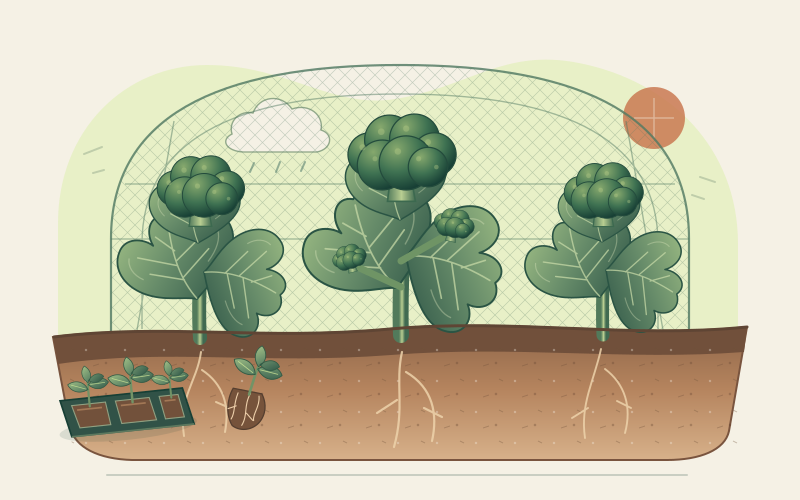
Time a cool-season crop around head formation
Garden broccoli, Brassica oleracea Italica Group, is grown for immature flower buds and their tender stalks. The familiar large green dome is commonly called heading broccoli or calabrese. Sprouting forms bear many smaller shoots and may need a longer, sometimes overwintered, growing cycle. The variety guide separates these packets before you plan the bed.
Broccoli grows most reliably in mild, cool conditions. The aim is leafy establishment without a severe check, followed by head development before hot weather. Spring transplants suit many temperate gardens; elsewhere, a late-summer planting for autumn harvest avoids the hottest weeks. Local frost dates, elevation, rainfall, and cultivar matter more than a universal month. Light frost can be tolerated by established plants, but hard freezes and frozen, waterlogged soil are different conditions.
Rooted’s 60–100 day window is an indicative first-harvest range under suitable conditions. Suppliers may count from transplanting rather than sowing, so read the packet definition. Raising a plant indoors adds weeks before that clock begins. Sprouting broccoli can fall outside this heading-crop window, and cool or stressful weather can delay any planting. Judge harvest by bud size and tightness, not the date alone.
Raise sturdy transplants and keep growth steady
-
Prepare fertile, drained soil
Choose a sunny or lightly shaded site with soil that holds moisture without remaining saturated. Remove perennial weeds and incorporate mature compost where needed. Use a soil test to guide pH and fertiliser: broccoli is a demanding feeder, but neither fresh manure nor repeated nitrogen doses guarantee larger heads. Firm loose soil before planting so a top-heavy plant remains anchored.
-
Sow for the local planting window
For an early crop, sow in clean modules or seed trays with fresh growing medium, following the packet’s depth and temperature guidance. Give seedlings bright light immediately after emergence and enough space to avoid weak, crowded stems. Direct sowing is also possible when outdoor conditions are mild and pests can be excluded. Make a small succession of sowings only if you can use several heads at once.
-
Harden off without stunting the plants
Gradually accustom indoor-grown seedlings to outdoor sun, wind, and temperature over about a week. Transplant while they are sturdy and still growing actively, before roots circle tightly or plants become starved in their modules. Avoid exposing tender plants to severe cold or planting during a hot spell. Keep the root ball intact, water before and after planting, and firm the stem in securely.
-
Allow room for leaves and access
A common spacing for full-sized heading broccoli is roughly 30–45 cm between plants, with about 45–60 cm between rows; compact cultivars may be closer and large sprouting types wider. Follow the supplier’s directions. Crowding restricts light, airflow, and head size, while wide access makes inspection and repeated picking easier. Do not confuse this final spacing with the closer temporary spacing in a nursery bed.
-
Feed by need, not by habit
Compost and a soil-test-based pre-planting amendment often provide the starting fertility. On poor soil, a local extension recommendation may include a nitrogen side-dressing after establishment. Water it in as directed and keep fertiliser off leaves and away from waterways. Pale, slow plants can have causes besides nitrogen deficiency, including cold, damaged roots, or drought, so diagnose before adding more.
-
Maintain even moisture
Check below the surface and water thoroughly when the root zone begins to dry. Consistent moisture matters during establishment and as heads form; repeated checks interrupt growth and can contribute to small or poor-quality heads. Sandy soils and containers need more frequent attention than moisture-retentive beds. Mulch around established plants to limit evaporation and weeds, keep it clear of stems, and never leave roots waterlogged.
Prevent pest damage and soil-borne clubroot
Use fine insect mesh as a barrier, not a cure. Support it on hoops so it does not rub the leaves, install it before cabbage-white butterflies or other pests lay eggs, and secure every edge. Inspect plants first so caterpillars are not trapped inside. Check leaf undersides and heads whenever you open the cover. Choose covers appropriate to the weather: a fabric that traps heat can undermine the cool conditions broccoli needs. Birds require a suitably taut, wildlife-safe barrier as well.
Flea beetles, aphids, cabbage root fly, slugs, and caterpillars cause different damage. Identify the culprit before acting; hand removal, sanitation, and physical barriers are useful where practical. Avoid routine spraying that harms beneficial insects. Any legally available pesticide must be used only according to its label for the crop and target, including harvest intervals.
Clubroot produces swollen, distorted roots and can cause stunting or wilting in warm weather. Start with clean transplants and fresh growing medium, rotate broccoli with cabbage, kale, cauliflower, and other brassicas as one group, and avoid moving soil or dirty tools from affected ground. Resting spores persist for years, so rotation alone does not eradicate them. Improve drainage and seek local advice on resistant cultivars and pH; do not apply lime blindly. Confirmed infestations require a long-term bed plan.
Read stress signs, then cut at the right stage
Buttoning means very small heads forming on young, undersized plants. Cold shock, drought, nutrient shortage, root damage, or old transplants can be responsible. Bolting is premature flowering; heat and lengthening days can accelerate it, though stress and cultivar also matter. High temperatures can additionally make heads loose, uneven, bitter, or absent. Prevention lies in suitable timing, vigorous transplants, and steady care. Once buds begin to open, cut promptly rather than waiting for a larger head.
| Harvest | Ready cue | What to do next |
|---|---|---|
| Central head | Full usable size, firm dome, tight green or purple buds | Cut with a short stalk; leave the lower plant intact |
| Opening buds | Loose clusters or yellow petals beginning to show | Harvest immediately if sound; quality will not improve |
| Side shoots | Small tender heads on shoots after the central cut | Pick every few days before flowers open |
| Sprouting stems | Slender shoots with tight bud clusters | Cut regularly with their tender stems and leaves |
Use a clean, sharp knife and avoid tearing the main stem. Many heading cultivars respond to the central cut by producing smaller side shoots over subsequent weeks; not every plant yields heavily, and sprouting types are designed around repeated shoots. Inspect every few days in warm weather. Yellow flowers are still part of the plant’s normal cycle, but the harvest becomes loose and less like the intended tight-bud crop.
Cool broccoli soon after picking and refrigerate it in a clean bag or container. Wash before use, separating any insects trapped in the florets with clean running water rather than soap. Use sound, tender stems as well as buds; peel only if the outer stalk is tough. Discard slimy, mouldy, or badly decayed produce. For freezing, follow a tested food-preservation recipe that includes suitable blanching and rapid cooling.