Land & boundaries · Homestead delimitation
A boundary that grows.
A homestead boundary is three lines at once: a legal line on the cadastre, a physical edge that keeps animals and people in or out, and a living system of hedges, trees, stones and water.
Survey first. Then design the edge as a layered habitat, windbreak, stock-proof barrier and long-term record. A hedge is not a substitute for a title, and a title is not a substitute for a maintained edge.
- Survey first
- Plant inside the line
- Use local species
- Record and maintain
- Three lines
- 03Legal, physical, living.
- Hedge rows
- 1–2Staggered native whips.
- Record
- 1 mapCorners, photos, agreements.
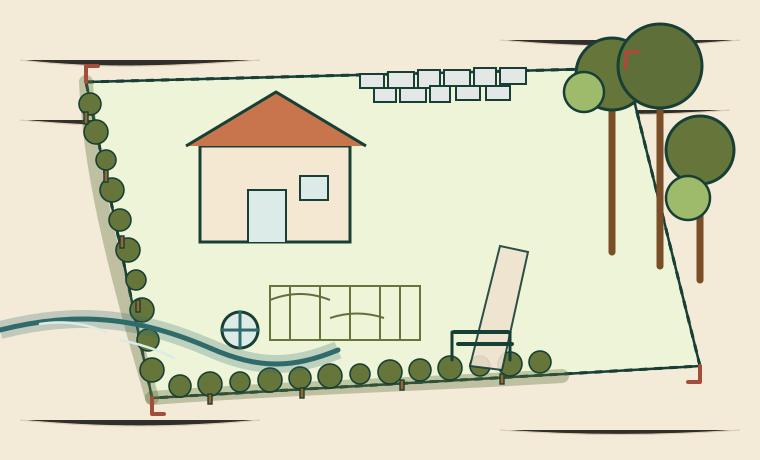
Before anything is planted
Three lines, not one
Most boundary disputes begin when a living edge is mistaken for a legal line. Keep the three ideas separate, then align them on a map.
-
Line 01 · Legal
The cadastral boundary
The line recorded in the title, cadastre or survey. It is defined by documents, coordinates and corner markers — not by the hedge, the fence or the neighbour’s memory.
-
Line 02 · Physical
The built edge
The fence, wall, bank, ditch or gate that controls access, animals and privacy. It can be repaired, moved or replaced; it is evidence of use, not proof of ownership.
-
Line 03 · Living
The growing edge
The hedge, tree line, wetland, stone bank or stream. It changes with growth, roots, shade, flooding and decay. It is habitat, windbreak, food and shelter — and it needs a plan.
Align them deliberately. Plant the hedge 0.5–1.5 m inside the legal line so it can be cut from your side without encroaching. Leave room for the mature width, roots, maintenance access and a gate. Put the corner markers where you can find them again.
The unglamorous part
Survey, agreement, map
A living boundary is a long-term commitment. The legal line is the one thing you cannot grow your way out of.
- Obtain the title, cadastral plan and any registered boundary agreement. Check them against the ground.
- Find the official corner markers; photograph them, record coordinates and do not move them.
- Walk the line with the neighbour. Agree in writing who owns, cuts and repairs which hedge, fence, wall or ditch.
- Check the wet-season line of streams, ditches and drainage; a dry channel is still a watercourse.
- Locate buried services, drains, cables and water pipes before digging or planting.
- Check protected trees, watercourse rules, hedge-cutting seasons, height limits and permits.
- Make a simple map: corners, lengths, gates, water, trees, buildings, utilities and the proposed hedge centre-line.
- Record the planting plan and the agreement in the maintenance register and the community book.
If the line is disputed, do not settle it by planting a hedge. Get a surveyor, a mediator or local legal advice. A hedge planted on a disputed line becomes a physical fact that is expensive to undo.
Choose the edge
Hedge, wall, bank, water or fence
Most good boundaries are layered: a hedge with a fence inside it, a wall on a bank, a tree line above a ditch. Choose for the job, the climate and the maintenance you can actually do.
| Edge | Best for | Limits | Maintenance |
|---|---|---|---|
| Mixed native hedge | Stock-proofing, windbreak, habitat, berries, privacy | Takes years to thicken; roots and shade; not a legal survey | Cut in rotation, lay every 10–20 years, replant gaps |
| Tree line / shelterbelt | Wind, shade, fruit, nuts, timber, long-term structure | Wide root zone; shade; height; power lines; slow | Prune, thin, coppice, protect young trees |
| Stone wall | Durable edge, habitat, drainage, firebreak in some sites | Cost, skill, foundation, frost heave, repair | Rebuild sections, clear vegetation, maintain drainage |
| Earth bank / ditch | Drainage, stock control, shelter, old field boundaries | Slumping, erosion, mosquitoes, water law; not for steep unstable ground | Clear, reshape, vegetate, keep outlets open |
| Stream or river | Natural edge, water, wildlife corridor | Changes course; flood risk; riparian law; erosion | Protect banks, do not dam or straighten without advice |
| Fence | Precise, fast, movable, stock control | Not living; rust, rot, maintenance; visual | Inspect, tighten, replace posts and wire |
| Path or avenue | Access, definition, ceremony, allée | Not secure; public rights; maintenance | Cut verges, repair surface, keep drainage |
A hedge alone is not reliably stock-proof in the first years. Use a temporary fence inside the hedge until it thickens. A wall without drainage becomes a dam; a ditch without an outlet becomes a pond. Design the water before the barrier.
The living wall
Designing a mixed hedge
A good hedge is a thicket, not a row of clipped balls. Mix a structural core with flowering and fruiting species, and leave some wildness.
Use one or two rows of bare-root whips, staggered, at 30–50 cm spacing. A double row 40–50 cm apart gives a denser base and a better windbreak. Plant in the dormant season, into clean soil, with the root collar at ground level. Mulch, water through the first two summers, and protect against rabbits, deer and strimmers. A hedge can be cut back hard after planting to encourage branching, but follow local advice for the species and the season.
Include 60–80% structural natives — hawthorn, blackthorn, hornbeam, hazel, field maple — and 20–40% flowering or fruiting species — dog rose, guelder rose, elder, wild pear, wild apple. Thorny species make a stock-proof core; evergreens give winter cover; deep-rooted species help the bank. Avoid a monoculture, and avoid invasive species that sucker or seed into the landscape.
Cut in rotation, not all at once, so there is always flower, fruit and cover. Leave a standard tree every 10–20 m for height and birds. Lay the hedge every 10–20 years where that tradition exists; laying thickens the base and makes a stock-proof barrier. Check the nesting season before cutting — usually spring to late summer — and never cut a hedge that is actively nesting.
The slow layer
Boundary trees and natural formations
Trees, stones, ridges and streams can mark a boundary for generations — but they move, grow and erode. Use them as part of the evidence, not the whole of it.
A boundary tree can be a standard, a pollard or a coppice stool. Standards give height and shade; pollards give repeated wood and keep the canopy low; coppice gives rods and stakes on a cycle. Plant them inside the line, with enough room for the mature crown and roots. Protect the root zone from compaction, excavation and animals. Keep trees away from power lines, drains, foundations and the public road, and check protected-tree rules before pruning or felling.
Stone piles, rock outcrops, ridges, old paths, springs and streams are natural or historical markers. A stream is a moving boundary: erosion and flooding can shift the channel, and the legal line may not follow the water. A ridge or outcrop is more stable, but still needs a survey. Old hedges, ditches and boundary stones are landscape evidence; record them, photograph them and ask local historians before altering them.
Do not straighten, dam or divert a stream without advice and permission. Do not remove a boundary stone or ancient hedge because it is “in the way”. A natural feature can be the most durable part of the boundary — and the most legally sensitive.
A local palette
Trees and shrubs for a living edge
These are widespread natives and traditional companions in the region. Check local provenance, soil and nursery stock; a species that thrives on one site may fail on another.
| Species | Role in the edge | Notes |
|---|---|---|
| Crataegus monogynaHawthorn | Stock-proof core, blossom, birds | Thorny; tolerant; cut after nesting. |
| Prunus spinosaBlackthorn | Dense thorny hedge, sloes | Suckers; good on poor soil; keep in bounds. |
| Rosa caninaDog rose | Flowers, hips, pollinators | Scrambles through the hedge; thorny. |
| Corylus avellanaHazel | Nuts, coppice rods, stakes | Cut on a rotation; good in mixed hedge. |
| Carpinus betulusHornbeam | Dense hedge, windbreak, coppice | Clips well; tolerates shade. |
| Acer campestreField maple | Small tree, hedge, autumn colour | Compact and adaptable. |
| Quercus roburPedunculate oak | Standard tree, timber, habitat | Large; plant only with room; slow. |
| Tilia cordataSmall-leaved lime | Canopy, shade, pollen | Large; good for avenues and standards. |
| Pyrus pyrasterWild pear | Fruit, blossom, small tree | Grafting and local varieties possible. |
| Malus sylvestrisWild apple | Fruit, blossom, wildlife | Good in a mixed edge; local varieties. |
| Sambucus nigraElder | Berries, flowers, fast cover | Spreads by seed; manage suckers. |
| Viburnum opulusGuelder rose | Damp hedge, berries, flowers | Moist soil; berries for birds. |
| Euonymus europaeusSpindle | Autumn colour, hedge | Toxic berries; keep from children. |
| Salix albaWhite willow | Wet edge, windbreak, coppice | Thirsty; roots near drains; pollard. |
| Alnus glutinosaAlder | Wet ground, nitrogen, windbreak | Roots in wet soil; coppices. |
| Hippophae rhamnoidesSea buckthorn | Berries, erosion, windbreak | Care: suckers and spines; use where it can spread. |
Avoid invasive plants. Do not plant species that sucker aggressively, seed into neighbouring land or are listed as invasive locally. A boundary that spreads into a neighbour’s field is a dispute waiting to happen. Check the national invasive-species list and ask a local nursery.
The human edge
Setbacks, shade and shared boundaries
A hedge is a relationship. Talk to the neighbour before the first stake goes in, and write down who does what.
- Plant inside your legal line; leave room for the mature hedge width and a maintenance strip.
- Keep trees far enough from foundations, drains, septic systems, cables and the road; check root spread.
- Agree who owns the hedge, who cuts which side, who repairs the wall or fence and who pays.
- Check height, light, view and shading rules; a tall evergreen can change a neighbour’s winter sun.
- Do not block a drainage line, ditch or flood path; water must still get away.
- Avoid fire-prone species close to buildings; keep access for emergency vehicles.
- Record the agreement, with a sketch and a date; review it if the use of either side changes.
On a shared boundary, ownership of the hedge, wall or ditch may be joint, split or unclear. The cadastre and local law decide. A written, signed note is not a substitute for a survey, but it prevents many small disputes.
The boundary year
Seasonal tasks
Add these to the seasonal almanac and the maintenance register. Dates shift with altitude and weather.
-
Winter
- Survey and map; check corner markers.
- Order bare-root whips and trees.
- Plant dormant stock; prune dormant trees.
- Repair walls, fences and gates; plan hedge laying.
-
Spring
- Finish late bare-root planting; mulch and water.
- Check tree guards, stakes and rabbit protection.
- Do not cut hedges during nesting.
- Repair winter damage; watch for late frost.
-
Summer
- Water young plants in dry spells.
- Inspect storm damage and root heave.
- Trim after nesting, in rotation.
- Remove invasive seedlings early; record failures.
-
Autumn
- Plant container and bare-root stock.
- Lay hedges and coppice on rotation.
- Repair walls and ditches before winter.
- Collect local seed; update the register.
Make it legible
Mark, calculate, maintain
A boundary that exists only in memory will be redrawn by the next owner. Put it on paper, in the register and on the ground.
Use the hedge planting calculator to estimate plants from length, spacing and rows. Add the hedge, tree line, wall, gate and corner markers to the maintenance register with a named caretaker and a next inspection date. Record the planting plan, species, provenance, dates and failures in the case-study template.
Keep a boundary file: title and cadastral extract, map, corner coordinates, photos, neighbour agreement, planting plan, receipts, maintenance dates. Store a paper copy and a digital copy. Give the next caretaker the file, not just the keys.
Scope and law
A living edge is not a legal survey.
These are general principles. Boundary law, water law, protected trees, hedge-cutting seasons and invasive-species rules are local and enforceable.
Before you plant or cut:
- Check the title, cadastre, corner markers and any registered agreement.
- Get written neighbour agreement for shared hedges, walls, ditches and trees.
- Do not alter a stream, ditch or drainage line without advice and permission.
- Check protected trees, utilities, road setbacks and fire rules.
- Do not plant invasive species or trees that will damage drains and foundations.
- Use a surveyor or lawyer for a disputed line; do not rely on a hedge.
Link to maintenance, almanac, calculators and case studies.
Sources and further reading
Where to check the details
Boundary and water law are local. Use the cadastre, a surveyor and local ecological advice.
- Wikipedia: Cadastre — legal property records and boundaries.
- Wikipedia: Surveying — measurement and boundary marking.
- Wikipedia: Boundary marker — physical markers and evidence.
- Wikipedia: Hedge — hedge types, planting and management.
- Wikipedia: Hedgerow — ecology and conservation.
- Wikipedia: Land tenure — rights, access and ownership.
- Wikipedia: Riparian zone — streams, banks and water law context.
Survey the line, then plant inside it.
Start with one edge: a corner, a gate, a short hedge. Record it, plant it, maintain it, and let it teach you before you plant the whole boundary.