
Crop 011 / Ipomoea batatas

Give the vines warmth; cure the roots for keeping.

Grow sweet potatoes from slips in a long, frost-free season. Wait for warm soil, leave room for trailing vines, water without saturation, then lift before frost and cure sound roots before frost-sensitive storage.

Planting material
Rooted shoots called slips Start with healthy food-crop planting material rather than botanical seed or pieces of root.
Typical crop window
90–150 days From planting rooted slips to mature storage roots; cultivar and accumulated warmth shift the timing.
Season
Long, warm and frost-free Cold soil checks tender plants, and roots do not reliably mature after frost kills the vines.
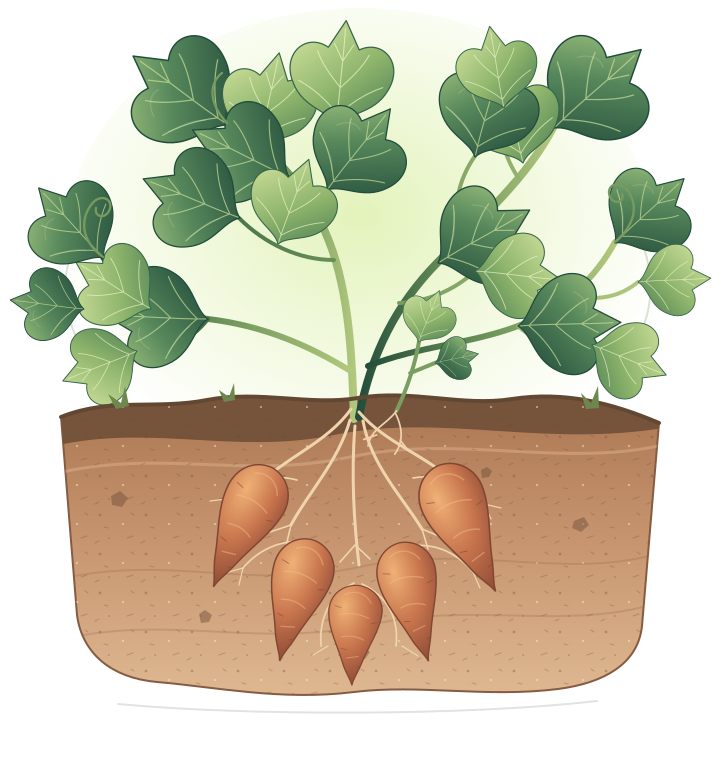
Sweet potato plant with a leafy slip, sprawling heart-shaped green leaves and orange storage roots with fine roots in a warm soil cutaway.
Sweet potato is a trailing storage-root crop grown from slips. Its vines and roots need warmth; neither its identity nor its storage needs match those of true yams.

Know the crop

Crop profile

A warm-season storage-root crop grown from rooted shoots called slips. Sweet potato is Ipomoea batatas, not a true yam (Dioscorea species); it needs a long frost-free period, warm soil and enough heat for roots to mature.

Crop essentials

Botanical name
Ipomoea batatas
Growth
90–150 days From planting rooted slips to mature storage roots. Early cultivars and warm conditions favour the shorter end; cool weather, late planting and long-season cultivars extend it. Roots do not reliably mature after vines are killed by frost.
Family
Convolvulaceae, the morning-glory family
Origin
Tropical Americas
Habit
Warm-season trailing vine with edible swollen storage roots; usually grown for one frost-free cropping period

Nutrition / baked flesh

Nutrition, in context

High Editorial nutrient-density rank 3. This is Rooted’s qualitative category for protein, fibre, folate, iron and potassium in the site’s cooked-food comparison, with highlights adding context. It is not an official nutritional score or a universal ranking of vegetables.

Reference nutrients per 100 g sweet potato, cooked, baked in skin, flesh only, without salt
Nutrient Amount
Protein 2.01 g
Fibre 3.3 g
Folate 6 µg
Iron 0.69 mg
Potassium 475 mg
  • Contains vitamin A (961 µg RAE) and beta-carotene (11,509 µg) in this orange-fleshed cooked reference.
  • Provides potassium, fibre and vitamin C (19.6 mg) per 100 g.
  • The reference is baked flesh, not raw sweet potato, boiled sweet potato or true yam.

Basis: Approximate values per 100 g sweet potato, cooked, baked in skin, flesh only, without salt (USDA FoodData Central SR Legacy 168483). Only the flesh is included in this baked-in-skin reference. Orange-, white- and purple-fleshed cultivars differ in carotenoids; preparation, water loss and serving size change intake. Values do not measure absorption or individual needs.

At the table

Build a varied meal around sweet potato

  • Beans, chickpeas or lentils — protein and fibre. Pulses add protein, folate and iron to sweet potato’s carbohydrate, fibre and potassium. Particular foods need not be eaten together at every meal. Serve baked sweet potato with black beans and vegetables, or alongside lentil stew.
  • Leafy greens, cabbage or broccoli — vegetable variety. Other vegetables broaden the meal’s flavours, textures and nutrients. This is dietary variety rather than a required nutrient-combining rule. Fill a sweet potato with chickpeas and serve with cabbage or broccoli.
  • Eggs, fish, yogurt or tofu — protein variety. These foods add protein and different nutrients to a sweet-potato meal. Choose according to dietary preferences and overall needs. Try sweet potato with tofu and greens, or with fish and a bean salad.

The essentials

From warm-season slips to the storage box

Six practical stages. Match cultivar and protection to your available heat, frost-free season, rainfall and soil.

  1. Choose the crop and a warm window

    Sweet potato, Ipomoea batatas, is a trailing member of the morning-glory family grown for storage roots. It is not an ordinary potato or a true yam; true yams are Dioscorea species with different cultivation and food references. Choose an early, locally proven cultivar if your warm season is short, and allow the full 90–150 day window as a broad guide.

  2. Start with healthy slips and a warm bed

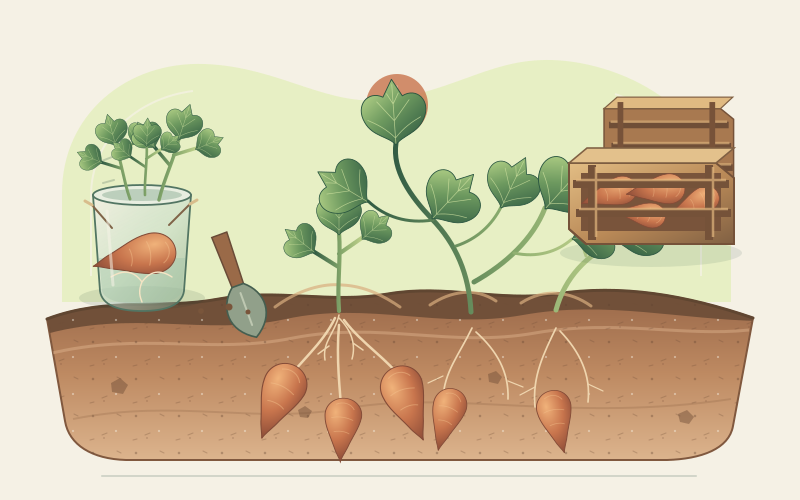
    Buy clean slips or young plants from a reputable food-crop supplier. Root unrooted shoots promptly in clean water or moist cutting compost, then harden off rooted plants before outdoor planting. Choose full sun and loose, fertile, freely draining soil; use broad raised ridges in heavy ground and avoid compaction, waterlogging and excessive nitrogen.

  3. Plant after frost into warm soil

    Wait until local frost danger has passed and soil is thoroughly warm; about 18 °C is a useful minimum guide. Set several lower stem nodes below the surface with upper leaves above it. As a starting point, allow about 30 cm between plants and 90–100 cm between rows, following local cultivar advice where it differs. In cool climates, pre-warm a sheltered bed or use suitable protection.

  4. Give vines room and water steadily

    Stems can trail 1.5 m or more, so allocate space, guide growth away from needed access and avoid repeatedly disturbing rooting stems. Keep the root zone evenly moist during establishment and early root growth, checking below the surface rather than following a rigid schedule. Water at the base without prolonged saturation, mulch warm soil and hand-weed while plants are young.

  5. Lift mature roots before frost

    Use cultivar maturity and a sample root rather than vine appearance alone. Harvest before frost or cold soil damages the crop; do not wait for frost to kill the vines. Loosen soil well outside the root cluster and lift gently by hand. Fresh skins are fragile, so avoid throwing, dropping, washing or scrubbing roots, and use badly damaged roots promptly.

  6. Cure warmly and store frost-free

    For a keeping crop, spread sound, unwashed roots with air around them at roughly 27–29 °C and 80–90% relative humidity for about 5–10 days, with ventilation but no chilling or condensation. After curing, store in breathable trays at about 13–16 °C. Temperatures below 10 °C can cause chilling injury; avoid wet sealed plastic, inspect regularly and wash roots only before cooking.

Growing notes by place

Read your region, then read your weather

Compare broad growing conditions, then adjust for your own frost dates, altitude, rainfall and soil.

Cool, temperate and often maritime, with limited summer warmth in northern, coastal and upland districts.

Northwestern Europe

Sweet potato is a marginal outdoor crop here and needs the warmest sheltered sites. A greenhouse or polytunnel improves reliability.

Indicative planting
Raise slips in warmth and plant late May–June after frost when soil has warmed; use protection and avoid cold, exposed ground.
Indicative harvest
Lift carefully in September or before the first frost and cold soil damage, allowing roughly the cultivar’s full warm-season window.
Soil and moisture
Light, fertile and free-draining soil in full sun; raised beds and mulch can warm soil, but waterlogging must be avoided.

Field note: Choose an early cultivar, pre-warm the bed and harden off slips; cool northern gardens should treat yields as uncertain.
Dates are indicative. Local frost forecasts, soil warmth, seasonal rainfall and recent weather—not the calendar alone—should guide planting and harvest.

Cool-temperate Northern Hemisphere · example

A warm-season rhythm

A compact planning guide, not a fixed schedule. Shift it with latitude, altitude, cultivar and local conditions.

  1. March–May

    Source or raise healthy slips in warmth and bright light. Prepare a sunny, sheltered, free-draining bed and pre-warm it with suitable protection where the season is cool.

  2. Late May–June

    Harden off rooted slips, then plant after local frost risk when soil is thoroughly warm. Water them in, allow room for vines and ventilate covers as conditions require.

  3. June–August

    Maintain even moisture during establishment and root growth without waterlogging. Weed early, guide vines through their allocated space and watch plant condition rather than assuming lush foliage means large roots.

  4. September–October

    Check cultivar maturity and sample roots, then lift carefully before frost or cold soil damage. Cure sound roots in warm, humid, ventilated conditions before moving them to frost-free storage.

The broad 90–150 day window runs from planting rooted slips. Cool weather and late planting extend it; protection cannot guarantee a crop where the remaining season is too cold or short.

From the field journal

Grow, choose and cook your sweet potatoes

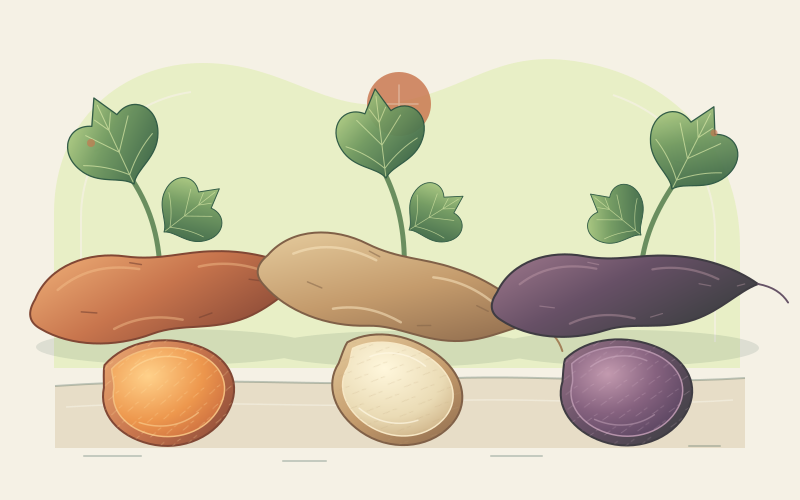
Practical reading for warm-season cultivation, flesh and cultivar choices, and cooked nutrition without superfood claims.

Your next harvest begins here

Start with warmth, healthy slips and a little room.

A small, sunny bed can teach you the rhythm of planting, vine growth, careful lifting and curing. Match the cultivar to your frost-free season and keep notes from the first slip to the stored roots.

Open the growing guide