
Crop 008 / Daucus carota subsp. sativus

Give the root room, and keep the seedbed moist.

Grow carrots for tender young roots or a mature storage crop. Direct-sow the fine seed, protect it while germination is slow, thin before roots crowd, and choose a root shape that fits the depth of your soil.

Establish the crop
Direct sow Keep the shallow seed zone moist until the fine seedlings emerge.
Typical crop window
60–85 days From direct sowing to usable roots under favourable conditions.
Root-growing conditions
Loose and evenly moist Match cultivar length to deep, stone-free soil without compaction.
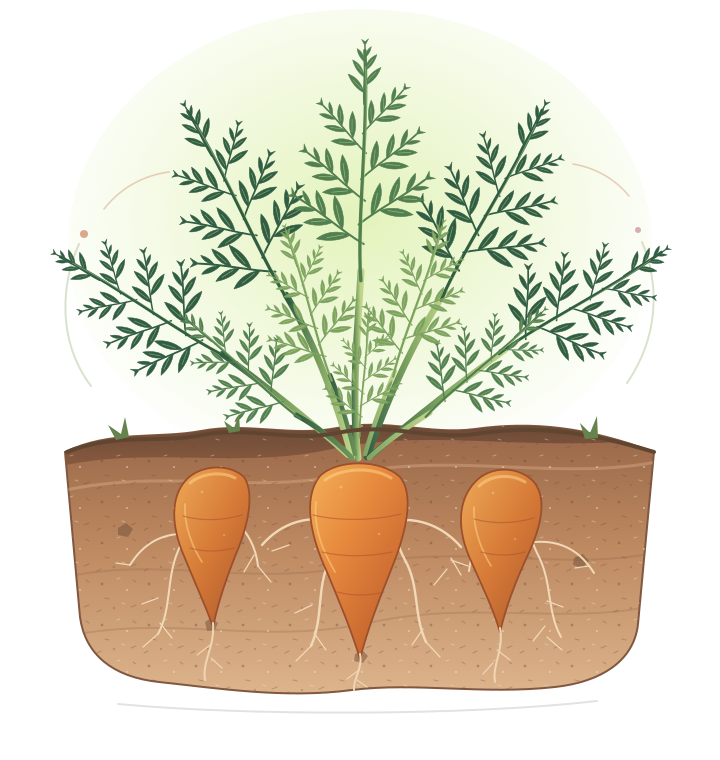
Carrot plant with finely divided green leaves above three tapering orange roots and fine root hairs in a soil cutaway.
Feathery foliage feeds the swollen taproots below; loose, unobstructed soil gives the selected root form room to develop.

Know the crop

Crop profile

A cool-season root crop harvested young or at mature storage size. Even moisture, loose soil and timely thinning matter more than a fixed calendar; heat, compaction and irregular watering can reduce root quality.

Crop essentials

Botanical name
Daucus carota subsp. sativus
Growth
60–85 days From direct sowing to usable roots under favourable conditions. Baby and early cultivars can be pulled sooner, while large storage types and cold soil take longer. Germination and growth slow in low temperatures.
Family
Apiaceae
Origin
Central Asia, with later diversification in Europe and western Asia
Habit
Biennial usually grown as an annual for its swollen taproot

Nutrition / boiled and drained

Nutrition, in context

High Editorial nutrient-density rank 3. This is Rooted’s qualitative category for protein, fibre, folate, iron and potassium in the site’s cooked-food comparison, with highlights adding context. It is not an official nutritional score or a universal ranking of vegetables.

Reference nutrients per 100 g carrots, cooked, boiled, drained, without salt
Nutrient Amount
Protein 0.76 g
Fibre 3 g
Folate 14 µg
Iron 0.34 mg
Potassium 235 mg
  • Contains vitamin A (852 µg RAE), principally from carotenoids including 8,332 µg beta-carotene, in the same cooked reference.
  • Provides fibre and potassium, with modest protein and folate.
  • These values describe drained boiled roots, not raw carrots, carrot tops or roasted carrots with added ingredients.

Basis: Approximate values per 100 g carrots, cooked, boiled, drained, without salt (USDA FoodData Central SR Legacy 170394). Cultivar colour and preparation change carotenoid and nutrient values. Drained weight, cooking water and serving size affect intake; listed content does not measure absorption or individual dietary needs.

At the table

Build a varied meal around carrots

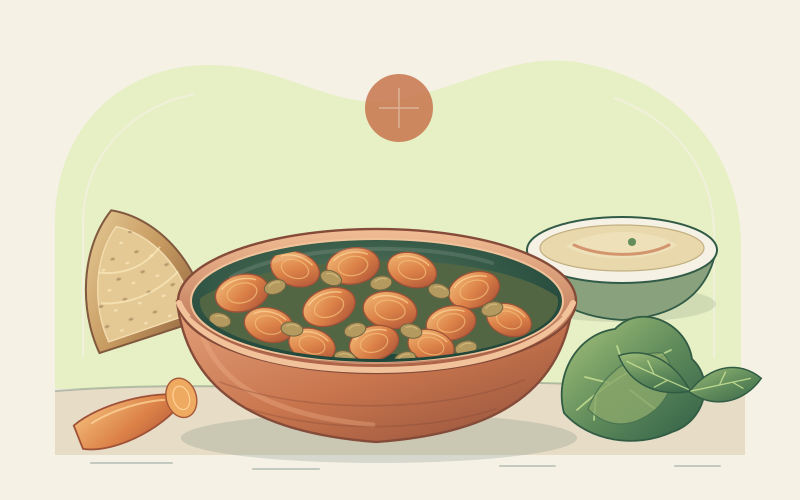
  • Beans, chickpeas or lentils. Protein and fibre. Pulses add more protein, folate and iron to a carrot-based meal. Their different amino-acid patterns can complement grains across the day without requiring a particular combination at one meal. Make carrot and lentil soup, or serve roasted carrots beside chickpeas and grains.
  • Rice, barley or whole-grain bread. A varied meal. Grains make a carrot dish more substantial and contribute their own nutrients. Add a protein-containing food according to dietary preference and overall needs. Serve carrots with barley, white beans and leafy greens.
  • Eggs, fish, yogurt or tofu. Protein variety. These accompaniments add protein and different nutrients alongside carrots. No single accompaniment is essential. Try carrots and peas with tofu, or serve carrots with fish and potatoes.

The essentials

From fine seed to sound storage roots

Six practical stages. Adapt timing, root form and protection to your soil, rainfall, temperature and local pests.

  1. Prepare loose soil for the chosen root

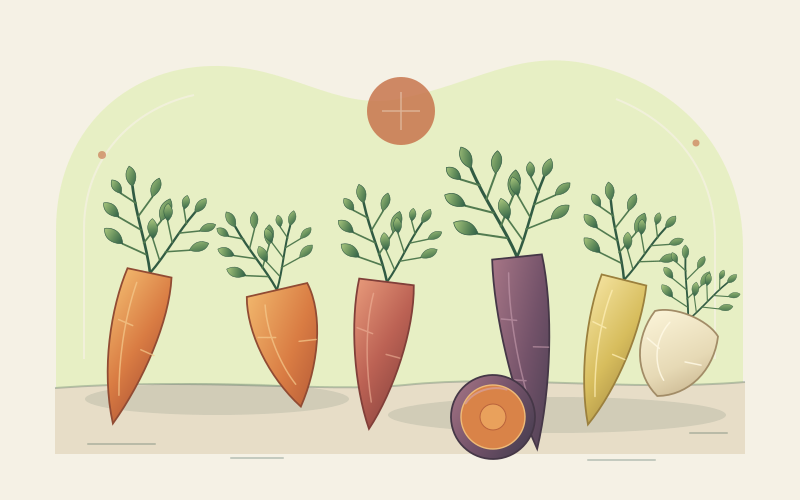
    Remove stones and coarse debris and loosen compacted soil to the depth required by the cultivar, without working wet ground into clods. Long types need deep, unobstructed soil; round and short types are practical in shallower beds or suitably deep containers. Avoid waterlogging and use mature organic matter where local guidance supports it.

  2. Direct-sow the fine seed shallowly

    Sow where the crop will grow because transplanting can disturb the taproot. Follow the seed packet first; roughly 0.5–1 cm deep is a common starting point. Water a dry drill before sowing, distribute the tiny seeds as sparsely as possible, cover lightly and firm gently rather than compacting the surface.

  3. Keep the surface moist through germination

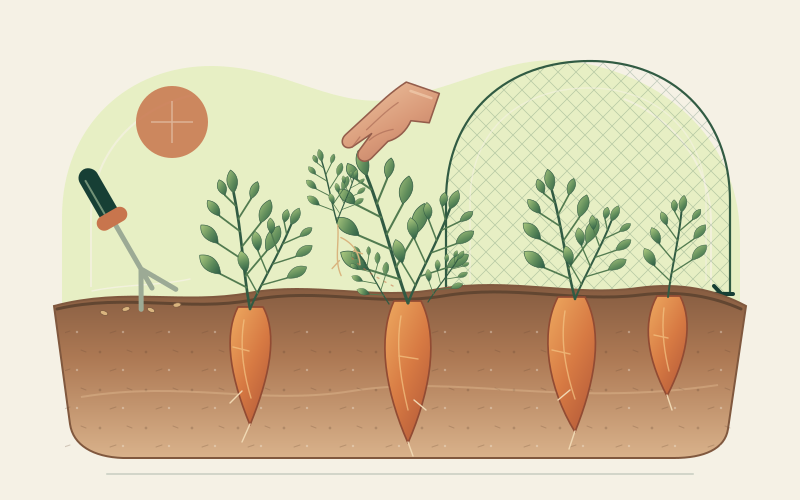
    Carrots can take one to three weeks or longer to emerge, and the shallow seed zone must not dry out. Check it daily in wind or heat and water gently enough not to wash seeds together. A light, permeable covering may reduce evaporation and crusting, but lift it promptly as seedlings emerge.

  4. Thin promptly, weed and water evenly

    When seedlings are large enough to handle, snip surplus shoots at soil level or pull carefully in moist soil, then firm remaining plants back in place. A common final spacing is about 5–7.5 cm, but cultivar and desired root size govern. Hand-weed close to the row and avoid repeated severe drying followed by heavy watering.

  5. Exclude carrot fly where it occurs

    Cover the crop with insect-proof mesh with every edge secured, allowing enough height for mature foliage. Rotate away from ground that recently held carrots or other susceptible Apiaceae crops so insects do not emerge inside a new cover. Clear away thinnings, avoid unnecessary foliage bruising and replace protective mesh immediately after working in the row.

  6. Harvest at a useful size and store sound roots

    Loosen the soil beside a row with a fork if needed, then pull without twisting or bruising. Remove tops soon after lifting, leaving a short stem stump without cutting into the crown. Refrigerate fresh roots with humidity but not trapped wetness; for longer keeping, select mature, undamaged roots for a cool, humid, frost-free store and inspect them often.

Growing notes by place

Read your region, then read your weather

Compare broad growing conditions, then adjust for your own frost dates, altitude, rainfall and soil.

Cool, temperate and often maritime, with colder springs and shorter seasons in northern and upland districts.

Northwestern Europe

Carrots suit spring and summer sowing in Britain, Ireland and nearby areas. Early crops need soil that is warming, not saturated.

Indicative planting
Direct-sow small batches from March–July once soil is workable; use cloches for early crops and delay cold, wet sowings.
Indicative harvest
Pull young roots from June and maincrops through autumn. Lift storage roots before severe ground frost, using root size rather than a fixed date.
Soil and moisture
Deep, loose, stone-free and free-draining soil; avoid fresh manure and compaction, and keep moisture even.

Field note: Thin seedlings promptly, protect against carrot fly where prevalent and leave later sowings enough time to size before cold weather.
Dates are indicative. Local frost forecasts, heat, seasonal rainfall and recent weather—not the calendar alone—should guide sowing and harvest.

Cool-temperate Northern Hemisphere · example

A root-crop rhythm

A compact planning guide, not a fixed schedule. Shift it with latitude, altitude, cultivar and local conditions.

  1. March–April

    Prepare a loose, drained bed to the depth required by the chosen root form. Direct-sow early batches once soil is workable, using cloches where appropriate and delaying cold, wet sowings.

  2. April–June

    Keep the shallow seed zone moist through emergence. Thin seedlings before roots crowd, hand-weed carefully and secure complete insect-proof mesh where carrot fly occurs.

  3. June–August

    Pull young roots at a useful size and make later small sowings where enough mild growing time remains. Maintain even moisture and avoid compacting the bed during harvest.

  4. September–November

    Lift maincrop and storage roots by size and local conditions, before severe ground frost. Remove the tops, select sound roots and keep them cool and humid, inspecting stored roots regularly.

The general 60–85-day window runs from direct sowing to usable roots under favourable conditions. Baby and early cultivars can be pulled sooner; large storage types and cold soil take longer, and germination slows in low temperatures.

From the field journal

Grow, choose and cook your carrots

Practical reading for steady root harvests, informed variety choices and balanced meals without superfood claims.

Your next harvest begins here

Start with a short row and a patient seedbed.

A small sowing is enough to learn the rhythm of moisture, emergence and thinning. Match the root form to your soil, protect the crop where carrot fly occurs and keep notes from sowing to storage.

Open the growing guide