Water & sanitation · Rainwater
Catch the rain.
A roof is a catchment. With gutters, a first-flush diverter, a covered tank and a simple filter, a household can turn rain into a reliable, low-energy water store.
Rainwater is usually cleaner than surface water, but it is not sterile. Dust, bird droppings, roof coatings and a dirty tank all affect quality. The design is simple; the maintenance is what makes it work.
- Roof first
- Divert the first flush
- Cover the tank
- Treat and test
- One millimetre
- 1 LPer square metre of roof plan area.
- Runoff
- 0.8–0.9Typical coefficient for a clean, hard roof.
- First flush
- 0.5–2 mmDivert before the tank.
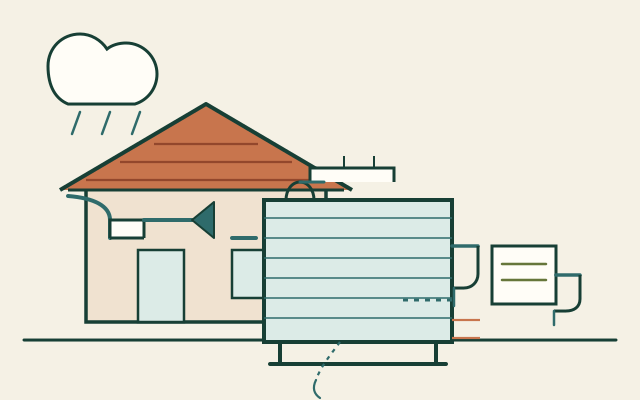
Before the tank
What a roof can give you
Estimate the supply before buying a tank. A tank that is too small overflows in the wet season and empties in the dry; one that is too large costs money and space.
The two calculations that matter
Annual harvest = roof plan area (m²) × annual rainfall (mm) × runoff coefficient.
100 m² roof × 600 mm rain × 0.8 = 48,000 litres a year
Tank size = daily use × the number of days you need to bridge. Use the dry-season gap, not the annual average.
200 litres/day × 90 days = 18,000 litres of storage
The roof plan area is the footprint, not the sloping surface. A 10 × 10 m building has a 100 m² plan area even if the roof is pitched. The runoff coefficient accounts for splashing, evaporation and first-flush losses; 0.8 is a reasonable starting figure for a clean hard roof, but measure your own if you can.
Rainfall varies enormously from year to year. Design for a dry year and keep a second source. A 20,000-litre tank is a useful household scale in many climates, but the right size is the one that covers your dry spell and fits your structure.
The chain from roof to tap
The components
Each part has one job. If one is missing, the tank becomes a breeding site or a bucket of dirty water.
| Component | Job | Watch |
|---|---|---|
| Roof | Catchment surface | Material safety, slope, ponding, access for cleaning |
| Gutter | Collect and carry water | Slope, leaf guards, joints, overflow |
| Downpipe | Deliver to the tank | Blockage, first flush, mosquito screen |
| First-flush diverter | Discard the dirtiest first rain | Drain after each event; size for the roof |
| Leaf screen / filter | Keep debris and insects out | Clean often; do not let it become a clog |
| Tank | Store water cool and dark | Cover, inlet, outlet, overflow, drain, foundation |
| Overflow | Send excess water away from the foundation | Screen; do not erode the slope |
| Tap / pump | Extract water without contaminating it | Keep above the tank bottom; no dipping |
| Treatment | Final barrier before drinking | Filter, boil, chlorine or SODIS; test |
Catchment quality
Roof and gutter
The roof is the first treatment surface. A clean, inert roof makes a better tank; a roof with lead, asbestos or a bitumen coating makes a water store you should not drink from.
| Material | Use for drinking water | Notes |
|---|---|---|
| Unpainted metal, lead-free | Good | Check fixings and coatings; avoid lead flashing. |
| Clay or concrete tile | Good | Porous surface; clean gutters; avoid moss treatments. |
| Slate | Good | Inert; check fixings and gutters. |
| Food-grade membrane | Good | Used for dedicated catchments; protect from UV and damage. |
| Painted metal | Check | Use lead-free paint; first flush; do not use flaking paint. |
| Bitumen / asphalt shingle | Not for drinking | Use for non-potable storage or a different roof. |
| Treated timber | Not for drinking | Preservatives can leach; use another catchment. |
| Asbestos cement | Avoid | Do not disturb; use another roof for drinking water. |
Gutters should fall steadily — a few millimetres per metre — toward the downpipe. Fit leaf guards and clean them before the rainy season. As a starting rule, allow about 1 cm² of gutter cross-section for every square metre of roof plan, and at least one 75–100 mm downpipe per 100 m²; local rainfall intensity and roof shape decide the real size. A gutter that overflows in a storm is not a failure of the tank; it is a failure of the gutter.
The first rain is for washing
First flush and tank
Dust, bird droppings and roof debris are concentrated in the first rain. Divert it before it reaches the tank.
A simple first-flush diverter is a vertical pipe or chamber that fills first and is drained after the rain. Size it for at least the first 0.5 mm of rain — about 0.5 litres per square metre of roof — and more on a dirty or overhanging catchment. A manual valve and a clear vertical section will do; automatic diverters are convenient but need maintenance. Drain the diverter after each event and before the next rain.
Keep the tank covered, screened and dark. Water enters through a calm inlet, not a splash; the outlet sits above the sludge layer; an overflow pipe takes excess water away from the foundation; a drain at the bottom allows cleaning. A first-flush diverter and a leaf screen reduce sediment, but they do not make the water microbiologically safe. Filter and treat before drinking, and test the stored water.
| Tank | Advantages | Watch |
|---|---|---|
| Food-grade plastic | Light, fast, easy to fit, replaceable | UV degradation, cost, must be food-grade and covered |
| Concrete / ferrocement | Local materials, cool, long life, repairable | Skilled construction, curing, cracking, foundation |
| Masonry / stone | Local, robust, cool | Waterproof render, structural design, labour |
| Steel | Strong, fast | Rust, coating, cost, potable-water lining |
| Underground cistern | Cool, hidden, gravity-friendly | Excavation, water table, access, contamination, cost |
Thinking of burying the tank? An underground cistern can be excellent — or an expensive hole. Check the soil, the wet-season water table, buoyancy, access and structural design first: evaluate an underground cistern.
Before drinking
Treatment and testing
Rainwater is usually low in dissolved minerals and can be slightly acidic. It still needs protection and, for drinking, a final barrier.
Use a first-flush diverter, a clean tank and a filter; then treat if the water is for drinking. Boiling is the most reliable household method for pathogens: bring water to a rolling boil for at least one minute at low altitude, longer at high altitude. Chlorination needs the right dose and contact time and works poorly in cloudy water. SODIS — clear PET bottles in strong sunlight — is a low-cost option in sunny climates but needs clear water, six hours or more of sun, and careful handling. None of these removes nitrate, arsenic or fluoride; test if the local geology is a concern.
Test the water at the start of the wet season and after any repair, flood, taste change or unusual illness. A clean-looking tank can still grow biofilm and harbour mosquitoes. Keep the tank covered, screen the overflow, and never let a bucket or hose contaminated with greywater or soil enter the tank.
The part that decides
Maintenance and safety
Rainwater systems fail from blocked gutters, forgotten first-flush valves, cracked tanks and uncovered inlets — not from the idea.
- Clean gutters, leaf guards and first-flush diverters before the rainy season and after heavy storms.
- Check the tank inlet, overflow and mosquito screens; repair leaks and cracks promptly.
- Drain and clean sediment from the tank every year or two; do not stir it into the outlet.
- Keep the tank covered, the tap clean and the area around it free of standing water.
- Test the water; record the result and the date. Retest after any repair or flood.
- Keep spare washers, screens, pipe and a tap in store.
Safety. A full tank is heavy and a fall into an open tank can drown. Fit a lockable, load-bearing cover; fence or secure the tank; never let children play on it; use a ladder and a second person for inspection. Ensure the tank base is level and designed for the weight. In freezing climates, protect pipes and tanks from frost and drain them before winter. Keep the roof and gutters free of lead, asbestos and toxic coatings if the water is for drinking.
Sources and further reading
Where to check the details
Rainfall, roof materials and water quality are local. Use regional data, a water test and local building advice.
- Wikipedia: Rainwater harvesting — catchment, storage and treatment.
- Wikipedia: Rainwater tank — tank types and installation.
- WHO: Guidelines for drinking-water quality — water safety and treatment.
- CDC: Household water treatment — boiling, filtration and safe storage.
- CAWST — household water treatment and rainwater resources.
Rainwater is not automatically safe. A clean roof and a covered tank help, but drinking water should be protected, treated and tested. If you are unsure, boil.
Measure your roof before you buy a tank.
Pace out the building footprint, find the annual rainfall for your area, and calculate the harvest. Then size the tank for the dry spell, not the average year.