Keep the cooked basis visible
Broccoli’s edible harvest includes immature buds, stalks, and often tender leaves. Those parts do not necessarily have identical nutrient profiles, and raw, steamed, roasted, and boiled broccoli are not interchangeable database entries. Cooking changes water content and serving weight. Heat and discarded cooking water can reduce some water-soluble vitamins, while softening does not remove the vegetable’s intact dietary fibre.
The values below are approximate amounts per 100 g of broccoli, cooked, boiled, drained, without salt, from USDA FoodData Central entry 169967. They do not describe raw broccoli, frozen broccoli, broccoli roasted in oil, or a salted packaged dish. A household serving may weigh more or less than 100 g, so any intake calculation must scale the values to the drained amount actually eaten.
Rooted places broccoli in the Very high, density rank 4 editorial nutrient category. This is qualitative shorthand for comparison among crops covered on this site, not an official score or a universal ranking. It does not measure absorption, a person’s requirements, or the nutritional quality of an entire meal. Cultivar, maturity, growing conditions, storage, and preparation all introduce variation.
What 100 g of the reference cooked broccoli contains
| Component | Amount | Meal context |
|---|---|---|
| Dietary fibre | 3.3 g | Contributes to fibre from vegetables, legumes, grains, fruit, nuts, and seeds |
| Folate | 108 µg | Food folate; not the same database field as added folic acid |
| Vitamin C | 64.9 mg | Amount varies with storage, heat, water, and preparation |
| Vitamin K | 141.1 µg | Phylloquinone, the principal vitamin K form in green plants |
| Protein | 2.38 g | A contribution, not a replacement for the protein in a serving of legumes |
| Iron | 0.67 mg | Non-heme iron; absorption depends on the meal and iron status |
| Potassium | 293 mg | One of many foods that can contribute potassium |
Fibre and folate belong to the whole diet
Dietary fibre remains part of cooked florets and stems even when they become tender. Juicing or finely extracting a liquid preparation can change that structure and is not equivalent to eating the whole vegetable. Broccoli’s fibre adds to the day’s total rather than meeting it alone; beans, lentils, intact grains, fruits, nuts, seeds, and other vegetables offer different amounts and textures.
Folate is a B vitamin involved in cell division and the formation of genetic material. The 108 µg figure is food folate in this particular cooked entry, measured in micrograms rather than a percentage of anyone’s requirement. Needs vary by life stage, and public-health recommendations for folic acid from fortified foods or supplements should not be replaced by a generic serving of broccoli.
Vitamins C and K respond to different contexts
Vitamin C contributes to normal collagen formation and other functions, and it can enhance absorption of non-heme iron from plant foods eaten in the same meal. It is also sensitive to storage and cooking conditions. Boiling and draining can transfer some into water; using cooking liquid in a soup is a different preparation from discarding it. No single method maximises every nutrient, so choose a safe and enjoyable cooking time that avoids unnecessary prolonged heating.
Vitamin K in broccoli is chiefly phylloquinone and participates in normal blood-clotting processes. People taking warfarin or a related vitamin-K antagonist are generally advised to keep vitamin K intake reasonably consistent rather than suddenly eating much more or eliminating green vegetables. Discuss major dietary changes with the clinician monitoring the medicine, and never adjust the dose yourself. Other anticoagulants do not all share this interaction.
Use florets and stems without overcomplicating cooking
Wash broccoli under clean running water just before preparation, working around the branching head where grit and small insects can lodge. Do not use soap or household disinfectant on produce. Cut away damaged areas and discard anything mouldy, slimy, or badly decayed. Separate florets into similarly sized pieces, then slice tender stalks so they cook at a comparable rate. Peel only the fibrous outer layer of a mature stem if needed.
Steam, simmer, sauté, or roast according to the dish. Brief cooking until tender keeps a distinct texture, while longer cooking suits some soups and purées; neither is nutritionally perfect in every respect. Added oil, cheese, salt, or sauce becomes part of the meal and means the finished serving no longer matches the plain boiled reference. That is not a reason to avoid flavour—only a reason to keep the comparison honest.
Refrigerate fresh broccoli promptly and use it while sound. Cool and refrigerate cooked leftovers in clean, covered containers without leaving them for extended periods at room temperature. Follow local guidance for storage and thorough reheating. Home-grown origin does not change these food-safety steps.
Pair broccoli with legumes, grains, and varied produce
Broccoli contributes fibre and micronutrients but is not a high-protein centrepiece on the scale of beans, lentils, eggs, fish, or tofu. Legumes add protein, fibre, folate, and minerals; grains add energy and their own protein and micronutrients. Their amino-acid patterns can complement one another across a varied diet without being combined in a precise ratio at every meal.
| Base | Broccoli addition | Other elements |
|---|---|---|
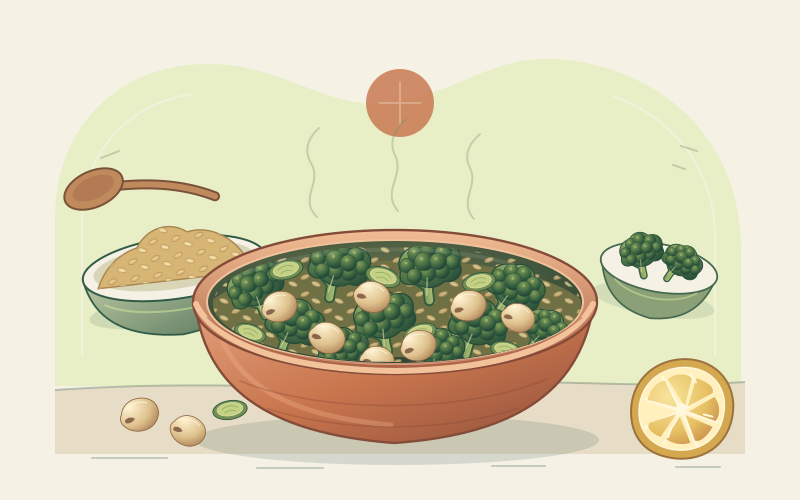
| Chickpeas and brown rice | Steamed florets and sliced stems | Lemon, herbs, and another seasonal vegetable |
| Lentil soup | Chopped broccoli added near the end | Tomatoes, carrots, onions, and bread |
| Tofu or eggs | Sautéed or steamed broccoli alongside | Noodles or potatoes, mushrooms, and peppers |
| White beans and pasta | Small florets cooked until tender | Tomatoes, garlic, and a side salad |
When the meal contains beans or another plant source of non-heme iron, broccoli’s vitamin C can support absorption. Tomatoes, sweet peppers, or citrus can add still more variety. This is a meal-planning interaction, not a treatment for diagnosed iron deficiency; that needs professional assessment and appropriate care.
Balanced pairings are not rigid formulas. Dietary preferences, energy needs, allergies, medicines, and medically advised restrictions differ. A practical plate might include a protein-containing food, a grain or starchy vegetable, broccoli or another vegetable, and additional produce across the day. The variety matters more than giving broccoli a special status.
Sources and specialist references
- USDA FoodData Central: Broccoli, cooked, boiled, drained, without salt (169967)
- NIH Office of Dietary Supplements: Vitamin C fact sheet
- NIH Office of Dietary Supplements: Vitamin K fact sheet
- NIH Office of Dietary Supplements: Folate fact sheet
- US Food and Drug Administration: Selecting and serving produce safely