
Crop 030 / Juglans regia

Plant the tree before you need the nuts.

Give English walnut a deep, sunny site with suitable winter chill and room for a mature crown. Choose late-leafing stock where spring frost recurs, build the tree patiently, and dry every sound harvest promptly.

Perennial establishment
Roots and framework first A grafted young tree needs several seasons of root and crown growth before a meaningful nut crop.
First meaningful crop
4–7 years From planting a grafted young tree, not an annual seed-to-harvest window; seedlings usually take longer.
Season
Chill, heat and frost timing Winter dormancy must be satisfied, while late frost can injure tender shoots, catkins and young fruit.
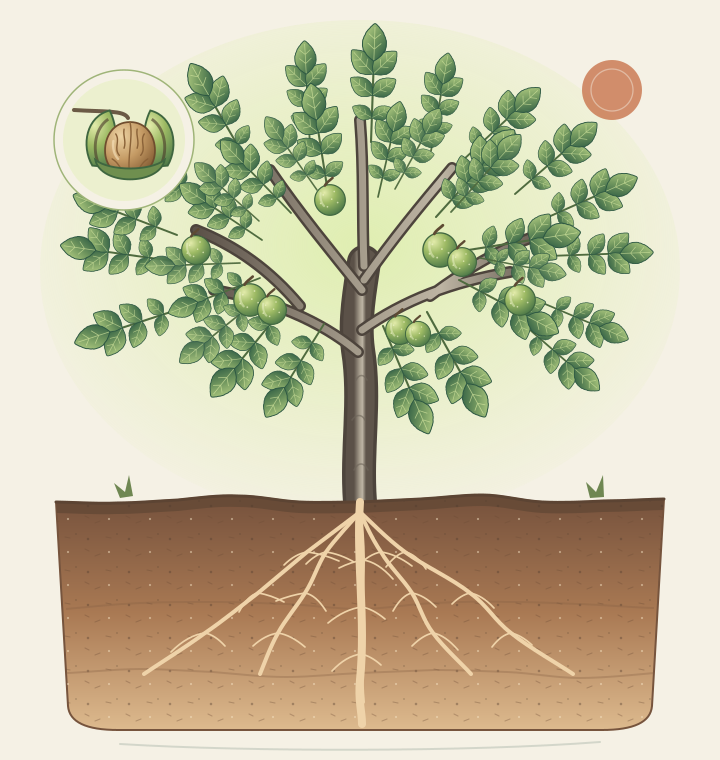
English walnut tree with pinnate leaves, green hulls, a split husk revealing a hard shell, and a deep branching root system.
An English walnut is a long-lived deciduous tree: its deep roots and scaffold branches establish before a meaningful harvest.

Know the crop

Crop profile

A long-lived deciduous tree grown for edible kernels. This entry concerns grafted Juglans regia, often called English or Persian walnut. Winter chill, late spring frost, seasonal heat, pollination and site depth determine local performance. The first meaningful crop commonly follows four to seven years of establishment after planting a grafted young tree, not four to seven months of annual production; seed-grown trees usually take longer.

Crop essentials

Botanical name
Juglans regia
Growth
4–7 years From planting a grafted young tree to a first meaningful nut crop. Roots, trunk and scaffold branches need years to establish, and full production takes longer. Seed-grown trees, weak stock, inadequate chill, late frost, drought, winter injury or poor pollination can delay or prevent cropping.
Family
Juglandaceae
Origin
Southeastern Europe through temperate Asia
Habit
Long-lived deciduous perennial tree with a broad crown and deep roots

Nutrition / raw English-walnut kernels

Nutrition, in context

High Editorial nutrient-density rank 3. This is Rooted’s qualitative category for protein, fibre, folate, iron and potassium in the site’s food comparison, with highlights adding context. It is not an official nutritional score or a promise of a health outcome.

Approximate values per 100 g raw English-walnut kernels, edible portion.
Nutrient Amount
Protein15.23 g
Fibre6.7 g
Folate98 µg
Iron2.91 mg
Potassium441 mg
  • Provides protein, fibre, folate, iron and potassium in the raw-kernel reference; the editorial rank does not account for every nutrient or individual dietary need.
  • The same 100 g reference contains 654 kcal and 65.21 g total fat, including 47.174 g polyunsaturated fat; a comparison basis is not a recommended serving.
  • These values describe raw English-walnut kernels, not walnut oil, candied nuts, toasted nuts or another Juglans species with a separate reference.

Basis: Approximate values per 100 g English walnuts (Juglans regia), raw edible kernels (USDA FoodData Central SR Legacy 170187). View the USDA reference.

Walnuts are tree-nut allergens. Anyone with a diagnosed walnut or tree-nut allergy should follow their clinician’s avoidance and emergency advice and check labels for cross-contact; nutrient value never overrides allergy safety. Dry freshly hulled nuts promptly, protect them from mould and pests, and store kernels airtight in cool conditions or refrigerated or frozen for longer keeping. Rancid, musty or mouldy nuts should be discarded.

At the table

Use walnuts as one ingredient

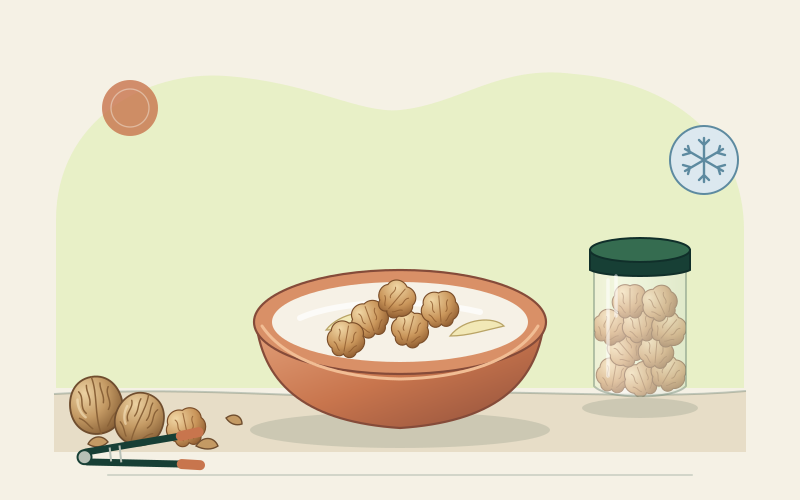
  • Oats, yogurt or fortified alternatives and fruit — A varied breakfast: Grains, fruit and a protein-containing food make a small portion of walnuts part of a broader meal. Choose each ingredient according to allergy and dietary needs. Sprinkle chopped walnuts over oats with fruit and yogurt or a suitable fortified alternative, accounting for other nuts and seeds in the recipe.
  • Beans, lentils or tofu with vegetables — A varied savoury meal: Pulses or tofu and vegetables add their own protein, fibre and micronutrients; walnuts contribute texture and energy rather than making the meal complete by themselves. Add a measured handful of walnuts to a lentil and roasted-vegetable salad, or serve them beside beans and greens.
  • Whole-grain bread and seasonal vegetables — Simple food preparation: Raw or plainly toasted walnuts can add flavour to ordinary dishes, while salt, sugar, oil and other recipe ingredients need to be counted separately. Use chopped walnuts in a vegetable filling for whole-grain bread or in a cabbage salad, keeping allergen-containing food clearly identified when sharing.

The essentials

From grafted tree to sound dry nuts

Six practical stages for Juglans regia. Adapt cultivar, pollination, training and harvest to your climate and local growing advice.

  1. Match site, winter chill and late frost

    Choose full sun, deep free-draining soil, good air drainage and enough room for a broad mature crown. Dormant buds need a locally suitable accumulation of winter chill for even growth, followed by enough frost-free warmth to flower and fill nuts. Avoid frost hollows where cold air settles. Late-leafing cultivars can reduce spring-frost exposure, but no cultivar is immune to a severe freeze or an unsuitable climate.

  2. Choose grafted stock and flowering overlap

    Buy a healthy tree with a named cultivar and rootstock suited to local soil and climate rather than relying on a seedling’s unknown nut quality and later bearing. Walnut trees carry separate male catkins and female flowers, and their timing may not overlap sufficiently within one cultivar. Ask whether a compatible polliniser is needed, then position trees within locally recommended pollination distance without crowding their mature roots or crowns.

  3. Plant and water for long establishment

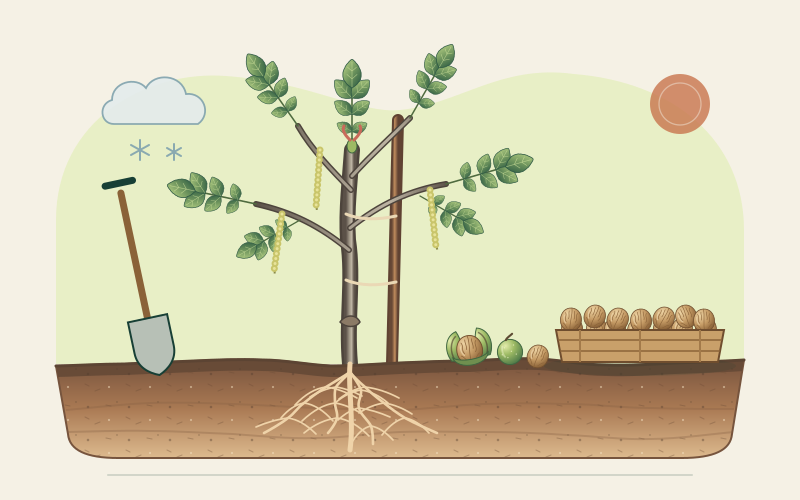
    Plant during local dormancy when soil is workable, keep the graft union positioned as the supplier advises, and spread roots without bending or burying them too deeply. Stake against wind with a flexible, checked tie. Keep a weed-free zone and water thoroughly when the root zone needs it through the first dry seasons; constant saturation is harmful. Expect a first meaningful crop about four to seven years after planting grafted stock, with full production later.

  4. Train the crown and judge juglone calmly

    Develop a strong trunk and well-spaced scaffold branches with light, locally advised pruning; large cuts and excessive pruning do not hasten a useful crop. Inspect leaves, shoots and nuts and obtain a diagnosis before treating pests or disease. Walnut roots and other tissues can release juglone, which affects some sensitive plants, but it does not make every nearby plant die. English walnut generally presents less risk than black walnut, and aerated soil biology can break juglone down. Separate known sensitive plants from the root zone and never diagnose every wilt as juglone injury.

  5. Harvest at hull split and dry promptly

    Collect nuts when green hulls split and nuts fall naturally or release with gentle, locally appropriate shaking. Gather frequently, wearing gloves to limit staining, and remove hulls without leaving wet nuts in heaps. Rinse off debris if needed, then dry immediately in thin layers with shade, clean airflow and protection from rain, rodents and birds. Do not use high heat. Dry until kernels are crisp or brittle rather than leathery, then cool and inspect the batch before packing.

  6. Store for quality and disclose the allergen

    Pack only sound, thoroughly dry nuts in clean containers, labelled with contents and date. In-shell nuts keep best in cool, dry conditions; shelled kernels need airtight protection and benefit from refrigeration or freezing for longer storage because their oils can become rancid. Discard musty, mouldy or doubtful nuts rather than trying to cook away spoilage. Walnut is a tree-nut allergen: prevent unlabelled sharing or cross-contact and follow individual clinical advice for anyone with a diagnosed allergy.

Growing notes by place

Read your region, then read your weather

Compare broad growing conditions, then adjust for your own chill, winter minimums, late frost, altitude, rainfall, heat and soil.

Cool, temperate and often maritime, with variable winter chill, late frosts and limited ripening heat in exposed or northern sites.

Northwestern Europe

Juglans regia can crop in favourable gardens, but cool wind, frost pockets and early-leafing cultivars reduce reliability. Choose a warm, open site and locally proven late-leafing, earlier-maturing stock.

Indicative planting
Plant a grafted dormant tree from late autumn to early spring while soil is workable and neither frozen nor waterlogged; spring is safer where winters are severe. Stake securely without constricting the trunk and expect four to seven years before a meaningful crop.
Indicative harvest
Once established, gather nuts as green hulls split and nuts begin to fall, commonly early to mid-autumn by cultivar and season. Hull and dry promptly under cover before cool, damp weather encourages mould.
Soil and moisture
Deep, fertile, moisture-retentive but free-draining soil in full sun; avoid shallow chalk over rock, compacted subsoil, waterlogging and low pockets where cold air collects.

Field note: Late leafing reduces exposure to spring frost but does not make a tree frost-proof; confirm pollination needs and ripening time with a nearby nursery or grower.
Dates are indicative. Local chill, frost forecasts, winter minimums, seasonal heat, rainfall and recent weather—not the calendar alone—should guide planting, training and harvest.

Cool-temperate Northern Hemisphere · example

A perennial tree’s rhythm

A compact planning guide, not a fixed schedule. Shift it with latitude, altitude, cultivar, rootstock, chill and local conditions.

  1. December–February

    Inspect stakes, ties and guards while the tree is dormant. Order or plant suitable grafted stock when soil is workable, and make only structural pruning cuts recommended for the local system and weather.

  2. March–May

    Watch local frost forecasts as buds open, keep new-tree root zones moist but not saturated, and record male and female flowering dates to check whether compatible cultivars overlap.

  3. May–August

    Maintain a weed-free zone, water young trees through dry periods and inspect foliage and developing nuts. Preserve a strong framework rather than forcing early fruit or making severe corrective cuts.

  4. September–November

    Collect split-hull nuts frequently, remove hulls with gloves, and dry the harvest promptly in thin ventilated layers. Inspect, pack and store only sound dry nuts; reject mouldy or musty material.

The 4–7 year window runs from planting a grafted young tree to its first meaningful crop, not from annual sowing. Seed-grown trees usually take longer, and frost, poor pollination, drought or winter injury can delay any tree.

From the field journal

Establish, choose and handle your walnuts

Practical reading for patient tree establishment, informed cultivar choices, and sound harvest, storage and food safety.

Your next harvest begins here

Start with one well-sited tree and a patient plan.

Choose locally proven grafted stock, plan for winter chill and late frost, and give the roots and framework priority. Sound drying and clear allergen handling protect the harvest you eventually gather.

Open the growing guide