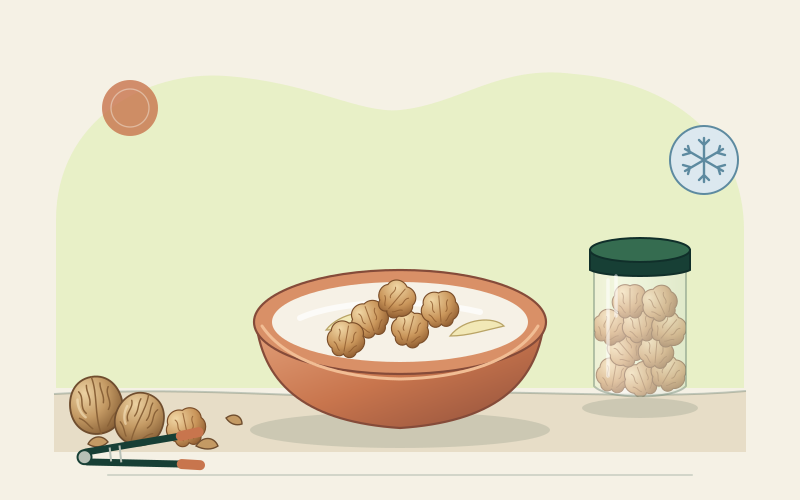
One raw-kernel reference, stated precisely
All nutrient values in this article come from USDA FoodData Central SR Legacy entry “Nuts, walnuts, english” (FDC ID 170187). The basis is 100 grams of raw edible English-walnut kernels, corresponding to Juglans regia. It does not describe a cooked food, walnut oil, candied walnuts, a nut blend, green pickled walnuts or another Juglans species with its own analysis.
| Component | Amount | Context |
|---|---|---|
| Energy | 654 kcal | A concentrated food; 100 g is not a required serving |
| Protein | 15.23 g | A contribution within the wider diet |
| Total fat | 65.21 g | Includes several fatty-acid classes, not walnut oil alone |
| Carbohydrate | 13.71 g | Includes fibre and naturally occurring sugars |
| Dietary fibre | 6.7 g | In the intact raw kernel |
| Total sugars | 2.61 g | Before sugar, honey or chocolate is added |
| Folate | 98 µg DFE | Food folate, expressed as dietary folate equivalents |
| Iron | 2.91 mg | A composition value, not a treatment claim |
| Potassium | 441 mg | One contribution within total food intake |
| Magnesium | 158 mg | Present in the same raw-kernel entry |
| Copper | 1.586 mg | Not a reason to consume unlimited portions |
| Manganese | 3.414 mg | Individual needs and the whole diet still matter |
| Sodium | 2 mg | Before salting or another prepared coating |
A 100-gram comparison weight is not a serving instruction. Actual handfuls and cups vary with chopping and packing, so weigh a portion if its energy or nutrient contribution matters to you. Cultivar, growing conditions, maturity, moisture and analysis introduce variation. Raw walnuts are not cooked merely because they have been dried after harvest: drying protects quality by reducing moisture, while roasting or cooking is a different preparation.
Rooted places walnuts in the High, density rank 3 editorial nutrient category. This qualitative shorthand considers protein, fibre, folate, iron and potassium in the site’s crop comparison, with highlights adding context. It is not an official nutrient-density score, a serving recommendation or proof of a health outcome. “High” does not turn walnuts into a superfood, and the category should not hide their energy density or allergen risk.
Read fat, fibre and micronutrients without promises
The raw reference lists 65.21 grams of total fat per 100 grams, including 47.174 grams polyunsaturated fat, 8.933 grams monounsaturated fat and 6.126 grams saturated fat. It also reports 38.093 grams of linoleic acid and 9.08 grams of alpha-linolenic acid within the detailed fatty-acid entries. These are composition facts, not a licence to claim prevention or treatment of cardiovascular, brain, inflammatory or any other disease. Total fat and energy remain relevant when deciding how walnuts fit into the rest of the diet.
Dietary fibre belongs to the intact kernel’s structure. Walnut oil contains the fat fraction, not the fibre, protein and minerals in the same proportions. Finely ground walnut meal still differs from extracted oil, while a sweet walnut pastry contains flour, sugar, fat and other ingredients that determine the finished food. The original 6.7-gram figure cannot simply be attached to every product with “walnut” in its name.
Folate, iron, potassium, magnesium, copper and manganese have normal roles in human nutrition, but a nutrient’s physiological role does not establish that a food cures a related condition. People prescribed supplements, a mineral restriction or another therapeutic diet should use their clinician’s advice and the actual product or recipe. No raw-food table predicts absorption, individual requirements or clinical benefit.
Raw, dried, toasted, oiled and candied are not interchangeable
Raw dried kernels match this article’s reference most closely. Fresh “wet” walnuts are a seasonal, less fully dried food with different moisture and storage needs; do not assume the same per-100-gram values or shelf life. Roasted or toasted walnuts can lose moisture and may include oil or salt. Their product label or a matching cooked reference is more appropriate than this raw table.
Walnut oil is a concentrated fat ingredient. It does not retain the whole kernel’s fibre or protein, and its energy value needs its own reference. Candied, chocolate-coated or honey-roasted walnuts include added ingredients that change sugars, energy and sometimes sodium. Walnut butter may contain only kernels or may include salt, sugar and oil; grinding changes texture, not the need to read the formulation.
| Food | What to check | What not to assume |
|---|---|---|
| Raw dried kernels | Actual portion and any added seasoning | 100 g is a normal serving for everyone |
| Roasted or toasted | Oil, salt, moisture and a matching reference | Identical per-100-g values to raw kernels |
| Walnut oil | Recipe quantity and total fat | The whole kernel’s fibre and protein remain |
| Candied or coated | Sugars, chocolate, salt and serving size | A walnut ingredient cancels added ingredients |
| Walnut butter or meal | Ingredients, fineness and storage | Every brand or home batch is equivalent |
Tree-nut allergy comes before nutrient comparison
Walnuts are tree nuts, and tree nuts are one of the nine major food-allergen groups under United States federal labelling law. Allergic reactions can be severe. Drying, roasting, grinding or baking does not make a walnut safe for someone with a diagnosed walnut allergy. Nutrient rank never outweighs avoidance instructions or an individual emergency plan.
In the US, packaged foods must identify the specific tree-nut source, such as walnut, when required allergen labelling applies. Read the complete ingredient list and allergen statement every time because formulations can change. Voluntary advisory phrases about possible cross-contact are not a substitute for the required ingredient declaration, and their absence does not prove that cross-contact is impossible. Rules and terminology differ by country; use the authoritative guidance where you live.
Do not assume that everyone allergic to walnuts is also allergic to peanuts or every other tree nut, and do not assume the opposite. Peanuts are legumes, but individual people can have multiple allergies and products can share equipment. Testing, avoidance and emergency decisions belong with a qualified allergy clinician. When serving a group, disclose walnuts clearly, keep them from unplanned cross-contact where someone must avoid them, and never hide ground walnuts in a shared dish.
Drying and storage protect quality; neither repairs spoiled nuts
A freshly harvested walnut still carries moisture from the hull and tree. Remove hulls promptly, rinse debris with clean water if needed and spread the in-shell nuts in a shallow, clean layer with shade and continuous airflow. Protect them from rain, condensation, birds and rodents. Follow current local food-preservation guidance for a controlled low-temperature dryer; high heat can damage quality and a dry shell does not prove a dry kernel.
Check cooled samples from different tray positions. A properly dried kernel should be crisp or brittle rather than flexible or leathery. Continue drying sound under-dried nuts, then cool before packing. Do not seal warm nuts, deep damp piles or nuts with wet centres. Mould can develop when harvest is delayed or drying is slow; discard mouldy, musty or doubtful nuts rather than washing, roasting or picking around the problem.
Store thoroughly dry in-shell nuts in a clean, cool, dark, dry place with pest protection. Shelled kernels have more exposed surface, so pack them airtight and refrigerate or freeze them for longer keeping, especially in warm conditions. Prevent condensation when opening a chilled container and avoid repeated warming and cooling. Label contents and packing date, keep batches separate until quality is confirmed, and inspect before use.
Rancidity and mould are different problems. Walnut oils can oxidise and smell paint-like, bitter or stale without visible mould. Rancid food should also be discarded. Cold storage slows quality loss but does not make nuts immortal, and freezing is not a remedy for an already spoiled batch. Allergy precautions apply even to food being discarded or handled for another person.
Keep juglone gardening claims out of food-health hype
Juglone is discussed in gardening because walnut roots and residues can injure certain sensitive plants. Black walnut is generally associated with greater injury than English walnut, and effects depend on the plant, exposure and soil conditions. Aerated soil supports organisms that break juglone down, while cold, wet, compacted conditions can slow disappearance. Not every nearby plant is sensitive, and not every sick plant beside a walnut has juglone injury.
This plant-interaction topic does not make raw English-walnut kernels a “detox” food, a universal poison or an explanation for a person’s symptoms. Tree-nut allergy is an immune reaction to food proteins and is a separate issue from juglone’s effects on plants. Garden mulch decisions should be based on plant sensitivity and root exposure; food decisions should be based on sound kernels, suitable storage and individual allergy advice.
Avoid using fresh walnut leaves, hulls or wood around known sensitive plants, and do not assume composting a little material neutralises a living tree’s root zone. At the same time, there is no evidence-based reason here to claim that a walnut tree makes an entire garden infertile. Separate these practical gardening questions from exaggerated medical or nutritional claims.
Build ordinary meals, not a walnut prescription
Use a portion that fits the overall meal: chopped walnuts over oats and fruit, a lentil and roasted-vegetable salad, cabbage and whole-grain dishes, or plain kernels alongside other foods. Pulses, dairy or fortified alternatives, eggs, fish, tofu and other protein-containing foods can contribute different nutrients. Vegetables, fruits and grains add variety that walnuts alone do not provide. These are flexible meal ideas, not mandatory combinations.
Count recipe ingredients honestly. A walnut cookie remains a cookie, a salted snack includes its sodium, and walnut oil does not become a fibre source because it came from a whole nut. Walnuts are not a cleanse, cure or guaranteed route to weight loss. Enjoy their flavour and texture as part of a varied diet, store them carefully, and make the allergen explicit whenever food is shared.
Sources and specialist references
- USDA FoodData Central: Nuts, walnuts, english, raw (SR Legacy 170187)
- USDA FoodData Central: SR Legacy downloadable nutrient dataset, April 2018 archive
- US Food and Drug Administration: Food allergies
- US Food and Drug Administration: Have food allergies? Read the label
- Royal Horticultural Society: Walnut harvest and growing guidance
- Penn State Extension: Walnut toxicity and juglone context