Begin with botanical identity
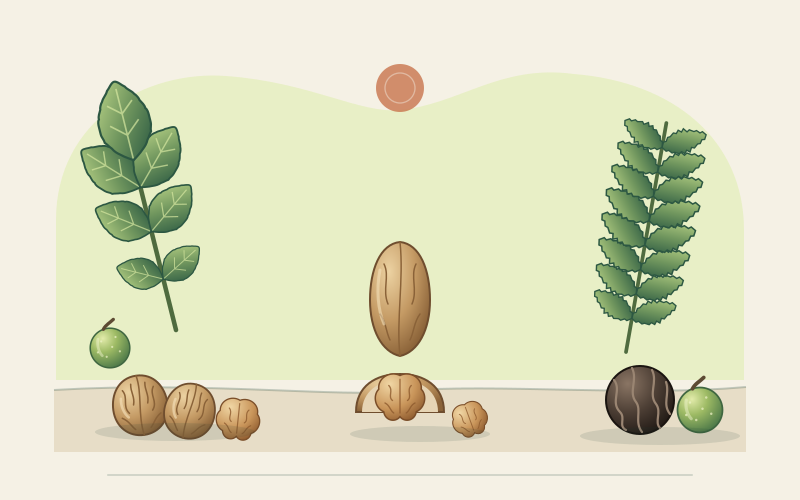
This guide concerns Juglans regia, called English walnut or Persian walnut in different markets. Neither common name describes a modern national origin, and both can refer to the same species. Named cultivars of J. regia differ in tree habit, flowering, leaf-out, maturity and nut characteristics, but they remain one crop entry in Rooted.
Black walnut, Juglans nigra, is a different North American species valued for timber and strongly flavoured kernels in thick, hard shells. Butternut, Juglans cinerea, is different again and faces serious conservation and disease concerns in parts of its native range. Hybrids and other Juglans species also exist. Do not transfer cultivar, pollination, harvest or nutrient information automatically among them.
“Carpathian walnut” is often used in nursery trade for cold-climate selections or strains of J. regia, rather than as a single universally defined cultivar. Ask for the actual clone or seed source, propagation method and documented performance. A regional adjective is not a substitute for winter records and a complete plant label.
Understand grafted cultivars and seedlings
A named grafted cultivar is clonally propagated so the fruiting top retains the selected parent’s characteristics. Its roots may belong to another seedling or clonal rootstock. This separation matters: the top determines the named nut and flowering traits, while the rootstock affects adaptation, vigour and response to some soil problems. A graft does not guarantee early bearing, immunity or compatibility with every site.
A seed-grown tree is genetically distinct from both parents. It can be valuable for breeding, locally adapted planting or eventual timber, but nut size, shell seal, flavour and bearing age may vary widely. Seed from an excellent cultivar does not grow into an identical copy of that cultivar. For a small garden where predictable kernel quality and a roughly four-to-seven-year first-crop window matter, healthy named grafted stock is usually the clearer starting point.
Inspect the graft union and ask which part is which. Shoots arising below the graft belong to the rootstock and should not be allowed to replace the selected cultivar. Conversely, a dead top does not mean a vigorous rootstock shoot will reproduce the lost nut type. Keep the original label, supplier and planting date with your garden records.
Put chill, leaf-out and maturity before kernel size
Winter chill is the cool dormant exposure needed for normal, even growth after winter. Requirements differ among cultivars, and regions calculate chill in different ways. Too little suitable chill can produce delayed or uneven bud break and poor flowering. Too much winter cold for the chosen stock can injure buds or wood. Ask for performance under local chill patterns rather than treating a number copied from another climate as complete advice.
Late leaf-out can help a cultivar avoid some spring frosts because tender growth appears later. It is relative, not a fixed date and not frost immunity. Female flowers and male catkins have their own vulnerable stages, and a late-leafing tree may still crop poorly if its flowering pattern does not overlap a polliniser or its nuts cannot mature before autumn. Conversely, an early cultivar can suit a site with unusually low spring-frost risk.
Early, midseason and late harvest describe relative nut maturity. Match them to the frost-free and dry-down season, not just to summer warmth. In a short season, a very late cultivar may retain green hulls or incompletely filled kernels when rain and cold arrive. In a warm site with dry autumns, late maturity may be acceptable. Record hull split and kernel quality over several years before judging a selection.
Read terminal and lateral bearing as growth patterns
Walnut cultivars differ in where fruitful buds occur. Terminal-bearing types produce most female flowers near the tips of shoots, while lateral-bearing types can fruit from a greater proportion of buds along the previous season’s shoots. Lateral bearing is often associated with precocity and cropping in younger or more compact orchard systems, but it does not remove the need for establishment or annual management.
Bearing habit affects pruning. Indiscriminate heading can remove fruitful positions or stimulate growth that changes the intended structure. A system designed for a terminal-bearing older cultivar cannot simply be copied onto a strongly lateral-bearing selection. Ask which training system was used in regional trials and how the mature canopy is renewed. “Dwarf” is also not a dependable walnut category: rootstock, pruning and site may restrict size, but many walnuts remain substantial trees.
Precocity is not the same as a guaranteed heavy early yield. Removing some early nuts or limiting crop load may benefit a small tree under local advice, while a tree that fruits heavily before establishing its scaffold can need support and thinning. Judge young-tree success by root and framework growth as well as by the first few shells.
Match male pollen and female receptivity
A walnut tree carries male catkins and separate female flowers, so “self-fertile” requires careful interpretation. If pollen is shed before or after the same tree’s female flowers are receptive, self-pollination may be limited even though both flower types are present. Protandrous describes pollen release generally preceding female receptivity; protogynous describes female receptivity generally preceding pollen release.
These tendencies help pair cultivars, but they are not absolute switches. Weather can compress, stretch or shift flowering, and some overlap may occur within one tree. The practical question is whether the exact cultivars overlap enough in your location. A polliniser must shed viable pollen when the main cultivar’s female flowers are receptive, not merely bloom in the same month.
Walnut pollen is primarily carried by wind. Nearby compatible trees, unobstructed air movement and an appropriate planting distance matter; adding beehives does not substitute for a flowering match. In an isolated garden, one tree may crop without a partner under some conditions, but reliable advice should come from observed local performance. Do not buy two unrelated late-leafing trees and assume they automatically pollinate one another.
Evaluate the shell and the kernel together
A large shell does not necessarily contain a large edible yield. Kernel percentage compares kernel weight with total in-shell nut weight; shell thickness and internal structure affect it. A thin shell can make hand cracking easier but may be more vulnerable to damage or a poor seal. The shell should protect the kernel from insects, mould and contamination through drying and storage, while still opening in the intended use.
Kernel colour, plumpness, ease of removing whole halves, flavour and freedom from shrivelling are separate traits. Light kernel colour is commercially important in some markets but does not by itself prove better flavour or nutrition. Strong flavour can be desirable in a home garden. A cultivar selected for mechanical orchard harvesting may not be the most convenient for a hand-cranked cracker, and a handsome exhibition nut may be late for a short season.
| Phrase | Mainly describes | Still ask |
|---|---|---|
| Late leafing | Relative spring bud development | Does flowering still meet late frost, and can nuts mature? |
| Lateral bearing | More fruiting positions along shoots | Which pruning system and young-tree crop load suit it? |
| Protandrous or protogynous | Relative male and female flowering sequence | Which partner overlaps here in real seasons? |
| High kernel percentage | Edible kernel relative to in-shell weight | Are shell seal, flavour and maturity also suitable? |
| Carpathian or hardy | A source, selection or relative cold claim | What exact stock and winter records support the claim? |
Use cultivar examples to ask better questions
Chandler is a widely planted J. regia cultivar associated with lateral bearing, relatively late leaf-out and high-quality kernels. Its reputation does not guarantee adequate pollination, disease performance or maturity everywhere. Hartley is an older cultivar commonly described as terminal bearing, with a different tree and nut profile. Franquette is a late-leafing, late-maturing French selection often encountered in discussions of pollination and traditional orchards.
Fernor and Fernette illustrate modern French cultivars whose flowering and bearing characteristics are considered together in some planting systems. Lara illustrates earlier-maturing, lateral-bearing selection. These are reference points for reading catalogues, not a ranked shortlist or a claim that any named polliniser pair transfers unchanged to another hemisphere or climate.
For each candidate, request independent local observations: winter injury, spring leaf-out, male and female flowering dates, hull split, shell seal, kernel fill, disease and actual yield. Compare several seasons rather than one exceptional year. A supplier should be able to distinguish verified cultivar traits from a general description of walnuts.
Do not overlook the roots below the graft
English walnuts may be grown on J. regia seedling roots, clonal own-rooted material where available, or hybrid rootstocks. Paradox commonly refers to hybrids derived from Northern California black walnut, Juglans hindsii, and J. regia; individual Paradox sources can vary, especially when seed propagated. Rootstock choice can influence vigour and response to soil-borne problems, but no rootstock corrects chronic waterlogging or every disease.
Ask why the rootstock is used locally, whether the graft combination has a good record, and what mature spacing it requires. In a home garden, a vigorous orchard rootstock may demand more room than expected. Where rootstocks are not specified, at least record that uncertainty and buy from a supplier who understands regional walnut culture. Never assume that rootstock sprouts have the named cultivar’s nuts or that a seedling label supplies information about the fruiting top.
Make the final choice with a short local trial
Start by ruling out stock that cannot satisfy your winter conditions, escape enough late frost or mature in your season. Next confirm flowering overlap and space for mature trees. Only then compare shell, kernel percentage, colour, flavour, cracking habit and intended use. This order prevents a beautiful kernel description from outweighing a tree that never sets a sound crop.
Where space permits, trial one or two locally promising grafted combinations and keep annual records. Note bud break, catkin pollen, female receptivity, frost damage, shoot growth, hull split, drying conditions and the proportion of well-filled kernels. Share food from the trial with clear walnut-allergen labelling. The growing guide covers the establishment and drying work that every cultivar still needs.