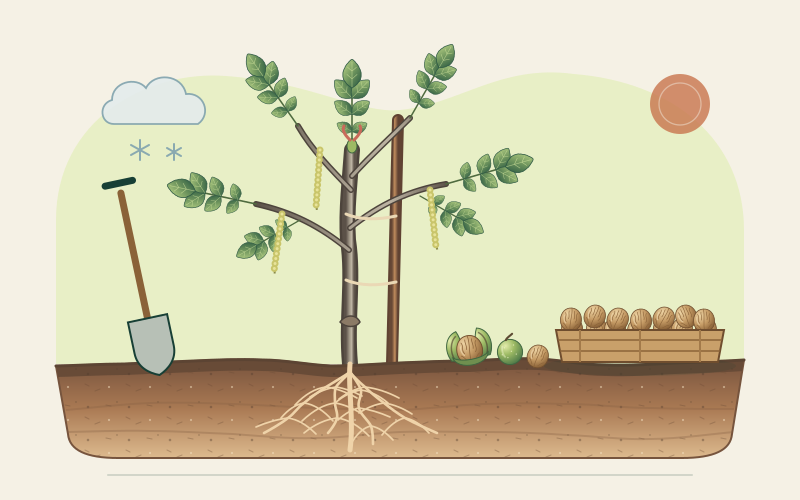
Plan for a perennial tree, not a fast annual
This guide concerns English or Persian walnut, Juglans regia, a long-lived deciduous tree with pinnate leaves and edible kernels enclosed first in a hard shell and then a fleshy green hull. It is not the same entry as black walnut, Juglans nigra, whose climate, timber use, shell and kernel characteristics differ. The planting should fit its mature crown, roots, shade and harvest access rather than the size of the nursery container.
A first meaningful crop commonly arrives four to seven years after planting a grafted young tree. That is a planning range, not a guarantee or a path to full production. A seed-grown walnut usually takes longer and its nut quality is not a predictable copy of a named cultivar. Frost, inadequate chill, drought, winter injury, weak roots, poor pollination or excessive pruning can delay bearing on any tree. Early years are successful when they produce sound roots, a straight trunk and strong scaffold branches, even if the nut bowl stays empty.
Match the site to chill, late frost and ripening heat
Choose full sun and deep, free-draining soil with room for a broad crown. A walnut needs a winter dormant period with enough chilling for even bud break, followed by a growing season warm and long enough to develop shoots and fill kernels. Chilling requirements differ among cultivars, and local methods for recording chill are not interchangeable. Rather than applying one universal hour total, ask regional advisers which cultivars flower and leaf evenly after your winters.
Late frost is a separate problem from winter cold. A tree can survive dormancy and then lose tender leaves, male catkins, female flowers or young nuts when a freeze arrives after bud break. Low frost hollows collect cold air; an open, gently elevated site with good air drainage is usually safer. Late-leafing cultivars can escape some spring frosts, but late leaf-out does not guarantee flower survival or timely autumn maturity. Northern and upland growers need both traits: delayed spring growth where possible and a crop that matures before autumn cold or persistent rain.
Allow air movement without choosing a wind-battered ridge. Strong wind can break poorly formed branches, dry young trees and complicate pollination and spraying where orchard management is used. Avoid waterlogged ground, severely compacted subsoil and shallow soil over an impenetrable layer. A mature root system is an asset only where the soil lets it explore.
Buy a named grafted tree and plan flowering overlap
A named cultivar provides information about relative leaf-out, bearing habit, nut maturity, shell and kernel that an unnamed seedling cannot. Grafting joins that cultivar to a root system, but it does not make every rootstock or cultivar suitable for every site. Buy healthy, traceable stock where plant-health certification is available, and check local restrictions on moving walnut plants or wood.
Walnut bears separate male and female flowers on the same tree. Male catkins release pollen; female flowers become receptive at a particular stage. In some cultivars these periods do not overlap enough for reliable pollination. Protandrous trees generally shed pollen before their female flowers are receptive; protogynous trees generally have receptive female flowers before their own pollen is shed. These descriptions help select compatible partners, but actual flowering shifts with weather and season.
Ask a nursery for documented local pollination advice, including whether the chosen cultivar crops adequately alone and which partner overlaps under local conditions. A second tree is not automatically necessary or sufficient: two cultivars with the same poorly overlapping pattern may not solve the problem. Position compatible trees within locally recommended distance, and avoid treating bees as the required pollen vector; walnut pollen is primarily wind dispersed. Our variety guide explains these catalogue terms in more detail.
Plant for the mature tree and protect the first roots
Plant during local dormancy when soil is moist but workable and not frozen or saturated. In severe-winter districts, spring planting may avoid exposing a new tree to the harshest months; in milder districts, autumn or winter planting can allow root growth before summer. Dig a hole wide enough to spread or accommodate the roots without bending them, and avoid creating a smooth-sided sump in poorly drained soil. Set the tree at the depth recommended by the supplier, leaving the graft union visible and positioned as advised.
Use a sound stake where wind or an unstable root ball requires it. Tie loosely enough to allow some trunk movement and thickening, inspect the tie often, and remove support when it is no longer needed. Fit a guard where rodents, deer or livestock are a real risk, while keeping it clear of trapped weeds and excessive moisture. Do not leave a label, wire or nursery tie to girdle the trunk.
Keep grass and weeds away from the young root zone without cutting surface roots. Mulch can buffer moisture and temperature, but keep it clear of the bark and do not bury the trunk. Water deeply when inspection below the surface shows need, then adjust for rain, soil texture, heat and tree age. Frequent shallow sprinkling encourages neither deep rooting nor good drainage. Containers and sandy soils dry faster; heavy soils can remain wet below a dry-looking surface.
Feed by evidence, water by need and prune with restraint
Test soil before making major pH or nutrient corrections. Excess nitrogen can drive soft growth, complicate training and increase susceptibility to some problems; deficiency can also restrict growth. Young trees do not need routine heavy feeding simply because they are not bearing yet. Observe shoot growth and foliage, use soil or leaf analysis where locally recommended, and seek diagnosis before treating yellow leaves. Yellowing can reflect waterlogging, drought, root damage, nutrient imbalance or disease rather than one fertiliser need.
Established trees still need adequate moisture during shoot growth and kernel fill, especially in dry-summer climates. Water stress can reduce nut size and kernel fill, while severe late stress can affect maturity. Direct irrigation to the soil rather than routinely wetting the canopy, and prevent standing water. Reduce unnecessary late-season lush growth where winter injury is a concern, but do not withhold water so severely that the tree declines.
Form a trunk and well-spaced scaffold branches using the training system recommended for your cultivar and region. Remove clearly dead, broken or rubbing wood, and avoid large heading cuts made without understanding the response. Walnut can bleed sap when pruned near spring growth, and heavy pruning delays rather than purchases a crop. Use clean, sharp tools, avoid pruning in wet conditions where local disease guidance advises against it, and consult an arborist for work at height or large limbs. Do not climb a young tree or improvise ladder work.
Diagnose tree problems and keep juglone claims in proportion
Walnuts can experience locally important insects, mites, blights, cankers, root disorders and other problems. Healthy stock, appropriate watering, moderate fertility, sound pruning and removal of infested or diseased material where recommended all matter, but no single cultural practice prevents every disorder. Record symptoms and obtain a diagnosis before choosing a legally available control. Any pesticide label must cover the site, crop and target, including timing and pre-harvest directions; avoid spraying during flowering or other periods when beneficial organisms could be harmed unless the label and local advice specifically support it.
Juglone is not a reason to describe a walnut as poisonously surrounded by dead ground. Walnut tissues contain juglone-related compounds, and sensitive plants can be injured when exposed through living roots, decaying roots or certain fresh plant residues. Black walnut is generally associated with greater juglone injury than English walnut. Sensitivity varies by plant species, and published lists are guides rather than universal outcomes.
Juglone can persist longer in cold, wet or poorly aerated conditions; soil organisms break it down more readily in aerated soil. Do not assume that every wilt, yellow leaf or dead vegetable beside a walnut proves juglone injury: shade, root competition, drought, waterlogging and disease can look similar. Keep known sensitive plants outside the root zone where practical, use a separate bed with its own soil and drainage where appropriate, and avoid fresh walnut leaves, hulls or wood as mulch around sensitive crops. Composting and ageing reduce concerns only when material is genuinely decomposed; they do not remove a living tree’s roots.
Harvest at hull split, then remove moisture promptly
Walnuts approach harvest when green hulls begin to split and the in-shell nuts separate or fall. Hulls need not be brown or fully decayed; waiting for a uniformly dark hull can sacrifice quality. Sample several nuts from different parts of the tree. A mature kernel should be well filled, with the internal packing tissue between shell and kernel becoming dry and brown as maturity advances. Actual timing follows cultivar, heat, elevation and seasonal weather.
Collect fallen nuts frequently so they do not remain on damp ground. Gentle shaking with suitable equipment can release mature nuts where locally practised, but avoid striking bark, breaking scaffold limbs or knocking down large quantities of immature fruit. Use stable ground-level tools where possible and never work beneath limbs being shaken. Wear gloves when handling hulls if you want to avoid brown staining; staining is not a measure of nut quality.
Remove loosened hulls promptly and rinse away adhering debris with clean water if needed. Do not leave hulled nuts wet in deep sacks or heaps. Spread them in a shallow layer on clean trays or screens, protected from rain, direct harsh heat, rodents and birds. A shaded, well-ventilated place or a controlled low-temperature dryer suits small harvests; follow current local preservation guidance for equipment and temperature. Do not oven-dry at high heat or assume a warm surface means a dry centre.
Drying is complete only when the kernel is no longer leathery and a cooled sample is crisp or brittle. Sample from several positions, because thick layers and still corners dry unevenly. Return sound under-dried nuts to the dryer, and discard mouldy, musty or otherwise doubtful material rather than mixing it into the batch. Drying delays encourage mould and reduce quality; decorative outdoor piles are not a storage method.
Store sound nuts and make the allergen visible
Let dried nuts cool before packing so warm residual moisture does not condense in the container. Pack only clean, sound nuts, label the crop and date, and inspect periodically for insects, moisture or off odours. In-shell nuts keep best cool, dark and dry. Shelled kernels have more exposed surface and should be sealed airtight; refrigeration or freezing extends quality, particularly in warm homes. Walnut oils can oxidise and become rancid even without visible mould, so smell and taste a tiny sample only when there is no allergy concern and no sign of spoilage. Discard rancid, musty or mouldy food.
Walnut is a tree-nut allergen. Home drying does not remove allergenic risk, and one person’s tolerance does not make a shared dish safe for another. Keep walnuts and tools used for them from creating unrecognised cross-contact where someone must avoid them. Label shared foods and gifts clearly. A person with a diagnosed walnut or tree-nut allergy should follow their clinician’s avoidance and emergency plan; this guide cannot decide which other nuts they must avoid.