Confirm the species before comparing names
Runner bean is Phaseolus coccineus. Common or French bean is P. vulgaris. Both can climb, both can bear long green pods and both can be described as pole or snap beans, so those everyday labels do not identify the species. Read the botanical name on the packet or supplier record, particularly when comparing flowering temperature, seed saving or dry-bean cooking.
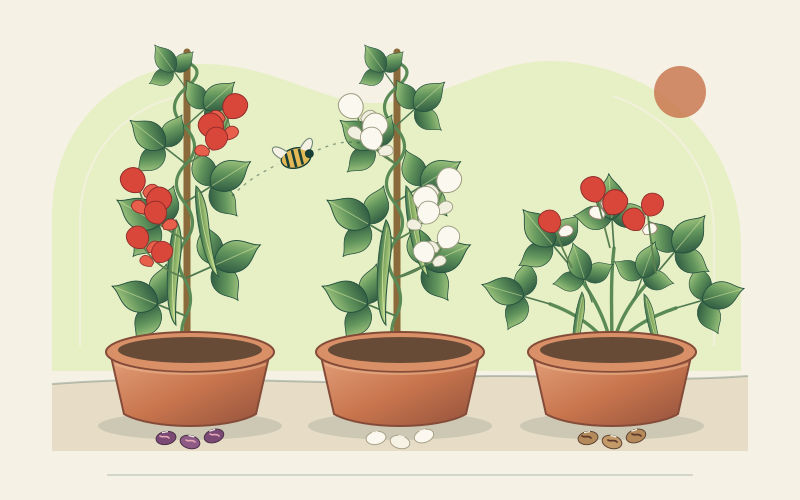
The species name coccineus means scarlet, but not every runner bean has red flowers. White, pink, salmon and red-and-white forms occur. Mature seeds may be white, black, purple, brown or mottled. Flower colour is useful for identification and ornamental value, but it does not by itself establish tenderness, maturity or dry-seed cooking quality.
Habit and harvest are separate choices
Climbing and dwarf describe the plant
Climbing runner beans produce long twining stems and need a secure support. They use vertical space and can continue flowering and yielding over many weeks when young pods are picked regularly. Their frame must bear the mature vines and local wind, and enough warm season must remain for the intended harvest. Pinching growth above the support keeps plants more manageable.
Dwarf runner beans stay much shorter and suit containers, small beds and exposed sites where a tall frame is impractical. They generally produce a smaller, earlier crop. Short twiggy branches can still keep pods off the soil. “Half-runner” and intermediate descriptions occur, so follow the supplier’s mature-height and support advice rather than assuming a rigid two-category division.
Snap and dry describe the harvest
Snap types are selected for whole young pods with acceptable tenderness and, in many modern cultivars, reduced seam strings. Pick before the seeds swell. A cultivar described as stringless can still become coarse when old. Dry-seed types are left to mature fully and may be selected for seed appearance, size and cooking character. Many traditional climbers are dual-purpose, but every pod left for seed reduces the plant’s incentive to make more flowers.
A first snap harvest can occur around 60–100 days after sowing under favourable conditions; mature dry seed commonly takes about 120–150 days. This makes an early cultivar especially valuable for dry seed in a short season. Heat, cool soil, day length, water and transplanting shift the figures.
Named cultivars are starting points, not universal winners
The following familiar names illustrate catalogue language. Selections and availability vary among suppliers, and local trial results matter more than fame. Confirm that each packet identifies P. coccineus or clearly describes an interspecific selection.
| Cultivar | Habit and flowers | Usual use and selection note |
|---|---|---|
| Scarlet Emperor | Tall climber; scarlet flowers | Traditional long green pods for young harvest; mature mottled seed can also be saved |
| Painted Lady | Tall climber; red-and-white flowers | Ornamental heirloom with edible young pods and mature seed; protect seed purity if saving |
| White Lady | Tall climber; white flowers | Young green pods; typically pale mature seed, with supplier-specific quality claims |
| Stardust | Climber; pale flowers | RHS-described runner/common-bean hybrid and self-fertile selection for pod production |
| Hestia | Dwarf; bicoloured flowers | Compact early snap crop for containers or small beds; only short support needed |
“Self-fertile” does not mean isolated from bees or incapable of crossing. It means the cultivar may set without the same pollen-transfer requirement associated with many older runner beans; it does not guarantee pure saved seed. Likewise, a hybrid’s common-bean ancestry does not make its cooking instructions interchangeable with every common bean.
Seed saving needs two levels of crossing caution
Runner cultivars cross readily with one another
Runner bean is predominantly cross-pollinating, with bees moving pollen among flowers. Different runner cultivars growing within pollinator range can therefore produce seed with mixed parentage even when the pods and seeds on the mother plant look normal. The clearest unexpected variation may appear only when that saved seed grows the following generation.
For a named cultivar, use the isolation distance recommended by a trusted local seed-saving organisation or isolate flowers within insect-proof cages or bags and hand-pollinate. Garden Organic’s heritage-seed guideline recommends 800 m between runner varieties to be certain of purity; that is a conservative programme recommendation, not a promise that a shorter distance is safe or that every garden needs the same system. Grow enough healthy plants to maintain diversity, remove off-types before flowering and keep generations clearly labelled.
Do not treat common bean as an absolute genetic barrier
The main everyday crossing risk is among runner cultivars, but runner bean and common bean are not completely incapable of hybridising. PROTA reports that crosses can be made with common bean as the female parent and that natural hybridisation may occur where the species grow together; progeny can have reduced fertility. This is not a claim that every adjacent row crosses freely. It is a warning not to use species difference alone as proof of breeding-grade purity.
Some modern cultivars, including Stardust, intentionally have runner/common-bean ancestry. If you are maintaining a heritage line, breeding or exchanging seed as a named variety, keep detailed parentage records and use a deliberate isolation plan. If you simply want pods for dinner, crossing does not make this year’s pods unsafe or inedible; it matters to the plants grown from saved seed and to the accuracy of the name attached to it.
Let the plot make the final selection
Match cultivar to your season and structure. A tall, late dual-purpose heirloom may excel in a mild, moist garden but fail to mature dry seed where autumn frost is early. A dwarf snap cultivar may be the better choice for a windy terrace. In hot districts, compare actual pod set rather than counting flowers. In tropical highlands, day-length adaptation and locally healthy seed are particularly important.
If space permits, trial two cultivars on the same support design. Record sowing and emergence dates, first flower, first usable pod, pod set during hot spells, eating quality, disease and mature-seed date. Repeat promising choices before relying on them. Our growing guide covers the frame, moisture and harvest routine that make such a comparison fair.
Sources and variety references
- Royal Horticultural Society: Runner bean habits, cultivars and growing guidance
- PROTA / Pl@ntUse: Phaseolus coccineus variation, pollination and interspecific hybridisation
- Garden Organic: Seed Saving Guideline No. 7, Runner Beans
- Schwember et al., 2017, hosted by UC Davis: Unravelling agronomic and genetic aspects of runner bean
- Meglič et al.: Morphological seed characterisation of common and runner bean germplasm