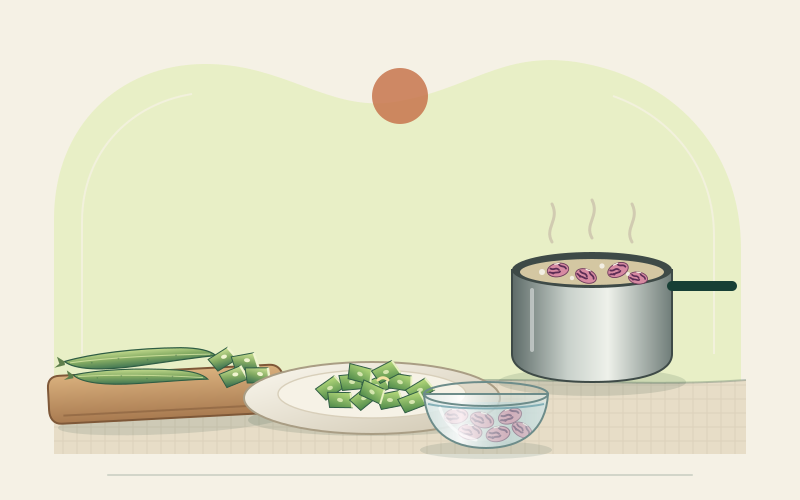
Start with the exact food and preparation
The runner bean crop profile uses USDA FoodData Central SR Legacy 168534, “Beans, snap, green, cooked, boiled, drained, without salt.” The values below are per 100 g of the cooked edible food after boiling and draining. They do not describe raw dry seed, fresh shelled seed, a canned product or a fried dish with added ingredients.
| Nutrient | Amount per 100 g cooked |
|---|---|
| Protein | 1.89 g |
| Fibre | 3.2 g |
| Folate | 37 µg |
| Iron | 0.8 mg |
| Potassium | 146 mg |
| Vitamin C | 12.2 mg |
| Vitamin K | 47.6 µg |
This is an exact, traceable cooked green snap-bean reference, but it is not a laboratory analysis specific to Phaseolus coccineus. Rooted uses it as the closest clear cooked-pod comparison and assigns an editorial nutrient-density rank 2 of 4, Moderate. That qualitative label concerns protein, fibre, folate, iron and potassium in the site’s cooked-food comparison; it is not an official score or a claim that one vegetable is best.
A separate species-specific reference illustrates why the basis matters. PROTA reports per 100 g raw runner-bean green pods, ends and sides trimmed: 91.2 g water, 1.6 g protein, 2.6 g fibre, 1.2 mg iron and 18 mg vitamin C. Those raw values come from a different source and food preparation, so they must not be mixed into the cooked USDA table or read as a before-and-after cooking experiment.
Do not transfer pod values to dry seeds
A young snap pod contains a large amount of water and is eaten with its pod wall. Mature dry seed has a different composition and is usually soaked and cooked before eating, taking up water in the process. Protein, fibre and minerals per 100 g therefore differ sharply among raw pods, cooked pods, raw dry seed and cooked dry seed. “Runner beans” without those qualifiers is not an adequate nutrient basis.
Cooking method matters too. Boiling and draining can move water-soluble nutrients into cooking water, while frying or adding oil, salt or sauces changes the final dish. Cultivar, pod age, seed maturity, storage and serving size also alter intake. Listed nutrient content is not the amount a person absorbs, and this article does not diagnose or treat a deficiency or any other condition.
Build a varied meal without a rigid formula
Add grains for a substantial, flexible meal. Rice, maize, barley or whole-grain bread contribute energy and their own protein and nutrients. Legumes and grains have different essential-amino-acid patterns that can complement one another across a varied diet. They do not need to be eaten in the same mouthful or even the same meal; adequate total food and variety across the day matter.
Include vitamin-C-rich produce alongside plant iron sources. Tomatoes, peppers, broccoli and citrus are practical choices. Vitamin C can support absorption of non-heme iron from plant foods in the meal, although the response depends on the whole diet and a person’s iron status. It does not create iron or guarantee prevention of deficiency.
Vary protein foods according to preference. Young pods alone provide modest protein per 100 g. Eggs, fish, yogurt, tofu or thoroughly cooked mature runner seeds can make the meal more substantial. No single accompaniment is essential. Try cooked pods with tofu and rice, dry runner beans with maize and tomatoes, or pods beside fish, potatoes and a pepper salad.
Keep fresh and dry harvests on separate paths
Young pods and fresh shelled seed
Pick young pods regularly while tender, refrigerate promptly in a clean container and cook before eating. Use them while quality is good; trimming and slicing expose more surfaces and are best done close to cooking. Fresh shelled seeds are perishable: shell with clean hands and equipment, refrigerate and cook thoroughly soon. Follow a tested recipe and local food-preservation guidance for freezing or canning rather than improvising a shelf-stable preserve.
Mature dry seed
Let seed mature and pods dry as far as weather permits, then finish under dry cover with strong airflow. Shell, remove debris and damaged seed, and continue drying until suitable for the intended storage period. Pack only fully dry, sound seed into clean food-safe containers, label the cultivar and year, and store cool, dark and dry. Inspect for condensation, insects, heating, odour and mould. Discard mouldy or doubtful lots; drying and storage do not make raw beans ready to eat.
Cook mature runner seed thoroughly
Raw or undercooked beans can contain phytohaemagglutinin and other antinutritional factors. PROTA specifically states that scarlet runner seeds must be cooked before eating. The FDA’s general bean precaution addresses phytohaemagglutinin and gives a minimum five-hour soak followed by at least 30 minutes of boiling in fresh water. The following conservative method applies that precaution to home-grown dry runner seed; commercially packaged instructions that provide a validated method should be followed.
-
Sort, rinse and soak
Spread out the dry beans. Remove stones and debris and discard mouldy or doubtful seeds. Rinse, then soak in plenty of cool water for at least five hours; a longer cool soak is commonly used. Keep the soaking conditions clean and cool.
-
Drain and use fresh water
Discard the soaking water and rinse the beans. Transfer them to a suitably sized pan with plenty of fresh water. Soaking, sprouting, drying or warming is not the cooking safety step.
-
Boil rapidly for at least 30 minutes
Bring the beans and water to a vigorous boil and maintain a rapid boil for at least 30 minutes. Keep sufficient water in the pan. Do not shorten this step because the beans appear soft, and do not rely on a low-temperature slow cooker for the initial destruction of phytohaemagglutinin.
-
Simmer until completely tender
After the rapid boil, reduce heat and simmer until the beans are fully tender throughout. Age, cultivar and soaking change total cooking time. Do not taste crunchy or undercooked beans to check progress. Once thoroughly cooked, use them in the intended dish and refrigerate leftovers promptly.
Commercially canned beans are already cooked and are not the same problem as raw dry seed. Use according to the label and handle leftovers hygienically. Young pods require ordinary thorough cooking as a vegetable; the 30-minute dry-seed precaution should not be confused with a required cooking time for every tender snap pod.
Keep the whole pattern in view
Runner beans can contribute fibre, folate, potassium and other nutrients as cooked young pods, or a different nutrient profile as thoroughly cooked mature seeds. Neither form is a medicine or a complete diet. Exact references are useful because they prevent false comparisons, not because a single 100 g table can determine what an individual should eat.
The practical approach is ordinary and repeatable: identify the harvest stage, cook appropriately, store it safely and combine it with varied grains, vegetables, fruits and protein foods that suit your needs.
Sources and specialist references
- USDA FoodData Central: Beans, snap, green, cooked, boiled, drained, without salt (SR Legacy 168534)
- PROTA / Pl@ntUse: Raw green-pod composition and the need to cook runner bean seed
- US Food and Drug Administration: Natural toxins in food, including bean phytohaemagglutinin
- NIH Office of Dietary Supplements: Iron fact sheet for consumers
- American Society for Nutrition: Protein complementation
- National Center for Home Food Preservation: Freezing snap beans