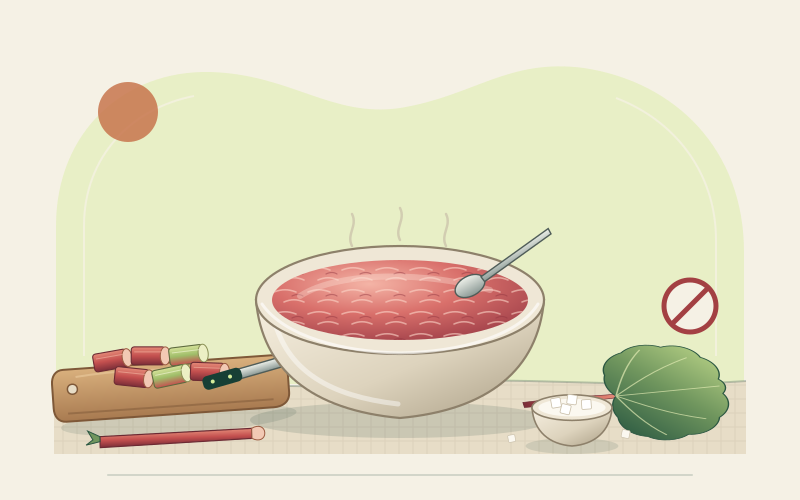
Start with raw stalks, not a sweetened dessert
Rooted gives rhubarb editorial nutrient category rank 2, “Moderate”. This is a qualitative site comparison centred on protein, fibre, folate, iron and potassium, with additional nutrients providing context. It is not an official score, a universal ranking of fruits and vegetables, or a reason to call rhubarb a superfood.
The exact reference is USDA FoodData Central SR Legacy 167758, “Rhubarb, raw”. The values are per 100 g raw, edible stalks, without added sugar or other ingredients. They are not values for cooked frozen rhubarb with sugar, canned rhubarb, jam, pie filling or a sweetened compote.
| Component | Amount per 100 g raw | Context |
|---|---|---|
| Energy | 21 kcal | Before sugar, fat or other recipe ingredients are added |
| Protein | 0.9 g | A modest contribution, not a protein-rich serving |
| Dietary fibre | 1.8 g | One source among grains, legumes, nuts, seeds, fruit and vegetables |
| Folate | 7 µg | A small amount compared with folate-rich legumes and leafy greens |
| Iron | 0.22 mg | Non-heme iron content, not an absorbed amount |
| Potassium | 288 mg | A useful mineral contribution within a varied diet |
| Calcium | 86 mg | Content is listed; oxalate can bind calcium and affect absorption |
| Vitamin C | 8 mg | Heat, water, storage and recipe preparation can change intake |
| Vitamin K | 29.3 µg | Relevant to normal vitamin-K-dependent processes; consistency matters with warfarin |
These are approximate database values for one defined food, not a laboratory reading of every stalk. Cultivar, growing conditions, maturity and portion size vary. The calcium figure is a particularly clear reason not to equate content with absorption: rhubarb contains oxalate, which can bind calcium. It should not be used as a stand-alone calcium plan.
Cooking changes the food and the comparison
Rhubarb softens readily and releases juice. Depending on the recipe, water may evaporate, liquid may be drained, or additional water may be added. One hundred grams of cooked rhubarb therefore need not represent the same starting quantity as 100 g of raw stalks. Heating can also reduce vitamin C and other heat- or water-sensitive nutrients, while the extent of loss depends on time, temperature and whether cooking liquid is consumed.
Added ingredients matter just as much. A plain stewed stalk compote, a syrup-packed frozen product and a slice of pie have different sugars, energy and nutrient profiles. Sugar is often used to balance rhubarb’s natural tartness, but the raw table cannot tell you how much was added. Read the recipe or product label rather than carrying “21 kcal per 100 g” across to the finished dish.
Cooking is nevertheless practical: it softens fibres, blends rhubarb with other ingredients and makes familiar compotes, sauces and baked dishes. There is no need to claim that raw is always superior or that cooked is nutritionally empty. Choose an enjoyable preparation and describe it on its own basis.
| Food on the plate | Can the raw USDA values be used unchanged? | Better approach |
|---|---|---|
| Raw trimmed stalk | Yes, as an approximate reference for that food | Weigh the edible stalk portion and account for actual serving size |
| Plain stewed rhubarb | No; water and heat change the comparison | Use a matching cooked record where available and retain recipe context |
| Compote with sugar | No | Include added sugar, yield and serving size |
| Pie or crumble | No | Assess the whole recipe, including pastry, fat, flour and sweetener |
The leaf warning is absolute
Never eat rhubarb leaves. Cooking, drying or juicing does not make them food. Utah State University Extension identifies high oxalic-acid concentrations in the leaves and warns that they can cause serious poisoning. Rhubarb leaves also contain other plant compounds, so the practical safety rule is broader than trying to calculate one chemical dose: discard the blade and use only the petiole.
Remove leaves in the garden or immediately after harvest, before stalks are stored with other food. Do not feed blades to livestock. Wash the edible stalks, trim damaged ends and prepare them with clean utensils. Composting discarded blades is different from eating them and is accepted in ordinary garden guidance.
Rhubarb’s botanical relationship to other Rheum species is not a reason to improvise with ornamental or medicinal rhubarb roots and leaves. This article concerns the stalks of culinary garden rhubarb, not herbal preparations or supplements.
Stalks are edible, not oxalate-free
Oxalate is a naturally occurring compound found in many plant foods. Rhubarb stalks contain it even though they are the accepted edible portion. Ordinary food guidance does not require everyone to avoid rhubarb, but it does rule out calling the stalks free of oxalate.
The US National Institute of Diabetes and Digestive and Kidney Diseases lists rhubarb among foods that people who have had calcium-oxalate stones may be advised to limit. That is not a prediction that eating rhubarb will cause stones in every person. Stone type, overall diet, fluid intake and individual medical history matter.
If a clinician or dietitian has given you a low-oxalate plan, ask how rhubarb fits rather than relying on generic claims that boiling solves the issue. Do not compensate by avoiding all dietary calcium without professional advice; NIDDK notes that appropriate food calcium can play a role in calcium-oxalate stone management. Individual recommendations should come from someone who knows your history.
Put the stalks into ordinary, varied meals
Rhubarb’s acidity pairs well with grains, dairy or fortified alternatives, nuts, seeds and other fruit. These combinations add flavour and different nutrients; none is a required nutritional formula. Because rhubarb is low in protein, let the rest of the meal supply protein according to preference and overall needs.
- Breakfast: spoon plain cooked rhubarb over oatmeal and add yogurt or a suitable fortified alternative. Account for any sweetener in the compote.
- Fruit combination: cook rhubarb with strawberries or apple, or flavour it with orange zest. The mixture’s nutrition reflects both fruits and every added ingredient.
- Dessert: use rhubarb in a crumble or pie as one enjoyable part of the diet, without assigning the raw-stalk nutrient values to the whole serving.
- Savoury sauce: cook a small amount with onion and spices to accompany beans, lentils, tofu or another protein-containing food, using a recipe suited to the desired flavour.
People taking warfarin are generally advised to keep vitamin K intake reasonably consistent rather than making sudden large dietary changes. Rhubarb does not need to be singled out as forbidden, but a major change in usual intake should be discussed with the anticoagulation clinical team. Never adjust a medicine dose yourself; other anticoagulants have different considerations.
Freeze with a tested method; do not improvise canning
For fresh storage, refrigerate trimmed stalks promptly and use them while firm and sound. Utah State University gives an indicative two-to-four-week refrigerator window, but damage and handling affect quality. Cooked leftovers need prompt cooling and refrigeration in clean containers.
The National Center for Home Food Preservation provides raw and preheated freezing packs. Its optional preheating is one minute in boiling water followed by prompt cooling; pieces can be packed without sugar, with appropriate headspace. Sugar syrup can affect flavour, colour and texture but is not the safety mechanism of freezing.
For room-temperature jars, follow a complete tested canning recipe with its jar size, headspace and altitude adjustments. Do not turn a compote recipe into a shelf-stable product by guessing a processing time, and do not assume sugar alone preserves a jar safely.