
Crop 047 / Rheum rhabarbarum

Plant a crown once, then harvest with patience.

Rhubarb rewards a permanent, well-drained bed with tart stalks each spring. Give a new crown its first year to establish, keep later pickings moderate, and remove every leaf: only the stalks are edible; the leaves are toxic.

Perennial planting
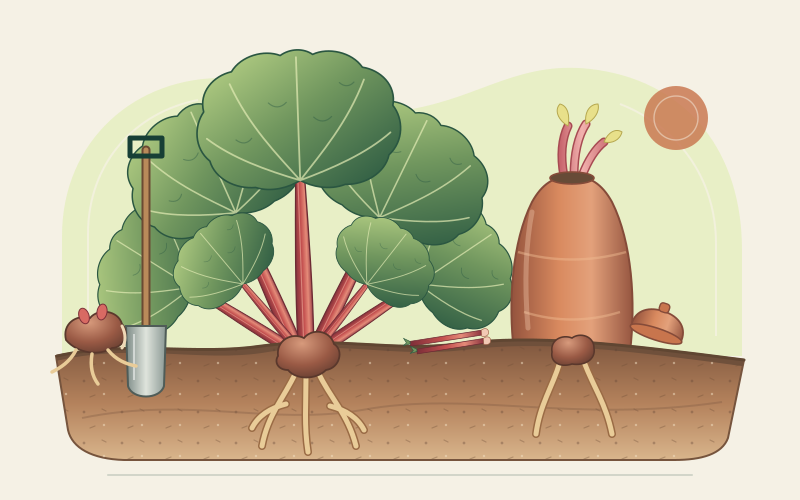
Crowns or divisions Set healthy buds with attached roots into a fertile, drained bed with room for a large clump.
Establishment and first harvest
1–2 years Take nothing in year one. A strong plant may allow a light second-year picking, or wait until year three.
Safe edible portion
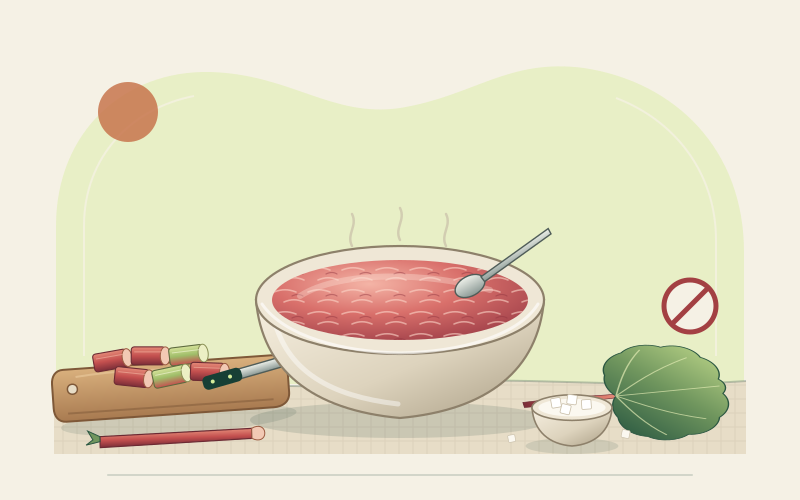
Stalks only Pull and twist the leaf stalk, then remove and discard the leaf blade before cooking.
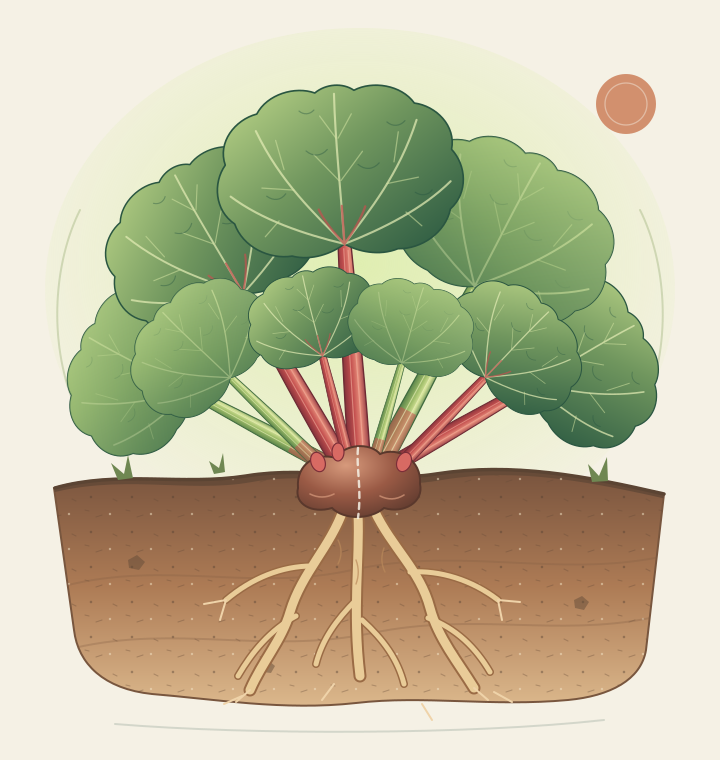
Mature rhubarb clump with red and green leaf stalks, broad toxic leaf blades, a divided crown and branching roots in a soil cutaway.
The edible stalk is the leaf’s petiole. The broad blade above it is toxic; below ground, buds and thick roots form the perennial crown.

Know the crop

Crop profile

A long-lived herbaceous perennial grown for tart leaf stalks, not leaves or roots. Rhubarb needs time to build its crown, a cool rest where the climate provides it, and enough foliage left after harvest to rebuild reserves.

Crop essentials

Botanical name
Rheum rhabarbarum
Growth
1–2 years to establish From planting a young crown or division. Do not harvest in the first year. Take only a light picking in the second year where local guidance permits, or wait until the third year; seed-grown plants generally take longer.
Family
Polygonaceae, the knotweed family
Origin
Temperate Asia, with culinary rhubarb developed through centuries of cultivation and selection in Europe
Habit
Long-lived herbaceous perennial with a dormant crown, large toxic leaves and edible leaf stalks

Food safety: never eat rhubarb leaves or feed them to livestock. Stalks contain oxalate too; people advised to limit oxalate should seek individual advice rather than assuming cooking makes an unrestricted serving suitable.

Nutrition / raw, unsweetened stalks

Nutrition, in context

Moderate Editorial nutrient-density rank 2. This is Rooted’s qualitative category for protein, fibre, folate, iron and potassium, with highlights adding context. It is not an official nutritional score or a universal ranking of vegetables.

Reference nutrients per 100 g rhubarb, raw, edible stalks only
NutrientAmount
Protein0.9 g
Fibre1.8 g
Folate7 µg
Iron0.22 mg
Potassium288 mg
  • The same raw 100 g reference provides calcium (86 mg), vitamin K (29.3 µg) and vitamin C (8 mg).
  • Protein, fibre and folate are modest; rhubarb contributes to a varied diet rather than carrying the whole meal.
  • Raw values are not interchangeable with stewed rhubarb, pie, jam or canned rhubarb with added sugar.

Basis: Approximate values per 100 g rhubarb, raw, edible stalks only (USDA FoodData Central SR Legacy 167758). This is an explicit raw, unsweetened basis, not a cooked value. Preparation, added ingredients and serving size change intake; listed content does not measure absorption or individual needs.

At the table

Cook the stalks, then build a varied meal

  • Oats, barley or other grains. Grains add their own fibre, energy and texture alongside tart rhubarb. Fold cooked rhubarb through porridge or serve it with an oat-based crumble, accounting for added sugar.
  • Yogurt, fortified alternatives, eggs or tofu. Rhubarb itself is low in protein, so a protein-containing food makes the overall meal more varied. Try compote with plain yogurt or a suitable fortified alternative.
  • Strawberries, apples or oranges. Other fruit can soften the sharp flavour and add different nutrients without making one combination essential. The final recipe, including sweetener, determines its nutrition.

The essentials

From a dormant crown to a spring harvest

Six practical stages for a perennial bed. Adapt timing, drainage and expectations to local cold, heat and rainfall.

  1. Choose a permanent site and healthy crown

    Rhubarb can occupy a bed for many years. Choose sun or light shade with fertile, moisture-retentive but free-draining soil and no prolonged standing water. Buy a healthy, disease-free crown or container plant; allow roughly 75–90 cm each way and room to reach the mature clump.

  2. Plant shallowly and let roots establish

    Plant dormant crowns during the locally recommended cool, workable season, or container plants in mild spring or autumn weather. Set buds at or just above the soil surface where RHS guidance applies, or no more than about 2.5 cm deep under other local systems. Water in, keep young plants moist without saturation, and take no stalks in year one.

  3. Mulch around, not over, the crown

    Use mature compost or another suitable organic mulch to conserve moisture and suppress weeds, leaving the buds exposed enough to avoid rot. Water young plants and containers during dry spells. Remove weeds and flower stalks at the base; use soil testing rather than routine heavy feeding.

  4. Pull stalks only, and leave enough leaves

    In year two, pick only a few stalks from a strong plant where local guidance permits; stricter extension advice waits two full years. On established plants, grasp a firm stalk near its base, pull and twist rather than leaving a cut stump, and take no more than about one third at once. Remove every toxic leaf blade before the stalk enters the kitchen.

  5. Divide a mature clump while dormant

    When an older clump becomes crowded or weak, lift it during local dormancy. Split healthy outer portions so each division has at least one strong bud and attached roots; discard soft or decayed tissue. Replant promptly at the original shallow depth and restart the establishment harvest rules.

  6. Force selectively, store safely

    For pale, tender early stalks, cover only a strong established crown with an opaque forcing jar in the locally cold season. Harvest after roughly four to eight weeks, uncover after that flush, and do not force the same plant in consecutive years. Refrigerate clean trimmed stalks promptly; freeze using a tested guide, and use a researched recipe for canning.

Growing notes by place

Read your region, then read your crown

Compare broad conditions, then adjust for winter chilling, summer heat, altitude, rainfall, drainage and the plant’s actual vigour.

Cool, temperate and often maritime, with winter chill and mild summers in many districts; exposed uplands and late-frost sites differ.

Northwestern Europe

Rhubarb is well suited to much of Britain, Ireland, the Low Countries and nearby areas. Wet crowns, late frost and local exposure matter more than a fixed regional calendar.

Indicative planting
Plant a healthy dormant crown from November–March while soil is workable, or a potted plant in spring or autumn. Keep the crown tip at or just above the surface and allow 75–90 cm between plants.
Indicative harvest
Take no stalks in the first year and only a few in the second where the plant is strong. From the third year, pull stalks mainly April–June, stopping by late June or early July to leave reserves for the crown.
Soil and moisture
Open sun or light shade with fertile, moisture-retentive but free-draining soil. Mulch around, not over, the crown and improve drainage on heavy ground.

Field note: Force only a strong established early cultivar in winter; check after four to eight weeks, return the crown to light after the forced flush and do not force it again the next year.
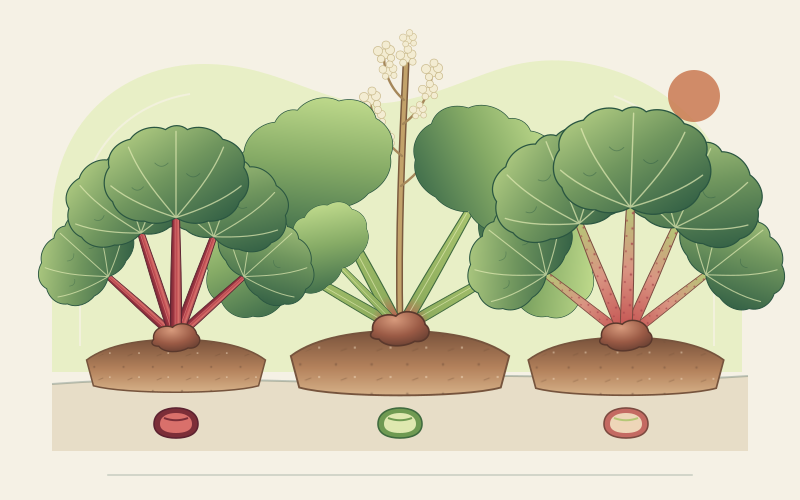
Dates are indicative. Local winter chilling, summer heat, frost forecasts, rainfall, drainage and recent plant growth—not the calendar alone—should guide planting and harvest.

Cool-temperate Northern Hemisphere · established bed example

A perennial rhythm

A compact planning guide, not a fixed schedule. Shift it with latitude, altitude, cultivar, dormancy and local conditions.

  1. January–March

    Plant or divide dormant crowns while soil is workable, avoiding frozen or saturated ground. Force only a healthy established clump; inspect covered stalks regularly and keep other beds clear of rotting old foliage.

  2. April–June

    Mulch around the crown, water young or container plants in dry spells and remove flower stems. Pull firm stalks from established plants, leaving at least two thirds at each picking. Remove all leaf blades immediately.

  3. July–September

    Stop ordinary harvest by late June or early July where that local guidance applies so the crown can rebuild. Water during prolonged drought, control weeds and do not force or heavily pick a stressed plant.

  4. October–December

    Let leaves die back naturally, then clear faded growth without burying the buds. Plant dormant crowns where locally recommended and plan division only for mature, overcrowded clumps during their normal rest.

New plants follow a different clock: no harvest in year one, only a light second-year picking where local guidance and vigour permit, then fuller harvests from year three. Seed-grown plants can take longer.

From the field journal

Plant, select and prepare your rhubarb

Practical reading for patient perennial harvests, cultivar choices and raw-versus-cooked nutrition without superfood claims.

Your next harvest begins here

Give one healthy crown a permanent home.

Prepare drainage before planting, let the first year belong to the roots, and learn the difference between a useful stalk and a leaf that must be discarded. Patient establishment is the beginning of many spring harvests.

Open the growing guide