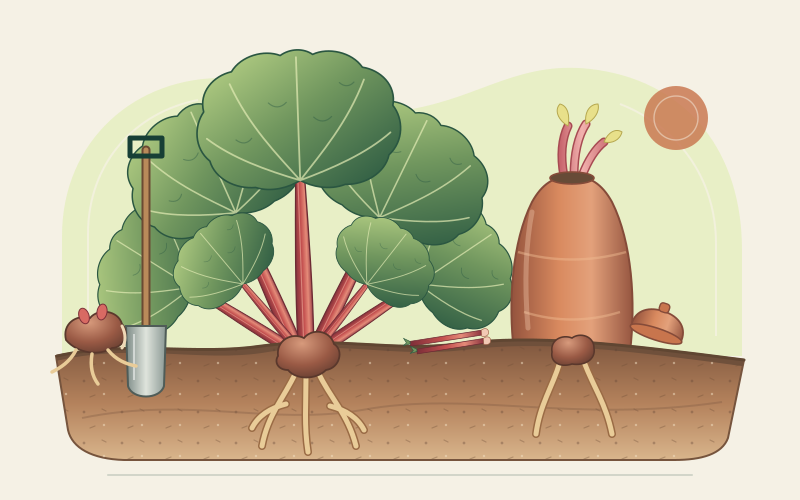
Plan for a clump, not a quick annual crop
Garden rhubarb, Rheum rhabarbarum, is an herbaceous perennial in the knotweed family. Its above-ground growth dies back in a cold-season dormancy where the climate provides one, while the crown and roots survive below ground. What cooks call a stalk is botanically the leaf’s petiole. The broad blade at its top is not edible.
A healthy clump can crop for many years, so choose its position before planting. Full sun or light shade suits many cool-temperate gardens. The soil should hold useful moisture without becoming stagnant; persistent wetness encourages crown and root rot. Allow roughly 75–90 cm each way, with more access room if needed, and do not squeeze the plant into a narrow annual-vegetable rotation.
Rhubarb’s traditional range does not make it universally reliable. Hot humid summers, saturated winter soil and inadequate winter chilling can all limit performance. In warm or tropical-highland climates, start with locally proven divisions and a small trial rather than assuming a European calendar will transfer.
Plant healthy crowns and protect the first year
-
Prepare the whole long-term root zone
Remove perennial weeds and loosen serious compaction while the soil is not wet enough to smear. Incorporate mature compost or apply it as a surface mulch according to your cultivation system. A soil test is a better basis for correcting nutrients or pH than a routine heavy feed. On ground that ponds, improve the site drainage or use a suitably raised bed; simply adding organic matter does not make a saturated hollow safe for crowns.
-
Choose a crown, division or container plant
Dormant crowns are sold with buds and thick roots. Divisions from a healthy mature clump preserve the parent’s traits, whereas seed-grown plants are more variable and often slower to reach cropping size. Obtain clean stock from a reputable supplier or a known healthy plant. Avoid soft, mouldy or decayed sections, and do not move unexplained disease problems between gardens.
-
Set the buds shallowly
Plant dormant crowns during the locally recommended dormant window while soil is workable, or container plants during mild spring or autumn conditions. RHS guidance places the crown tip, where leaves emerge, just above the soil surface. Utah State University guidance covers buds by no more than about 2.5 cm (1 in). Follow your supplier and local system rather than burying a crown deeply; excessive depth can delay establishment and encourage death or rot.
-
Water, mulch and wait
Firm soil around the roots and water thoroughly. Check below the surface during dry spells, especially through the first growing season and in containers. Mulch around the plant to conserve moisture and suppress weeds, but do not heap it over the buds. Harvest nothing in the first year. Those leaves are building the root reserves that later harvests will draw upon.
The first useful harvest depends on establishment
Rooted describes the establishment period as one to two years, not a guaranteed crop in exactly 365 days. The RHS advises no harvest in year one, only a few stalks in year two and normal harvest from year three. Utah State University gives the more cautious instruction not to harvest for the first two years, followed by a short third-year harvest. Both approaches protect a young crown; local guidance, planting size and visible vigour decide which is appropriate.
A light second-year picking means a few well-developed stalks from a strong plant, not a full six-to-eight-week harvest. A weak or small plant needs longer. From an established clump, take no more than about one third of the stalks at one time, and stop the main cool-temperate harvest by late June or early July where that guidance applies. Continuing to strip stalks late into summer leaves less foliage to restore the crown.
Remove flower stems at the base as they elongate. This avoids spending resources on seed production, but it is not a substitute for correcting poor drainage, drought, overcrowding or weak growth. Thin stalks can reflect youth, overharvesting, an ageing crowded crown, water stress or cultivar differences rather than a single deficiency.
Pull the petiole; never eat the blade
Rhubarb leaves are toxic. Only the stalks are edible. Do not cook, juice or feed the blades to livestock. Keep the distinction clear when children or unfamiliar helpers are harvesting, and remove blades before a bundle reaches the kitchen. The leaves can be composted under ordinary composting guidance; toxicity to eat does not make them a hazardous compost ingredient.
Choose firm, well-developed stalks, often around 25–38 cm (10–15 in) depending on cultivar. Grasp one low near the crown, then pull and twist sideways so it separates cleanly. Avoid cutting a stump at the base, which can leave tissue prone to rot. Harvest with clean hands and equipment, discard damaged or doubtful material, and do not include flower stems in an edible-stalk bundle.
The stalks themselves contain oxalate even though the edible portion is different from the toxic blade. Do not describe them as oxalate-free or promise that boiling removes oxalate. Anyone with a clinician-directed low-oxalate diet, including some people with a history of calcium-oxalate stones, needs individual advice on whether and how rhubarb fits.
Divide during dormancy, then restart the clock
Division is both propagation and renewal. Consider it when a mature clump becomes overcrowded or less vigorous, commonly after roughly five to ten years depending on the plant and site. Lift during the locally dormant period, either after top growth dies back or before strong spring growth resumes. Avoid working frozen or saturated soil.
Split the lifted crown into sections with at least one strong bud and healthy attached roots. Vigorous outer portions are often preferable to an old woody centre. Discard weak or decayed material and replant promptly at shallow depth with full spacing. If short-term holding is unavoidable, prevent roots drying out and follow supplier guidance; do not leave divisions packaged until they exhaust themselves.
A division is a new establishing plant even if it came from an old clump. Return to no first-year harvest and cautious second-year decisions. Propagating from a strong healthy plant also matters because division faithfully carries the parent—and potentially its problems—into every new piece.
Force an established crown, not a struggling one
Forcing excludes light so that stored crown reserves produce pale, tender stalks earlier than the outdoor crop. In a suitable cool-temperate climate, cover a strong established early cultivar with an opaque forcing jar, tall bucket or similar light-excluding cover in the locally cold season. Ensure the cover is stable and check it regularly. RHS guidance gives an indicative four to eight weeks to harvest after covering.
Pull the forced stalks, remove their blades as usual, then uncover the crown after that first forced flush so later leaves can photosynthesize. Do not force the same plant in consecutive years, and do not continue stripping it after the forced crop. Forcing draws heavily on reserves; it cannot improve a weak plant.
Indoor forcing by lifting and potting chilled roots is a more specialised and debilitating method. RHS notes that crowns forced this way are significantly weakened and usually discarded afterward. It is not the same as repeatedly covering a garden crown, and it should not be presented as a no-cost way to multiply harvests.
Cool the stalks and use tested preservation guidance
Rhubarb is best used fresh. Trim away all leaf material, wash the stalks before preparation, and refrigerate them clean and contained. Utah State University reports a typical refrigerated storage window of two to four weeks, but actual quality depends on maturity, damage and temperature. Use your senses and safe-handling judgement rather than treating that range as a guarantee.
For freezing, the National Center for Home Food Preservation advises choosing firm, tender, well-coloured stalks, washing, trimming and cutting to fit the package. It permits raw or preheated dry packs without sugar; its optional preheating step is one minute in boiling water followed by prompt cooling. Leave appropriate headspace, seal and freeze. Sugar syrup affects pack quality but is not what makes freezing safe.
Cooked compote and leftovers should be cooled and refrigerated promptly in clean shallow containers, not left indefinitely at room temperature. For shelf-stable jars, use a complete researched recipe with the specified acidification, jar size, headspace and altitude-adjusted process. Do not improvise a water-bath time from a stewing recipe or assume a sugar-heavy jam method applies to plain rhubarb.
Sources and further guidance
- Royal Horticultural Society: How to grow rhubarb
- Utah State University Extension: How to Grow Rhubarb in Your Garden
- NC State Extension Gardener Plant Toolbox: Rheum rhabarbarum
- National Center for Home Food Preservation: Freezing Rhubarb
- National Institute of Diabetes and Digestive and Kidney Diseases: Kidney stones—eating, diet and nutrition