Start with a named, healthy cultivar
This guide uses Rheum rhabarbarum for culinary garden rhubarb. Suppliers and botanical references may also use Rheum × hybridum, reflecting the crop’s cultivated hybrid history. A vendor’s common name is therefore not enough: buy from a reputable source, check the named cultivar and its described traits, and start with healthy, disease-free stock.
A crown division is a clone. With a suitable bud and roots, it preserves the parent’s stalk colour, harvest timing and general habit. This is useful when a neighbouring plant has demonstrated good flavour and local persistence. It is also why diseased or weak stock should not be shared: division does not select away the parent’s problems.
Seed-grown rhubarb is cheaper for raising many plants but is more variable and generally slower to establish. A packet carrying a cultivar name does not make every seedling identical to a vegetatively propagated crown. If uniformity, a known colour or a specific forcing season matters, a named crown or division is usually the clearer choice.
Stalk colour is appearance, not a sweetness guarantee
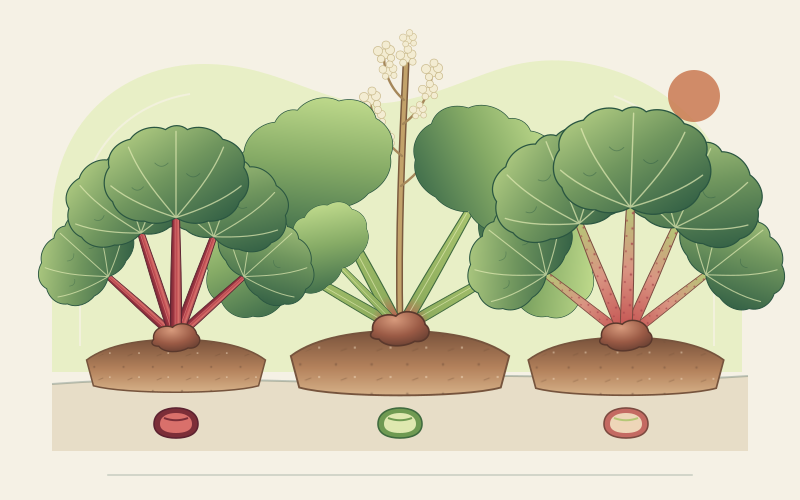
Cultivars range from deep red through pink to largely green, and colour can vary along one stalk. Light exposure, stalk age, growing conditions and cooking method also affect the final appearance. Forced stalks are typically pale because they develop without light; that does not create a new cultivar.
Red does not automatically mean sweeter, more tender or more nutritious. Rhubarb’s acidity and a cultivar’s flavour need to be judged in the kitchen. Green-stalked types can be productive and flavoursome even if their cooked colour is less dramatic. Likewise, red skin does not guarantee a red filling after heating or combining ingredients.
Choose colour for the use you actually have: bright slices for a tart, a familiar red compote, or a productive green type whose flavour you prefer. Then compare maturity, thickness, stringiness and season separately. No cultivar colour changes the safety rule: leaf blades are toxic, and only stalks are edible.
| Trait | What it can tell you | What it cannot guarantee |
|---|---|---|
| Red or pink stalk | Intended raw appearance and likely culinary presentation | Sweetness, low oxalate or colourfast cooking |
| Green stalk | A different appearance, often on vigorous traditional types | Poor flavour or lower productivity |
| Early cultivar | Earlier natural cropping or suitability for forcing | A crop in year one or reliable forcing without chilling |
| Thick stalk | Potentially heavier individual harvests | Tenderness at every age or freedom from fibres |
Match early, midseason and late crops to the site
Early cultivars begin growth and reach harvest sooner under their normal cool-temperate conditions. They are the usual candidates for garden forcing, but still need an established crown and adequate dormancy. In a late-frost pocket, very early growth may be more exposed to damage; forcing is not a universal solution to that risk.
Midseason and late cultivars can spread the harvest and may be useful where early shoots repeatedly suffer frost. “Late” does not mean the plant can be stripped through high summer. Harvest still needs to leave enough foliage for crown reserves, and local heat can end useful production regardless of catalogue timing.
Flowering tendency is another practical trait. Some cultivars produce seed stems more readily, and those stems should be removed at the base. Frequent flowering can also be associated with age, stress, excessive nitrogen or seed-raised variability. Select a lower-flowering cultivar where reports are locally credible, but do not treat a catalogue claim as immunity.
Useful cultivars as starting points
The examples below are documented garden cultivars, not universal recommendations. Names and synonyms vary between suppliers. Confirm current availability and local trial evidence before planting a permanent bed.
| Cultivar | Stalk and season notes | Selection question |
|---|---|---|
| Timperley Early | Early type widely recommended for outdoor and forced crops | Is early growth an advantage at your frost-prone site? |
| Victoria | Traditional productive type, often green with red or pink colouring; later than early forcers | Are its reported vigour and flowering tendency acceptable? |
| Valentine | Deep red stalks and classic flavour; colour reported to hold in processing | Is a red culinary type available as verified local stock? |
| Canada Red | Also listed with names such as Chipman’s Canada Red; red colour suited to processing | Which synonym and performance does the supplier actually document? |
| Crimson Red | Bright red, flavourful and commonly described as less stringy | Does local experience confirm its vigour and flowering habit? |
RHS recommended-cultivar lists and university extension variety tables are more useful starting points than a single garden centre description. They still cannot predict every site. In short-season, hot or humid districts, regional survival and crown health matter more than winning a colour comparison.
Select for forcing only after selecting for survival
A forcing cultivar is not a separate botanical species. It is a cultivar whose timing and growth suit early production. ‘Timperley Early’ is one RHS example. Whatever name you choose, the plant must first establish under the ordinary rules: no first-year harvest, a cautious second year where permitted, and enough mature crown reserves to support an early flush.
Forcing works with dormancy and stored reserves, not by creating warmth and growth from nothing. In climates without adequate chilling, covering a crown may produce weak or disappointing results. Do not import a forcing schedule into a tropical highland merely because nights feel cool. Observe whether the plant naturally dies back, rests and resumes strong growth, and seek local experience.
Even an ideal forcing cultivar should not be forced in consecutive years. After the forced flush, remove the cover and return the plant to light. A cultivar label never overrides crown health.
Run a small perennial trial before filling the bed
Because rhubarb occupies ground for years, a little observation is worthwhile. If space allows, compare two locally available cultivars under the same soil and watering conditions. Label them clearly and record planting date, first spring growth, natural harvest window, stalk colour and thickness, flavour after cooking, flower-stem frequency, summer decline and any rot or unexplained collapse.
Do not judge productivity by harvesting young plants heavily. Keep establishment rules consistent and compare mature crowns only after they have had time to develop. A plant that looked vigorous in its first leafy year may still be unsuitable if it rots in seasonal rain or fails to resume growth after an inadequate dormant period.
Once you find a healthy, flavoursome plant that persists, division provides a practical way to preserve it. Our growing guide explains how to lift and split a dormant crown, replant shallowly and restart the establishment harvest clock.