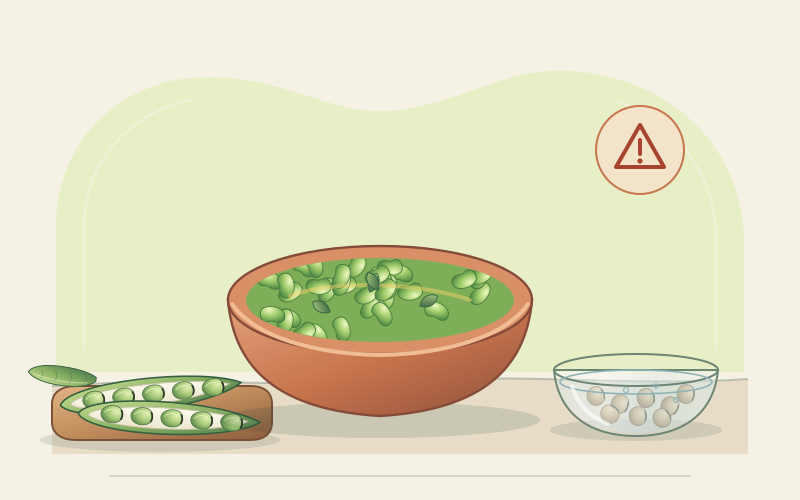
Start with the exact cooked reference food
Broad beans, Vicia faba, can be harvested as very young pods, fresh green seed or mature dry seed. They can later be boiled, stewed, pureed, frozen or canned. Those forms are not nutritionally interchangeable. Dry seed contains little water; boiling changes its weight and nutrient concentration per 100 grams. Salt, oil, other recipe ingredients and canning liquid change the comparison again.
The table below is deliberately specific: 100 g of mature broad beans (fava beans), cooked by boiling without salt, from USDA FoodData Central SR Legacy 173753. These are approximate values for that reference food, not raw dry seed, fresh immature beans or a prepared recipe. Cultivar, cooking time, water uptake and serving size introduce variation.
| Nutrient | Amount per 100 g | Meal context |
|---|---|---|
| Protein | 7.6 g | Total intake and the day’s other protein foods still matter |
| Dietary fibre | 5.4 g | Other pulses, grains, vegetables, fruits, nuts and seeds also contribute |
| Folate | 104 µg | A food-content value, not an absorbed or supplemental dose |
| Iron | 1.5 mg | Plant-food non-heme iron; absorption varies with the meal and the person |
| Potassium | 268 mg | One mineral contribution within the wider diet |
Rooted gives this cooked reference editorial nutrient-density rank 3, “High.” That qualitative category considers protein, fibre, folate, iron and potassium among the site’s crop entries, with highlights adding context. It is not an official USDA score, a universal pulse ranking or evidence of a medical effect. Do not apply these numbers to 100 g of raw dry broad beans or to a stew containing many other ingredients.
Favism: people with G6PD deficiency must avoid fava beans
Fava beans can trigger haemolytic anaemia in people with glucose-6-phosphate dehydrogenase (G6PD) deficiency, a reaction called favism. In this inherited condition, red blood cells can break down faster than the body replaces them after particular triggers. MedlinePlus identifies eating fava beans as one such trigger.
People with G6PD deficiency, and those told by a qualified clinician to avoid fava beans because of susceptibility, must not eat them. Cooking, soaking, drying, fermenting, removing the seed coat or choosing another cultivar does not make fava beans safe for susceptible people. Do not use a small taste as a test.
Symptoms associated with this haemolytic reaction can include paleness, yellowing of the skin or eyes, dark urine, fatigue, shortness of breath and a rapid heartbeat. Anyone experiencing concerning symptoms after eating fava beans needs urgent medical assessment. Individual prevention or testing advice belongs with a qualified health professional; this article cannot identify whether an untested person has G6PD deficiency.
Put protein, fibre, folate and iron in context
Protein complements grains without a same-meal rule
Cooked broad beans provide protein, and their amino-acid pattern can complement that of cereal grains. Pulses generally supply proportionally more lysine, while grains generally supply proportionally more sulfur-containing amino acids. Rice, barley, wheat and other grains are therefore useful companions, but the pulse and grain do not need to appear in the same mouthful or at the same meal. Varied protein-containing foods across the day can do that work.
A pairing does not guarantee adequate protein. Energy intake, portions, overall variety and individual needs still matter. Use combinations because they make enjoyable, practical meals, not because every plate requires nutritional arithmetic.
Fibre and folate belong to the whole diet
The reference food contributes dietary fibre, but other pulses, intact grains, vegetables, fruits, nuts and seeds bring varied fibres and additional nutrients. A broad-bean dish does not make those foods redundant. Large abrupt dietary changes can be uncomfortable for some people, so ordinary portions and gradual variety are more sensible than chasing a single-food target.
The folate value describes the boiled food. It is not equivalent to a folic-acid supplement dose and does not address individual requirements during growth, pregnancy, illness or medicine use. People with specific dietary needs should seek qualified individual advice.
Vitamin C can support non-heme iron absorption
Broad beans contain non-heme iron, the form found in plant foods. Its absorption varies with iron status and other meal components. A vitamin-C-rich vegetable or fruit eaten alongside the beans can enhance non-heme iron absorption. Tomatoes, sweet peppers, cabbage, broccoli and citrus are flexible options.
Vitamin C does not create iron or guarantee prevention of deficiency. Diagnosed deficiency, persistent symptoms or concerns about absorption require professional assessment rather than self-prescribed iron based on a food table.
Prepare fresh and dry broad beans by different routes
Fresh pods and green seed
For a fresh shelling harvest, split or cut open the pod and remove the seeds. The inner pod lining and mature pod walls are not the edible portion in a normal shelling harvest. Very young, tender pods can be cooked whole when deliberately harvested at that stage. Boil or steam shelled fresh beans until tender before eating. Large beans may have a tough outer seed coat; slipping it off after cooking can improve texture, but this is optional for most people and does not address favism risk.
Refrigerate fresh pods and shelled seed promptly. For freezing, follow a reliable vegetable-freezing method: blanch, cool rapidly, drain and dry, pack in suitable containers and keep frozen. Frozen or chilled broad beans remain perishable once thawed or cooked. Refrigerate leftovers promptly in clean covered containers and follow local food-safety guidance for storage time.
Mature dry seed
-
Sort and rinse
Spread out the dry seeds and remove stones, pod debris and damaged material. Discard mouldy, insect-damaged or doubtful seed. Rinse sound seed in clean water. Garden seed treatments and planting instructions are not food-preparation methods.
-
Soak if using that method
Cover generously with cool water and soak for about 8–12 hours, or follow a reliable package method. Keep the container clean and cool; refrigerate if the kitchen is warm. Drain, discard the soaking water and rinse. Soaking is not cooking. Unsoaked seed can be cooked by another sound method but generally takes longer.
-
Boil in fresh water until fully tender
Cover the drained beans with fresh water, bring to a boil and continue boiling or simmering until the centres are completely tender. Seed age, size, soaking and equipment affect timing, so use texture rather than a rigid timer. Follow the manufacturer’s fill limits and safe-opening instructions if using a pressure cooker.
-
Cool and store cooked food promptly
Drain for a salad or use the cooking liquid in the dish if desired. Refrigerate leftovers promptly; do not leave a pot at room temperature for an extended period. Salt, oil and other ingredients in the final dish change its nutrient profile away from the plain reference values.
Build ordinary meals with grains and vitamin-C-rich produce
These combinations are flexible examples, not prescriptions. Grains contribute their own protein, carbohydrate, fibre and micronutrients; vegetables and fruits add flavour, texture and vitamin C. The grain can be eaten at another meal, while the vitamin C source is most useful alongside the plant-iron-containing food.
| Grain base | Broad bean dish | Vitamin-C-rich addition |
|---|---|---|
| Rice | Broad bean and vegetable stew beside rice | Tomatoes, broccoli or a pepper salad |
| Barley | Broad beans folded through barley and greens | Lemon, tomatoes or steamed broccoli |
| Wheat | Broad bean puree with wholegrain flatbread | Tomato and cucumber salad or lemon |
| No required grain | Broad bean, carrot and cabbage soup | Sweet peppers, tomatoes or fruit afterwards |
Keep the whole pattern in view: properly cooked broad beans for people who can safely eat them, grains enjoyed across the day, varied vegetables and fruits, and other protein sources as appropriate. “Made with fava beans” never overrides the G6PD warning, and no recipe turns this pulse into a treatment.
Sources and specialist references
- USDA FoodData Central: Broadbeans (fava beans), mature seeds, cooked, boiled, without salt (173753)
- MedlinePlus Genetics: Glucose-6-phosphate dehydrogenase deficiency
- NIH Office of Dietary Supplements: Iron fact sheet for consumers
- NIH Office of Dietary Supplements: Vitamin C fact sheet for consumers
- Royal Horticultural Society: Broad bean harvest stages