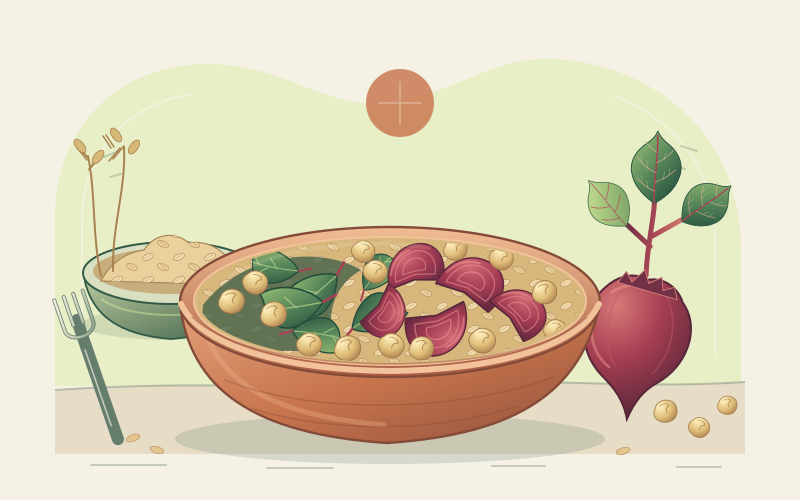
Do not give the root and leaves one nutrient profile
Garden beetroot, Beta vulgaris, supplies a swollen root and leafy tops. They share a plant but not a nutritional identity. The root is a firm vegetable with natural sugars, fibre, folate, potassium, and smaller amounts of other nutrients. The leaves behave more like other cooked dark greens, with a different balance of vitamins, minerals, water, and fibre. A value for cooked beet roots cannot simply be applied to cooked beet greens.
“Raw”, “boiled”, “roasted”, and “steamed” are not interchangeable database entries either. Cooking changes water content, portion weight, and some nutrient concentrations. Vitamins such as folate and vitamin C can be lost through heat or into cooking water, while fibre and minerals are not destroyed by ordinary cooking in the same way. Boiling in water that is discarded has different consequences from roasting or using the cooking liquid in a soup.
For a meaningful comparison, start with a reliable food-composition database, select the correct plant part and preparation, and compare the amount actually served. Variety, maturity, soil, storage, and laboratory method introduce further variation. Exact figures belong to particular samples and portions, not to every beet from every garden.
Folate, fibre, potassium, and the cooked portion
Folate is a B vitamin involved in making DNA and in cell division. Beet roots contribute folate, and greens provide their own amounts; beans, peas, other vegetables, and fortified grains can contribute to the wider diet. Folate needs vary by life stage, and folic acid from fortified food or supplements is handled differently from naturally occurring food folate. A serving of beetroot should not be presented as a substitute for targeted advice where folic acid is recommended.
Dietary fibre is found in the intact root and the greens. Whole cooked beets retain their fibre even when soft, whereas juicing commonly removes much of the insoluble plant structure. A juice serving is therefore not nutritionally equivalent to eating the whole root, even if both begin with beets. Fibre intake still depends on the portion and on other grains, legumes, vegetables, fruits, nuts, and seeds eaten across the day.
Potassium occurs in roots and greens and remains part of their mineral contribution after cooking, although some can move into cooking water. Beetroot also provides varying amounts of manganese, magnesium, iron, and vitamin C; greens are notable for a different profile that can include vitamin K and carotenoids the body can use to make vitamin A. These are useful contributions, not reasons to describe the crop as a cure or to overlook the rest of the meal.
| Plant part | Nutrition context | Preparation context |
|---|---|---|
| Roots | Fibre, folate, potassium, carbohydrate, and other nutrients | Water and nutrient losses vary by cooking method |
| Greens | Leafy-green profile, including folate, potassium, vitamin K, and carotenoids | Volume shrinks markedly; compare cooked portions |
| Juice | Depends on ingredients and processing; usually lacks the whole root’s intact fibre | A drink or concentrate is not the same serving as cooked beets |
Rooted’s crop comparison places beetroot in the High, density rank 3 editorial nutrient category. This is qualitative shorthand for comparing crops on a common cooked basis, not an official score, a medical recommendation, or a universal ranking. It does not collapse roots and greens into one food or imply that rank 3 suits every dietary need.
Put dietary nitrate claims on a short leash
Beetroot and leafy vegetables can contain substantial naturally occurring nitrate. Its amount varies with cultivar, growing conditions, plant part, maturity, storage, and preparation. In the body, dietary nitrate can enter a pathway that produces nitric oxide, a signalling molecule involved in blood-vessel function. That biochemical pathway is real; it does not establish a guaranteed outcome from an ordinary serving.
Research often uses measured quantities of beetroot juice or concentrated products under particular study conditions. Those preparations cannot be assumed to match a home-cooked portion, and results in a defined group cannot be extended to everyone. Accordingly, this guide makes no promise that beetroot will lower blood pressure, improve endurance, or enhance athletic performance. Food is not a replacement for prescribed treatment or an individual training plan.
Nitrate is neither an automatic reason to avoid vegetables nor a reason to consume concentrates indiscriminately. Overall dietary pattern and food safety matter. People with a medical condition, those using medicines affected by dietary changes, and anyone considering a concentrated supplement should seek advice from a qualified health professional.
Build meals with beans, grains, and other produce
Beetroot is best used as one component of a varied plate, not as a stand-alone nutritional solution. Beans and lentils add protein, fibre, and their own folate and minerals. Whole or refined grains add energy and varying protein, fibre, and micronutrients; enrichment and fortification differ by product and country. Additional vegetables and fruit broaden texture, flavour, and nutrient variety.
| Base | Beetroot addition | Other produce |
|---|---|---|
| Brown rice or another cooked grain | Roasted red or golden root with white beans | Cabbage, herbs, or a citrus dressing |
| Lentils | Diced cooked root folded through warm lentils | Carrot, onion, tomatoes, or leafy salad |
| Bulgur, barley, or pasta | Beet greens sautéed or simmered with chickpeas | Sweet peppers, tomatoes, or mushrooms |
| Tortillas or flatbread | Black beans with grated or roasted beet | Tomato salsa, peppers, or avocado |
These are combinations to adapt, not prescriptions. Bean-and-grain proteins can contribute complementary amino-acid patterns across the day without mandatory same-meal combining. A vitamin-C-rich vegetable or fruit served with a meal can support absorption of non-heme iron from plant foods, but it does not create iron or treat a diagnosed deficiency.
Colour offers culinary cues too. Golden roots keep a grain salad yellow; red roots colour neighbouring ingredients; Chioggia-type rings are most distinct when freshly sliced. These differences change presentation, not the need for an overall balanced diet.
Store and prepare roots and greens safely
-
Separate and chill promptly
At home, remove damaged leaves and separate tops from roots so the leaves do not draw moisture from them. Leave a short stump of stem on each root rather than cutting into the crown. Refrigerate sound roots in a vented bag or container. Chill greens separately and use them soon; do not leave either part for extended periods at room temperature.
-
Wash just before use
Rinse roots and leaves under clean running water and rub or brush away soil without harsh scrubbing. Wash hands, boards, knives, and sinks after handling garden soil or raw produce. Do not use soap or household disinfectant on food. Cut away damaged areas, and discard produce that is mouldy, slimy, badly decayed, or otherwise doubtful.
-
Cook for the ingredient and recipe
Young, sound roots can be grated raw where local food-safety guidance permits, or roots can be roasted, steamed, or boiled until tender. Cooking in their skins can reduce mess; peel after cooking if desired. Treat greens like other leafy vegetables: wash carefully, remove tough stems if necessary, and cook until suitably tender. Use clean utensils and avoid cross-contamination from raw meat or other hazards.
-
Handle leftovers as perishable food
Cool and refrigerate cooked roots, greens, and mixed dishes promptly in clean, covered containers; do not leave them out for more than two hours, or more than one hour in conditions above 32°C. Reheat leftovers thoroughly and follow local guidance for refrigerator storage time. Home-grown origin does not remove the need for safe cooling and reheating.
Red beet pigment can temporarily colour urine or stools in some people, but unexplained or persistent colour changes should not simply be assumed to come from food. Seek medical advice when concerned, especially if other symptoms are present.
Sources and specialist references
- US Department of Agriculture: FoodData Central, including separate cooked beet root and beet green entries
- NIH Office of Dietary Supplements: Folate fact sheet for consumers
- European Food Safety Authority: Nitrate in vegetables, scientific opinion
- US Food and Drug Administration: Raw produce—selecting and serving it safely
- US Department of Agriculture: Leftovers and food safety