Water & sanitation · Rainwater storage
Below the ground.
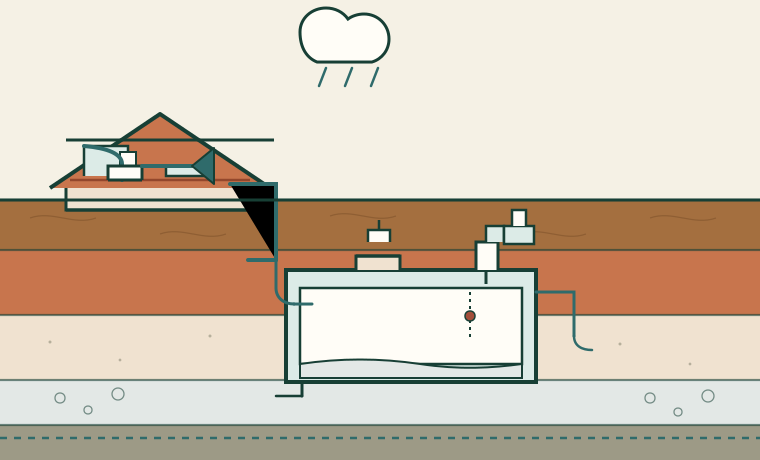
An underground cistern can keep rainwater cool, hidden and frost-free — if the soil, water table, slope and maintenance access allow it. It is a good idea in the right site and a very expensive mistake in the wrong one.
This page is an evaluation framework, not a design. The decision depends on a test pit, a water-table reading, a structural design and local permits. Start with the ground, not the tank.
- Test the ground
- Stay above the water table
- Design for access
- Treat the water
- Best depth
- Above the water tableAnd below frost, with a structural lid.
- Access
- 1 hatchFor inspection and cleaning, not just filling.
- Never
- Enter aloneConfined space; gas, drowning and collapse.
The short answer
Feasible, conditional, or a bad idea
The same tank can be sensible on one plot and impossible on the next. Judge the site before you choose the material.
Usually feasible when…
- The dry-season water table is comfortably below the tank base, and the ground is stable enough to excavate.
- There is room for a safe excavation, spoil, a crane or delivery, and future access to the hatch.
- The tank can be structurally designed for soil, water, frost and vehicle loads, and anchored against buoyancy.
- There is a permit, a maintenance plan and a way to test and treat the water.
Usually a bad idea when…
- The water table rises above the tank base in the wet season, or the site floods.
- The ground is fill, peat, running sand, unstable clay or shallow fractured rock.
- The tank would sit under a road, slope, retaining wall or building without engineering.
- There is no safe access for cleaning, or no budget for a proper lid, vent, pump and repair.
- The water is intended for drinking without first flush, treatment and testing.
The trade-off
Why bury a tank — and what it costs
Underground storage solves some problems and creates others. Compare it honestly with an above-ground tank before committing.
| Advantage | Liability |
|---|---|
| Cool, dark water; less algae and temperature swing. | Excavation, spoil removal and backfill can cost more than the tank. |
| Freeze protection in cold climates; pipes can be kept below frost. | High water table, buoyancy and flooding; an empty tank can float or crack. |
| Frees surface space; hides the tank; less visual impact. | Difficult inspection, cleaning, repair and leak detection. |
| Can use gravity to a lower garden or tap. | Pumping is usually needed; suction lift is limited. |
| Protected from vehicles, animals and vandalism. | Structural design, lid loads, access and confined-space safety. |
| May reduce mosquito breeding and sunlight exposure. | If the hatch, vent or overflow is poor, it becomes a trap and a contamination point. |
The ground decides
Site assessment
A test pit in the dry season and again in the wet season tells you more than a soil map. Record the layers, the water level and how the sides stand.
| Factor | What to measure | Why it matters |
|---|---|---|
| Soil | Layers, clay/sand/gravel, fill, organic matter, bearing strength | Excavation stability, foundation, backfill and settlement |
| Water table | Dry-season and wet-season level; perched water | Flooding, buoyancy, contamination and construction difficulty |
| Bedrock | Depth and fractures | Excavation cost, blasting/permit, water paths |
| Slope | Gradient, retaining needs, access | Lateral loads, erosion, safe excavation and delivery |
| Flood | Flood line, runoff paths, drain capacity | Contamination and structural damage |
| Contamination | Latrines, manure, fuel, pesticides, septic, industrial fill | Groundwater and tank water quality |
| Utilities | Water, sewer, electric, telecom, drains | Strike risk and legal setbacks |
| Access | Excavator, truck, crane, spoil storage, future hatch | Construction cost and maintainability |
| Loads | Vehicles, buildings, trees, frost depth | Lid, wall and foundation design |
| Law | Permits, setbacks, water rights, protected trees | Approval and liability |
Do not design from this table alone. A structural engineer or experienced cistern builder should size the walls, lid and anchorage for your ground. A tank that is strong when full may fail when empty and surrounded by wet soil.
Water in, water out
Hydraulic design
A cistern needs more than a hole and a lid. Plan the inlet, first flush, calm inlet, overflow, drain, vent, access and pump as one system.
Volume. Start with daily use × the dry spell you need to bridge, then add dead storage for sediment and a margin for loss. The tank volume is not the same as the water volume: freeboard, sediment and the height of the outlet reduce usable storage. A rectangular tank 3 × 3 × 2 m holds about 18 m³ gross; usable volume is less.
Inlet. Roof water should pass a leaf screen and a first-flush diverter before entering. Use a calm inlet that does not stir the sediment, and keep the inlet above the highest water level with an air gap where possible. Overflow must be screened, sized for the storm and led away from the tank and foundation. Drain at the lowest point for cleaning. Vent screened and protected from rain and animals. Access a load-bearing, lockable hatch large enough for inspection and cleaning, with a ladder and a safe working platform.
Pump. A submersible pump in the tank avoids suction-lift limits; a surface pump can only lift water a few metres in practice. Keep the pump intake above the sludge layer, fit a filter, and provide a disconnect and a dry-run protection if possible. A hand pump or gravity outlet may be enough for irrigation. Level indicator saves overfilling and helps you learn the real demand.
Never enter a cistern alone. It is a confined space with drowning, gas and collapse risks. Use a harness, tripod, attendant and gas testing; if you cannot provide these controls, clean and inspect from outside with long tools or hire a professional.
The shell
Materials and construction
The tank must be watertight, strong enough for the ground and safe for potable water. The cheapest shell is not the cheapest system.
| Material | Advantages | Watch |
|---|---|---|
| Reinforced concrete | Strong, local, repairable, good for large volumes | Design, cracking, curing, waterproofing, potable coating, cost |
| Ferrocement | Thin, local, repairable, good for curved tanks | Skilled work, mesh and mortar quality, curing, impact |
| Masonry with render | Local materials, robust | Waterproof render, movement, joints, labour |
| Food-grade plastic / fiberglass | Fast, watertight, replaceable, smooth interior | Buoyancy, anchoring, cost, access, potable rating, structural backfill |
| Steel | Strong, fast | Rust, coating, potable lining, buoyancy, repair |
Use potable-water-rated materials and coatings. Avoid lead, bitumen, unknown recycled plastic and contaminated salvaged tanks. A plastic or fiberglass tank buried in wet ground needs a properly compacted bed, side support and anchoring; an empty tank can float. Concrete tanks need control joints, reinforcement and a curing plan; a crack below the water line is a leak you may not see until the ground settles.
Cool and dark is not sterile
Water quality and maintenance
Underground storage reduces algae and temperature, but sediment, biofilm and contamination still happen. Protection and testing remain the barriers.
Keep the roof catchment clean, divert the first flush, screen the inlet and overflow, and keep the hatch locked and watertight. Inspect the tank annually for sediment, cracks, roots and mosquito larvae. Remove sediment with a pump or long tools; do not enter without confined-space controls. Test the water at the start of the wet season and after any flood, repair or change in taste. For drinking, filter and treat — boiling is the reliable household method for pathogens; chlorination and filtration have their place.
Keep surface water away from the hatch and overflow. Do not site a cistern downhill of a latrine, manure heap, fuel store or pesticide store. A cistern is not a substitute for a well or a spring; it is a storage vessel for water you have already captured.
The honest comparison
Underground versus above-ground
Underground is not automatically better. It is a different set of costs and constraints.
| Criterion | Underground | Above-ground |
|---|---|---|
| Water temperature | Cooler, more stable | Warmer; algae risk in light |
| Frost | Protected below frost line | Needs insulation or draining |
| Space | Uses ground area; frees surface | Uses surface space |
| Construction | Excavation, structural design, spoil, access | Simple base, delivery, assembly |
| Maintenance | Harder access, confined space | Easy inspection and cleaning |
| Failure | Hidden leaks, buoyancy, collapse | Visible cracks, overturning, UV |
| Cost | Often higher upfront; site-dependent | Lower upfront for small volumes |
| Pumping | Usually needed; suction lift limited | Gravity or low-lift pump |
A simple screen
Green, amber, red
Use this as a conversation starter with a builder or engineer, not as a permit.
| Signal | Interpretation | Next step |
|---|---|---|
| Green | Low dry-season water table, stable soil, good access, no contamination, permits clear | Size the tank, get a structural design, build a test pit |
| Amber | Seasonal high water table, clay, slope, rock, tight access, limited budget | Investigate further; compare above-ground; consider a smaller shallow tank |
| Red | Flooding, high water table, fill/peat/running sand, contamination, no access, no permit | Do not build; choose another site or an above-ground tank |
Before you dig
A staged approach
Spend the first money on information, not on the tank. A test pit and a design review are cheaper than a failed excavation.
- Measure the roof catchment, rainfall and dry-season demand; size the storage.
- Dig a test pit to below the proposed base; record soil, water level and stability in both seasons.
- Check utilities, contamination, setbacks, permits and water rights.
- Ask a structural engineer or experienced builder to design walls, lid, foundation and anchorage.
- Compare the full cost with an above-ground tank, including pump, access, maintenance and repair.
- Build a small trial if you are unsure; monitor water level, quality and movement for a season.
Use the cistern volume calculator for a first estimate, and the rainwater sizing method for the catchment and demand.
Scope and safety
A buried tank is a structure, not a barrel.
This is a feasibility guide, not a structural design, permit or water-quality approval. Excavation and confined spaces can kill.
Before building:
- Get a geotechnical/structural review for the tank, lid and anchorage.
- Check permits, setbacks, water rights and flood rules.
- Never enter a cistern without harness, tripod, attendant and gas testing.
- Keep the hatch, vent and overflow screened and above flood level.
- Test and treat drinking water; do not assume cool water is clean.
Related: rainwater harvesting, water & sanitation, wells, maintenance register.
Sources and further reading
Where to check the details
Design loads, water tables and permits are local. Use a qualified engineer and the water authority.
- Wikipedia: Cistern — underground storage and history.
- Wikipedia: Rainwater harvesting — catchment and storage.
- Wikipedia: Rainwater tank — tank types and installation.
- WHO: Guidelines for drinking-water quality — water safety.
- CDC: Household water treatment — treatment and safe storage.
Test the ground before you buy the tank.
A test pit, a water-table reading and a structural review will tell you more than a catalogue. If the site is red, stop and choose another option.