Sun and shade
Track the sun across the day and across the seasons. A courtyard may bake at noon and freeze at night; a north wall may never dry. Put sun-lovers on the warm edge, shade plants under the canopy, and keep winter sun on the house.
Rooted field guides · Landscape · Edition 01
A local landscape guide for courtyards, slopes, hedges, orchards and berry gardens: design with plants that already belong, and bring in a few traditional ones with care.
Landscape architecture is not a border of flowers around a building. It is the slow infrastructure of shade, windbreak, soil cover, water, food, habitat and beauty. Get the layers right and the garden maintains itself; get them wrong and every season becomes a fight.
Before the first plant
Local species are not a shopping list. The same tree can be a blessing on a cool north slope and a liability beside a well, a foundation or a power line.
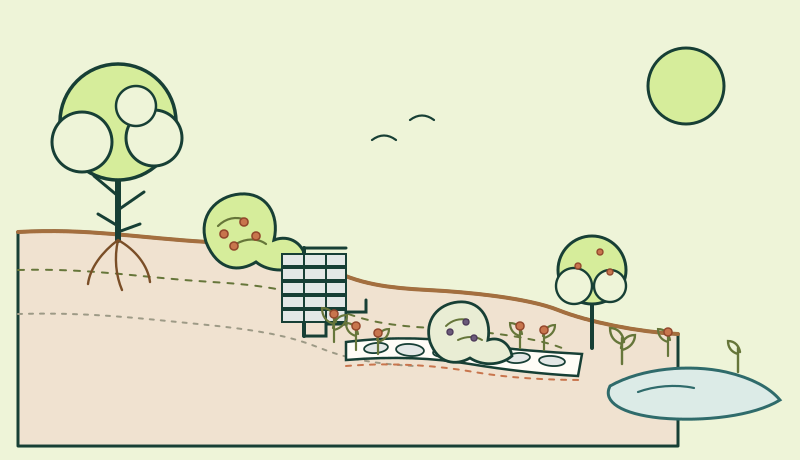
Track the sun across the day and across the seasons. A courtyard may bake at noon and freeze at night; a north wall may never dry. Put sun-lovers on the warm edge, shade plants under the canopy, and keep winter sun on the house.
Watch where rain runs, where it stands and where it disappears. Plant wet corners with willow, alder and sedges; plant dry slopes with juniper, thyme and deep-rooted shrubs. Never plant a thirsty tree over a cellar, drain or foundation.
Dig a hole and squeeze a handful. Clay, sand, silt, stones and organic matter tell you what will thrive. Most local trees prefer a deep, drained soil; berries and herbs are more forgiving. Improve with compost and mulch, not with a bag of fertilizer.
A hedge is a filter, not a wall. A porous windbreak of native shrubs slows wind without creating a destructive eddy. Leave rough edges, seed heads and bare ground for insects and birds; the tidiest garden is often the least alive. For the legal line, corner markers and a living boundary, see a boundary that grows.
Use the site atlas first. The Lay of the Land atlas can help you read the ground, water, rock and existing vegetation before you choose a single species. A local botanist or nursery is a better guide to provenance than a generic list.
The vertical plan
A natural plant community has several floors. A designed garden can use the same structure: tall canopy, shrub layer, herbs and flowers, ground cover and climbers.
Trees give shade, wind protection, fruit, nuts, timber, leaf litter and habitat. They are the longest-lived decision you will make.
The middle floor makes boundaries, shelter, berries and nesting cover. It is the easiest layer to coppice, prune and repair.
This is the working layer: nectar, medicine, dye, scent, kitchen herbs and colour. It changes with the season and can be divided and moved.
Ground cover protects soil, holds moisture and suppresses weeds. Roots, bulbs and fungi do the quiet work below.
Vertical space is free space: a vine can shade a wall, screen a yard, produce fruit or feed pollinators without taking ground.
A regional starting point
These species are native, wild or long-established in Romania and Bulgaria. “Local” still needs checking: provenance, soil, altitude and local laws vary.
Native wild or native in the region Traditional long-grown, not always native Care toxic, thorny, suckering or needing management
| Species | Use in the landscape | Notes |
|---|---|---|
| Quercus robur Pedunculate oak | Large canopy, wildlife, timber | Native Wet-heavy soils; give it room. |
| Quercus petraea Sessile oak | Hillside canopy, timber | Native Drier slopes; slow. |
| Carpinus betulus Hornbeam | Hedge, windbreak, coppice | Native Clips well; tolerates shade. |
| Acer campestre Field maple | Small tree, hedge, autumn colour | Native Adaptable and compact. |
| Tilia cordata Small-leaved lime | Shade, nectar, coppice | Native Aphid honeydew; place away from paving. |
| Prunus avium Wild cherry | Blossom, birds, timber | Native Needs space and deep soil. |
| Sorbus aucuparia Rowan | Small tree, berries, birds | Native Cool, acid soils; berries cooked. |
| Alnus glutinosa Alder | Wet ground, windbreak, nitrogen | Native Roots in wet soil; coppices. |
| Salix alba White willow | Wet ground, coppice, erosion | Native Aggressive roots; keep from drains. |
| Juglans regia Walnut | Nuts, shade, timber | Traditional Juglone suppresses some plants; late frost. |
| Castanea sativa Sweet chestnut | Nuts, coppice, timber | Traditional Mild sites; acid soil. |
| Pinus sylvestris Scots pine | Windbreak, timber, dry sites | Native Acid, well-drained soil; not for rich gardens. |
| Species | Use in the landscape | Notes |
|---|---|---|
| Corylus avellana Hazel | Nuts, hedge, coppice, stakes | Native Cut on a rotation for straight rods. |
| Crataegus monogyna Hawthorn | Stock-proof hedge, blossom, birds | Native Thorny; cut after nesting. |
| Prunus spinosa Blackthorn | Hedge, sloes, nesting | Native Suckers; keep out of beds. |
| Cornus sanguinea Dogwood | Hedge, winter colour, erosion | Native Coppices well; damp or dry. |
| Sambucus nigra Elder | Flowers, berries, birds | Native Spreads; cook berries. |
| Viburnum opulus Guelder rose | Damp hedge, berries, flowers | Native Berries for birds; moist soil. |
| Euonymus europaeus Spindle | Autumn colour, hedge | Native Care Toxic berries. |
| Rosa canina Dog rose | Hedge, hips, pollinators | Native Thorny; good in mixed hedges. |
| Hippophae rhamnoides Sea buckthorn | Berries, erosion, windbreak | Care Suckers and spines; use where it can spread. |
| Syringa vulgaris Lilac | Flowers, scent, courtyard | Traditional Balkan native; suckers. |
| Philadelphus coronarius Mock orange | Scent, flowers, hedge | Traditional Prune after flowering. |
| Cotinus coggygria Smoke tree | Dry slope, colour, nectar | Native Hot, dry sites; colourful leaves. |
| Species | Use in the landscape | Notes |
|---|---|---|
| Fragaria vesca Wild strawberry | Ground cover, fruit | Native Edges and shade; spreads. |
| Rubus idaeus Raspberry | Berry hedge, fruit | Native Cut old canes; needs support. |
| Rubus fruticosus Blackberry | Berry hedge, fruit, habitat | Native Care Spreads aggressively. |
| Ribes rubrum Red currant | Berry hedge, fruit | Traditional Shade-tolerant; prune. |
| Ribes nigrum Black currant | Berry hedge, fruit | Traditional Moist, fertile soil. |
| Ribes uva-crispa Gooseberry | Berry hedge, fruit | Traditional Thorny; good in a mixed hedge. |
| Cornus mas Cornelian cherry | Small tree, early flowers, fruit | Native Tart fruit; excellent for pollinators. |
| Sambucus nigra Elderberry | Flowers, syrup, birds | Native Cook berries; spreads. |
| Malus sylvestris Crab apple | Small tree, fruit, pollinators | Native Fruit for jelly; wildlife. |
| Pyrus pyraster Wild pear | Small tree, fruit, blossom | Native Tough; good on dry edges. |
| Prunus domestica Plum | Orchard, fruit | Traditional Grafted; prune and harvest. |
| Cydonia oblonga Quince | Orchard, fruit, scent | Traditional Cook; needs sun and space. |
| Species | Use in the landscape | Notes |
|---|---|---|
| Achillea millefolium Yarrow | Pollinator strip, meadow, medicine | Native Dry, sunny; spreads by root. |
| Salvia pratensis Meadow sage | Pollinator strip, colour | Native Sunny, well drained. |
| Thymus serpyllum Wild thyme | Ground cover, aroma, pollinators | Native Dry banks and stone edges. |
| Origanum vulgare Oregano | Herb, pollinators, dye | Native Sunny; cut back after flowering. |
| Lavandula angustifolia Lavender | Scent, pollinators, border | Traditional Mediterranean; needs sun and drainage. |
| Iris variegata Variegated iris | Spring colour, dry border | Native Sun; rhizomes at the surface. |
| Paeonia peregrina Balkan peony | Spring colour, courtyard | Native Care Do not dig wild plants. |
| Helleborus odorus Scented hellebore | Winter/spring colour, shade | Native Care Toxic; buy propagated stock. |
| Primula veris Cowslip | Spring meadow, pollinators | Native Do not dig from the wild. |
| Geranium macrorrhizum Balkan cranesbill | Ground cover, dry shade | Native Tough; good under trees. |
| Festuca ovina Sheep fescue | Ground cover, meadow, dry border | Native Sun; low fertility; clump-forming. |
| Stipa pennata Feather grass | Ornamental grass, dry meadow | Native Care Protected in places; buy cultivated stock. |
| Carex flacca Blue sedge | Rain garden, ground cover | Native Wet or drained soil; spreads slowly. |
| Clematis vitalba Old man's beard | Climber, screening, pollinators | Native Care Very vigorous; keep off gutters. |
| Vitis vinifera Grape | Pergola, fruit, shade | Traditional Prune yearly; sun and air. |
Names change; local status does too. Confirm species and provenance with a regional flora, a local nursery or a botanist. Some plants listed as “native” are native only in part of Romania or Bulgaria, and some traditional garden plants are naturalised rather than truly native.
Seven useful arrangements
Start with one pattern and one small area. A courtyard, a hedge and a rain garden will teach you more than a whole-estate plan drawn at the kitchen table.
One canopy tree 4–6 m from the walls, with shade-tolerant shrubs and herbs beneath. Keep winter sun on the house and summer shade on the sitting area.
Plant with: lime or field maple; hazel, guelder rose; hellebore, primrose, ferns; stone paving.
A mixed hedge of native shrubs with berries and nesting cover. Cut in rotation, not all at once, so flowers and fruit keep coming.
Plant with: hawthorn, blackthorn, hazel, dogwood; currants, gooseberry; dog rose.
Fruit trees spaced for light and airflow, with a low herb and bulb layer that feeds pollinators and doesn’t compete with the trees.
Plant with: apple, pear, plum, quince; yarrow, oregano, chives; spring bulbs.
Stone retaining walls or contour swales slow water and create level beds. Plant immediately after shaping; bare soil on a slope is a leak. See the stone and slope notes.
Plant with: dogwood, hazel, sea buckthorn (care); deep-rooted grasses; stone steps.
A shallow, planted depression that catches roof and path runoff, holds it briefly and lets it soak away. It is not a pond and needs an overflow.
Plant with: willow, dogwood, guelder rose; iris, sedges, rushes; stone mulch.
A sunny, low-fertility edge left unmown through summer. Native flowers, bare ground and stems are habitat, not untidiness.
Plant with: yarrow, sage, oregano, thyme; scabious, knapweed, campanula; native grasses.
Two staggered rows of native trees and shrubs, about half porous. A solid wall makes turbulence; a filter slows wind across the yard.
Plant with: hornbeam, hawthorn, alder; field maple, hazel; pine on dry ground.
After the plan
Most young plants die from bad timing, dry roots, competition and neglect — not from a lack of species. Plant smaller stock, plant it well, and water it for two summers.
Use a regional nursery, local seed or cuttings. Ask for provenance. Never dig wild plants, and check protected status before collecting seed.
Bare-root trees and shrubs go in during dormancy, ideally autumn. Container plants can go in autumn or spring; avoid planting into drought or heat.
Read the mature size, not the pot size. Trees 8–12 m apart, shrubs 1–2 m, hedges 30–50 cm, herbs 20–40 cm. Crowding is not a design.
Keep the root collar at ground level. Dig a hole wider than deep, tease out circling roots, backfill with the soil you took out, and firm gently.
5–8 cm of compost or straw, kept clear of the stem. Water deeply in the first two summers; little and often makes shallow roots.
Use tree guards against rabbits and deer; stake only if needed, and remove ties after two years. Record species, source, date and survival.
Working with gravity
On a slope, water is the designer. Slow it, spread it, sink it — then plant. Stone gives structure; roots give permanence.
Use contour swales and shallow terraces to catch runoff, not to dam a stream. A stone retaining wall needs a proper footing, batter, drainage behind it and weep holes; a wall holding back saturated soil is a small dam. For walls above about a metre, or any wall near a building, get engineering advice. River cobbles are excellent in drainage, paving and lime-mortar rubble, but their rounded shape makes them a poor choice for a dry-stone retaining wall. For a drinking-water source, see wells, water and soil, and for the whole system from roof to greywater, see water & sanitation.
Plant the slope as soon as it is shaped. Deep-rooted shrubs and grasses hold soil; mulch protects the surface; paths and steps should shed water away from the face. The cellar and stone notes cover stone selection, retaining walls and drainage in more detail.
What not to plant
“It grows well here” is not the same as “it belongs here.” Some vigorous plants escape the garden and replace the local flora; some are dangerous.
Ailanthus altissima (tree of heaven), Robinia pseudoacacia (black locust), Amorpha fruticosa, Elaeagnus angustifolia and Acer negundo can spread into native habitats. Do not plant them; remove young seedlings promptly.
Fallopia japonica (Japanese knotweed), Heracleum mantegazzianum (giant hogweed), Impatiens glandulifera, Solidago canadensis and Ambrosia artemisiifolia are serious problems in parts of Europe. Giant hogweed sap causes severe burns.
Yew (Taxus baccata), Daphne mezereum, foxglove, monkshood and hellebore are toxic. Use them only where children and livestock cannot reach them, or leave them out.
Common barberry (Berberis vulgaris) can host wheat stem rust; buckthorn (Rhamnus cathartica) can host oat crown rust. Keep them away from cereal crops and check local advice.
Sea buckthorn, blackberry, ivy on walls and bindweed can be useful in the right place and a problem everywhere else. Put them where their spread is an asset, or not at all.
Snowdrops, wild peonies, orchids and many bulbs are protected or locally scarce. Buy propagated stock; never dig from the wild.
Check the regional invasive list. The Global Invasive Species Database and the European invasive species list are starting points, not substitutes for local advice.
The long middle
A landscape is not installed; it is tended. The work changes with the years, but it does not stop.
Water young plants for two summers. Mulch annually, but keep mulch away from trunks. Prune hedges in rotation so there is always flower and fruit. Coppice hazel and willow on a cycle for rods and stakes. Prune fruit trees in winter or early summer according to local practice. Remove invasive seedlings while they are small. Leave some seed heads and rough corners for insects and birds. Watch for disease, storm damage and root heave, and replace failures with better-adapted stock.
Over time, the canopy will close, the hedge will thicken and the soil will darken. Thin the canopy if the understorey becomes too dark; open a gap if a tree dies. Let the garden move toward a managed woodland edge rather than a static border. Record what thrives, what dies and what spreads — that notebook is the real design.
Choose a local canopy tree, a mixed berry hedge and a shallow rain garden. Plant them well, water them for two summers, and let the layers fill in. The rest is observation.
Sources and further reading
Species status, local names and protected plants change. Use regional floras, local nurseries, botanical gardens and the site atlas.