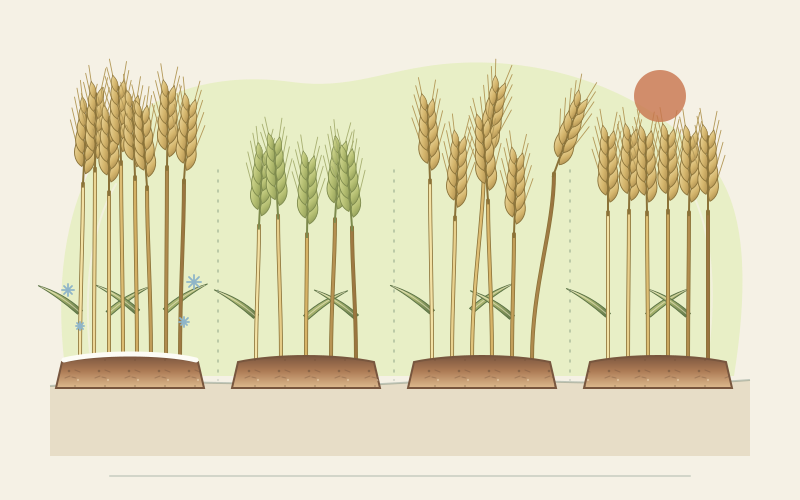
Confirm cereal rye before comparing cultivars
The crop here is cereal rye, Secale cereale, an annual grass cultivated for grain. “Rye” in a lawn or pasture mixture usually means perennial or Italian ryegrass, Lolium perenne or L. multiflorum; these are different species and are not substitutes for cereal-grain seed. Triticale is a wheat–rye hybrid cereal, not a cultivar of S. cereale. All of these names deserve a full label reading.
“Winter” and “spring” describe growth habit within cereal rye. They are not flour colours or guarantees about every environment. A winter cultivar generally needs cold exposure before normal heading and is sown to overwinter. A spring cultivar can develop normally without that requirement and is sown for a same-season harvest. Facultative descriptions, where used, need precise supplier and local interpretation rather than an assumption that the cultivar suits every sowing date.
Neither form is a perennial food plant. Winter rye’s first and only grain harvest comes after overwintering; spring rye’s comes in its sowing season. A packet labelled only “rye” leaves the central choice unanswered. Ask for S. cereale, the cultivar or population name, habit, lot, germination and any treatment before buying.
Match vernalization to the calendar
Winter rye is valued for exceptional cold hardiness and early spring regrowth. It still needs timely establishment: sow too late and plants may enter cold too small; sow excessively early under favourable conditions and an overdeveloped, lush stand can face other problems. Use the district’s recommended date, not simply the first cool week. A northern winter cultivar may also fail to vernalize adequately in a mild Mediterranean lowland.
Spring rye fits a same-season window where locally available and adapted. It is not merely winter rye planted later. If a supplier cannot state habit, treat the seed as unsuitable for a deliberate grain trial. At high elevation in tropical regions, vernalization can be unpredictable, so locally tested spring forms are generally the clearer starting point. Warm lowlands may not offer a suitable cool growing and grain-filling period at all.
| Question | Winter rye | Spring rye |
|---|---|---|
| Typical sowing | Autumn, at a locally timed establishment window | Early spring when soil is workable |
| Cold requirement | Cultivar-specific vernalization before normal heading | No winter vernalization requirement |
| First harvest | Following summer, after one winter | Same season, commonly about 100–140 days |
| Key site evidence | Winter survival and local sowing date | Maturity before local heat, rain or frost |
| Shared needs | Drainage, modest fertility, lodging control, ergot inspection and sound dry storage | |
Open-pollinated populations and hybrids
Traditional cereal rye is cross-pollinated, and many cultivars are maintained as open-pollinated populations. Individual plants vary while the population retains its described characteristics. Saving seed requires attention to identity, flowering isolation from other cereal rye, population size, off-types and local seed rules. A few plants from a garden do not automatically preserve the cultivar’s performance.
Hybrid rye, especially in European winter-grain production, is produced using a controlled breeding system. Hybrids are often described with improved yield or standing power, but those claims remain cultivar- and site-specific. Seed saved from a hybrid grain harvest will not reproduce the original hybrid combination predictably. Buy fresh documented seed when hybrid performance is the reason for choosing it.
Hybrid does not mean ergot-proof, gluten-free or perennial. Some hybrid systems improve pollen availability and may reduce ergot susceptibility under particular conditions, but flowering inspection and rejection remain necessary. Likewise, a shorter or stiffer-strawed cultivar can still lodge under excessive nitrogen, dense growth, waterlogging or severe weather.
Treat named cultivars as local examples
Aroostook is a long-established North American winter rye; Danko is a widely known European open-pollinated winter cultivar; Brasetto is an example of a European hybrid winter rye. Prolific is sold as a spring rye in some markets. These names illustrate real choices, not a worldwide recommendation list. Availability, registration and performance change, and an old familiar name may be less useful than a newer locally tested release.
Ask nearby trials or experienced growers about winter survival, heading date, plant height, lodging, disease, test weight and clean grain yield. For spring forms, compare actual maturity in the local heat and rainfall pattern. A cultivar that survives on an exposed northern field may not be the earliest or best-standing choice in a wet maritime garden.
| Evidence | Why it matters | Practical question |
|---|---|---|
| Seasonal habit | Controls vernalization and harvest year | Is this explicitly winter, spring or a defined facultative type? |
| Regional trials | Survival, maturity and lodging depend on place | Were conditions and management comparable to mine? |
| Straw characteristics | Tall rye can flatten under lush growth | How did it stand without excessive nitrogen? |
| Seed lot | Identity and establishment begin with the lot | What are the germination, purity and treatment details? |
| Ergot plan | No cultivar makes contaminated grain acceptable | What local prevention, inspection and rejection advice applies? |
Separate cultivar from purpose and food form
Cover-crop rye, forage rye and food-grain rye can differ in price, label information, maturity and quality expectations. A cover crop may be terminated before seed formation, so it need not occupy the full 100–300-day grain window. A grain crop must mature and enter safe storage. Do not allow a cover planting to set contaminated or unmanaged seed, and do not expect an unnamed cover-crop lot to provide a named baking cultivar.
Whole rye berries are intact cleaned kernels; rye flakes are rolled; wholemeal, light, medium and dark flours describe milling or extraction choices; sourdough rye describes fermentation and a food process. None names a cultivar. Pumpernickel can mean a bread style or, in some markets, a coarse rye meal. Read both agricultural and food labels for what they actually state.
Every ordinary rye grain and flour contains gluten, regardless of winter habit, breeding system, stone milling or sourdough fermentation. Rye is unsuitable for a gluten-free diet and for people with coeliac disease. See the food and nutrition guide for exact raw-grain values and preparation distinctions.