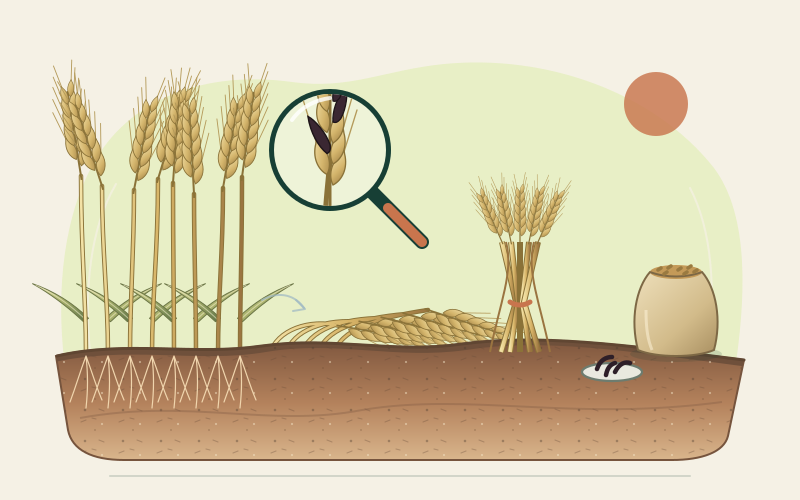
One annual crop, two seasonal habits
Rye, Secale cereale, is a cool-season annual grass in Poaceae. It forms additional shoots—tillers—from the base, sends up tall jointed stems and finishes with long grain-bearing ears. It is not a perennial grain: each sowing produces one mature-grain harvest, after which the plants are finished. Perennial ryegrass, Lolium perenne, is a different forage and turf species and is not the crop in this guide.
Winter rye is sown in autumn, establishes before severe cold and resumes growth early in spring. A winter cultivar needs suitable cold exposure, or vernalization, before it can head normally. Its single harvest comes the following summer, commonly about 240–300 days after sowing including dormancy. Correctly established rye is among the hardiest winter cereals, but cultivar, sowing date, snow cover, ice, freeze–thaw cycles and drainage still determine survival.
Spring rye is sown at the locally recommended start of spring and harvested in the same growing season, commonly about 100–140 days later. It does not need the winter cultivar’s vernalization. Do not assume that any rye packet can be sown in either season: an unverified winter cultivar sown in spring may remain vegetative or head poorly, while spring seed does not gain winter hardiness merely from an autumn sowing.
Sow sound seed into an even, drained stand
Read the planting-seed label
Buy documented S. cereale seed with its cultivar, winter or spring habit, lot and germination identified. Ask for local maturity and lodging evidence. Food-grade rye berries are selected for eating, may be old or treated and do not come with the agronomic assurances of planting seed. Seed lots containing ergot bodies are unacceptable; clean, certified or otherwise locally quality-assured seed reduces risk but does not eliminate field inspection.
Match the sowing window to the habit
Winter grain needs enough autumn growth to root and tiller before severe cold, but not a date so early that lush growth invites lodging or local disease. Spring rye goes in when soil is workable rather than sticky and saturated. The broad examples are September–October for northwestern-European winter rye and February–April for spring rye; northern continental winters and altitude can move both windows substantially.
Prepare a firm seedbed and calculate the rate
Use full sun and a fine, firm, well-drained seedbed. Relieve compaction and drainage problems first. A common small-grain starting depth is about 2–3 cm, adjusted modestly for soil texture and moisture. Follow the supplier’s rate for the cultivar and purpose, using thousand-kernel weight and realistic establishment to calculate grams per square metre. Broadcasting much more seed does not guarantee a stronger stand; crowding can weaken stems and complicate airflow and inspection.
Establish without feeding for height
Rye has a reputation for managing light, acidic or lower-fertility soil, but tolerance is not immunity to severe deficiency, drought or waterlogging. Use a soil test and local nutrient advice. Avoid fresh manure and heavy nitrogen, especially on an already dense stand: lush tall straw is prone to lodging, meaning stems lean or fall. Weed early, cultivate gently and stay off saturated ground. Rotate with unrelated crops and manage host grass weeds under local disease and ergot guidance.
Hardiness and standing power are different traits
A plant can survive severe winter cold and still lodge in June. Winter survival concerns crowns, roots and regrowth; lodging concerns the height and strength of stems, rooting, density, nitrogen and weather. Tall rye catches wind, and rain can flatten an already leaning stand. Choose locally proven lodging resistance, calculate an even seed rate, avoid excessive nitrogen and preserve drainage. Do not trample or roll a food crop simply to shorten it, and do not improvise plant-growth-regulator use: commercial decisions belong to current local product labels and specialist advice.
During winter, inspect after water stands, ice forms or freeze–thaw weather heaves plants. Do not judge survival from brown leaves alone; wait for suitable regrowth conditions before deciding whether the crowns have failed. In spring, look for thin patches and weeds, but avoid late reseeding with a different habit without advice. An uneven crop flowers unevenly, complicating both maturity and ergot scouting.
Ergot means rejection, not a cleaning challenge
Ergot is caused by the fungus Claviceps purpurea. Infection at flowering can replace individual kernels with sclerotia: hard, elongated, dark purple-black bodies that project from the ear. They contain toxic alkaloids and are a food- and feed-safety hazard. Cool, wet or extended flowering conditions can favour infection, and other cereals and grasses can act as hosts. Rye’s open flowering makes vigilant inspection especially important.
Use clean seed, rotate away from susceptible cereals, control grass hosts and avoid leaving old sclerotia in the seedbed. No preventive step makes scouting optional. Walk beyond the easy edge, part the canopy and inspect lodged patches and late tillers during flowering and again before harvest. If you find sclerotia, keep the affected heads and all grain they contacted separate. Do not feed suspect material to animals or leave it where wildlife or poultry will eat it.
Reject an ergot-affected home lot for food and feed. Do not assume that picking out visible bodies, sieving, washing, soaking, fermenting, cooking or milling removes the danger. Cleaning can spread fragments or dust, and alkaloids are not made acceptable by an ordinary kitchen process. Isolate the lot without spreading it, avoid breathing dust, and seek local agricultural or food-safety advice on disposal and cleaning equipment. Do not sow it or compost it in a way that returns viable sclerotia to the field.
Harvest mature sound grain, then manage moisture
Sample several sound areas as heads and stems yellow. Kernels should be hard and mature, not soft or milky; harvest before shattering or prolonged rain damages the crop. Straw colour alone does not establish kernel maturity or storage moisture. Cut surface-dry plants with clean, well-maintained hand tools over a clean sheet or tarpaulin to catch loose heads. Keep suspect patches out of this harvest stream entirely.
| Stage | Check | Action |
|---|---|---|
| Flowering | Heads, edges, late tillers and lodged areas | Inspect for ergot; isolate suspect patches |
| Cutting | Hard mature kernels and dry surface conditions | Harvest sound heads before shattering or prolonged rain |
| Drying | No damp pockets in heads or sheaves | Spread thinly or hang loose small sheaves under ventilated cover |
| Threshing | Brittle heads and stable safe equipment | Thresh gently, control dust, winnow and sieve |
| Storage | Measured dryness for the intended storage period | Pack clean cool grain, label and inspect regularly |
Spread heads in shallow layers or hang small loose sheaves under cover with strong airflow. Never heap damp sheaves into a warm stack. Once brittle, thresh by rubbing or treading gently inside a clean sheet, or use properly guarded equipment according to its instructions. Tie back loose clothing and hair, keep bystanders clear, disconnect power before clearing blockages and avoid breathing grain dust. Winnow with a gentle cross-breeze or stable guarded low fan, then sieve out stones and damaged material.
Hard kernels and rattling are clues, not a moisture measurement. For a substantial store, use an appropriate grain-moisture test and locally recommended target for grain species, temperature and intended duration. Keep only clean, sound, dry, cool grain in labelled food-safe airtight containers or a properly managed store. Inspect for condensation, insects, heating, odour or mould, and discard mouldy grain rather than diverting it to feed. The nutrition guide explains why raw-grain values do not describe cooked berries or flour.