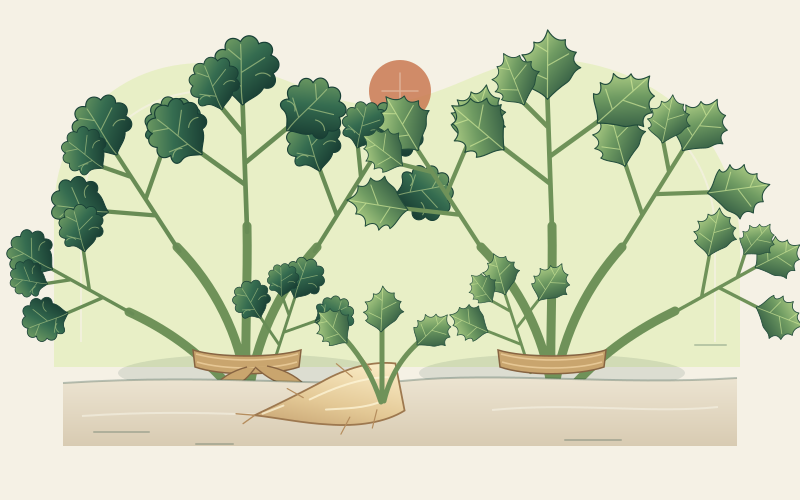
One species, several garden forms
Cultivated parsley is Petroselinum crispum, a member of Apiaceae. Curly-leaf and flat-leaf parsley are the main choices for repeated leaf harvests. Hamburg or turnip-rooted parsley has been selected for an enlarged edible root as well as leaves. Catalogues and older horticultural references may use varietal names such as P. crispum var. neapolitanum for flat-leaf and var. tuberosum for root parsley; naming is not perfectly consistent across sellers.
A named cultivar is a maintained selection, while “Italian”, “curled”, “moss curled” or “giant” can also appear in broader type descriptions. Read the botanical identity and the whole packet rather than relying on a front-panel photograph. Check whether the crop is intended for leaves or roots, its mature height, spacing and any local disease-resistance claim. Japanese parsley, Cryptotaenia japonica, is a different species and is not interchangeable in a variety trial of P. crispum.
Curly and flat leaves: real differences, flexible uses
Curly-leaf parsley has finely divided leaflets with crisped, frilled margins. Plants often form dense, relatively compact rosettes that work well as an edible edging or in a container. ‘Bravour’ is an RHS-recommended curly selection, and ‘Moss Curled’ is a familiar catalogue name. The curled surface holds chopped pieces together attractively, but it can also trap garden grit, so separate and rinse the leaves carefully.
Flat-leaf parsley, often called Italian parsley, has broader, flatter segments and frequently a taller, more open habit. ‘Titan’ is an RHS-recommended flat-leaf selection; ‘Giant of Italy’ and similar names usually describe vigorous flat-leaf forms, though supplier strains differ. Flat leaves are straightforward to chop into sauces, salads and cooked dishes. Their openness can make individual stems easier to inspect, but does not remove the need for washing.
Flat-leaf parsley is often described as stronger-flavoured and curly parsley as milder. That is a useful general observation, not a guarantee for every packet or garden. Cultivar, leaf age, water supply, temperature, storage and the taster all affect flavour. Neither leaf shape is universally more nutritious or more suitable for every recipe. Grow the form you enjoy and will actually use, and judge freshness and productivity alongside taste.
Compare common catalogue forms
| Name or form | Typical garden character | Selection point |
|---|---|---|
| Bravour | Curled leaflets; compact leafy clump | Curly garnish, edging and containers |
| Moss Curled | Dense, finely curled foliage | Decorative leaves; check the supplier’s selection |
| Titan | Flat leaflets; robust leafy habit | Everyday chopping and cooked dishes |
| Giant of Italy type | Large flat leaves; often tall and vigorous | Substantial bunches where space allows |
| Generic flat-leaf / Italian | Flat divided leaves; habit varies by strain | Read height, spacing and days on the packet |
| Hamburg / root parsley | Enlarged pale root plus edible leaves | Root crop with different spacing and harvest timing |
Rooted’s 70–90-day first-harvest window applies to a substantial picking from leafy parsley. Do not apply it to the mature root harvest of Hamburg parsley, which needs its own packet and local root-crop schedule. Leaves from a root-parsley plant can be eaten, but repeated heavy defoliation may reduce root growth.
Look beyond the leaflet
Plant size determines spacing and container choice. Compact curly selections may fit a smaller pot, while a vigorous flat-leaf plant needs room for its crown and root. A pot at least 25 cm wide and deep is a reasonable starting point for a leafy plant, with drainage and a suitable growing medium. Supermarket pots often contain many crowded seedlings intended for quick indoor use; they are not equivalent to one well-spaced garden plant.
Harvest style matters too. For small frequent meals, a compact plant near the kitchen may be more useful than a huge variety at the far end of the plot. For pesto-like herb sauces, tabbouleh or repeated bunches, a vigorous flat-leaf selection may reduce the number of plants needed. All leafy forms respond to the same basic harvest: cut a few complete outer stems at the base and leave the central crown to regrow.
Seed quality can matter as much as the variety name. Parsley is slow to germinate, often for 2–5 weeks, and older seed can be less reliable. Buy from a reputable supplier, check the packing or sow-by date and store unused seed cool, dry and sealed. Saving seed requires keeping a healthy plant into its flowering year and preventing unwanted crossing with other flowering parsley; for most small gardens, fresh bought seed is simpler.
Run a small, useful comparison
If space permits, sow one curly and one flat-leaf selection at the same time and give both equivalent care. Record sowing date, first emergence, establishment, first substantial pick, regrowth and any leaf disease. Taste both raw and in the dish you cook most often. A variety that looks impressive in a catalogue but grows poorly in your soil is not the best choice for your garden.
Repeat the comparison in another season before drawing a firm conclusion. Cool, damp weather and hot, dry weather can reverse apparent advantages. Ask local growers or extension services about cultivars that perform reliably in your conditions, and treat “slow-bolting” or resistance claims as specific traits rather than immunity. The parsley growing guide covers the shared sowing, moisture and outer-stem harvest routine.