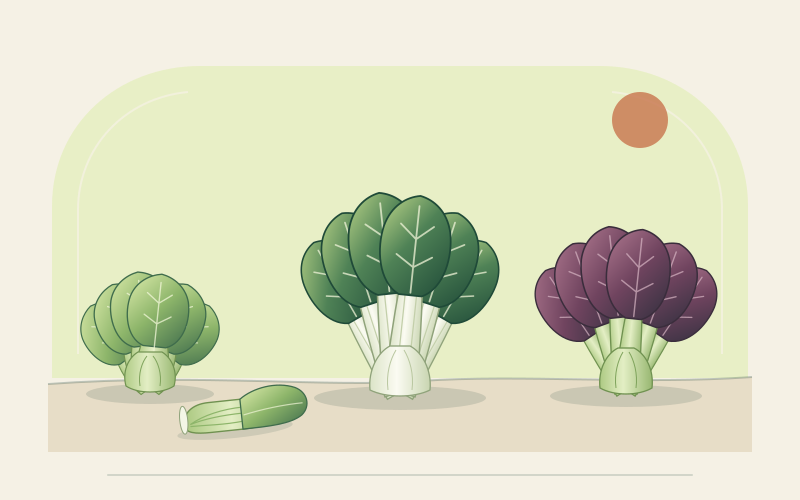
Start with size, then look at colour
Pak choi belongs to Brassica rapa var. chinensis. Catalogues also use bok choy, bok choi, pac choi and Chinese white cabbage. These names overlap, so the botanical identity and complete cultivar description are more reliable than a front-packet colour photograph. Unlike heading Chinese cabbage, pak choi forms an open, upright cluster of leaf blades and fleshy petioles rather than a closed barrel.
Practical groups are based on harvest stage, mature height, stem colour and leaf colour. They are not rigid botanical subdivisions. A dwarf cultivar can have green or white stems, and many standard cultivars can be picked young. “Baby” may describe either a naturally compact cultivar or an ordinary cultivar harvested early; the packet should tell you which.
Rooted gives an indicative 30–60 days from sowing to first harvest. Baby leaves may be ready in about 30 days and many full plants in 45–60 days, but cool or hot conditions can extend the range. A fast harvest does not remove the need to match the cultivar to spring or autumn conditions.
Baby, compact and full-size selections
Baby-leaf and naturally dwarf types
Baby-leaf sowings are harvested while the blades and stems are small and tender. They suit close spacing, broad containers and repeated light pickings. Naturally dwarf or “baby” cultivars are selected to form a complete miniature rosette, often with proportionally thick stems; they are useful when a recipe calls for halved or whole small plants rather than a pile of loose leaves.
The short crop can fit between slower vegetables, but only if it receives enough light and water. Close spacing still requires thinning. A compact cultivar is a sensible first trial where a full-size row would produce more than the household can use. Do not assume that a small plant is inherently more bolt-resistant: check the season claim separately.
Compact green-stem types
Many compact selections have pale to deep green petioles rather than bright white ones, with rounded green blades and a neat rosette. ‘Mei Qing Choi’ is a familiar example of this general form, not a universal recommendation. Local seed may use different names and perform differently. Compact types are commonly chosen for small-space growing, quick whole-plant harvests and stir-fries.
Green petioles are a normal varietal trait, not a sign that a white-stem plant is underripe. Their texture still depends on maturity and growing conditions. Allow the packet’s recommended space and harvest while stems remain crisp rather than waiting for a compact type to become a giant.
Full-size white-stem types
Standard white-stem pak choi forms a taller rosette with broad ivory or very pale petioles and dark green leaves. ‘Joi Choi’ is one widely sold example of a larger white-stem type. Full-size cultivars need more room than baby crops; the RHS suggests 25–30 cm between mature plants as a starting guide. Their crisp stems can be sliced and cooked briefly before the more delicate leaves.
A large cultivar offers more substantial stems for soups and stir-fries but spends longer in the bed and can produce a glut if sown all at once. Use small successions and choose a locally recommended season. Outer leaves on a mature plant may be tougher than baby foliage, so trim only damaged tissue rather than discarding every large leaf.
Purple- and red-leaved types
Purple-leaved cultivars combine reddish-purple to deep violet blades with green or pale stems. ‘Red Choi’ is an example of a name used for this colour form. Pigmentation can vary with temperature, light and leaf age, so a plant need not match the saturated catalogue image to be healthy. Young leaves may show a different intensity from mature ones.
Use purple types as baby leaves for colour or grow them to the mature size specified by the supplier. Colour can transfer during preparation and cooking, and does not indicate a different harvest calendar. Judge readiness by the rosette and stem, not by waiting for a particular shade.
| Selection | Recognise it by | Likely use | Selection note |
|---|---|---|---|
| Baby or dwarf | Small complete rosette or young loose leaves | Salads, quick cooking, whole halves | Check whether “baby” means early harvest or genetics |
| Compact green-stem | Green petioles and a neat small rosette | Small-space growing and stir-fries | Green stems are a normal trait |
| Full-size white-stem | Tall rosette with broad ivory petioles | Soups, stir-fries and separated stems | Allow more room and sow in small batches |
| Purple-leaved | Red-purple to violet blades | Baby colour or full cooked harvests | Pigment varies; colour does not set maturity |
Treat bolting tolerance as a seasonal trait
Seed described as slow-bolting or bolt-resistant is valuable when growing full plants through a period that has caused premature flowering before. It is not immunity. Drought, heat, cold snaps and old root-bound transplants can still trigger a flower stem. For the most reliable result, combine suitable genetics with steady moisture, appropriate timing and an early harvest.
Some suppliers distinguish spring and autumn performance or note particular cold or heat tolerance. These claims apply only within reasonable local conditions. In a Mediterranean lowland, “spring” may mean a much earlier sowing than in northern Europe; at tropical high altitude, rainfall and night temperature matter more than temperate month labels.
For a first comparison, sow two short rows of contrasting forms in the same suitable window: one compact green-stem and one white-stem or purple-leaved cultivar. Keep labels, use the same care and record days to baby and full harvest, flower-stem appearance, pest damage and kitchen texture. This is more informative than comparing a baby harvest of one with an old full plant of another.
Do not substitute every Asian green by name alone
Tatsoi forms a low rosette of small, dark spoon-shaped leaves; choy sum is grown especially for tender stems and yellow flowering shoots; komatsuna has larger upright leaves; and napa or Chinese cabbage forms a dense elongated head. These related Brassica rapa crops can share pests and rotation considerations, but they differ in habit, spacing and best harvest stage.
Seed mixes of “oriental greens” may include several species or botanical groups. That is useful for mixed baby leaves but less useful when a recipe requires uniform pak choi stems. Read the ingredient list and grow mixed leaves at their common baby stage, or buy named pak choi for full rosettes.
Make the packet answer five questions
Before buying, ask: Is it meant for baby leaves or full rosettes? What is its final spacing? Which sowing season is recommended? Is bolting tolerance stated? Does its size and colour suit the intended meal? Add locally important disease resistance where a supplier provides a specific, credible claim, while maintaining rotation and hygiene.
Buy fresh seed from a reputable supplier and store it cool and dry. There is no reason to choose a large cultivar solely for yield when a short row can be resown. The best selection is one whose harvest window and size you can use promptly, not the plant that stands longest in the garden.