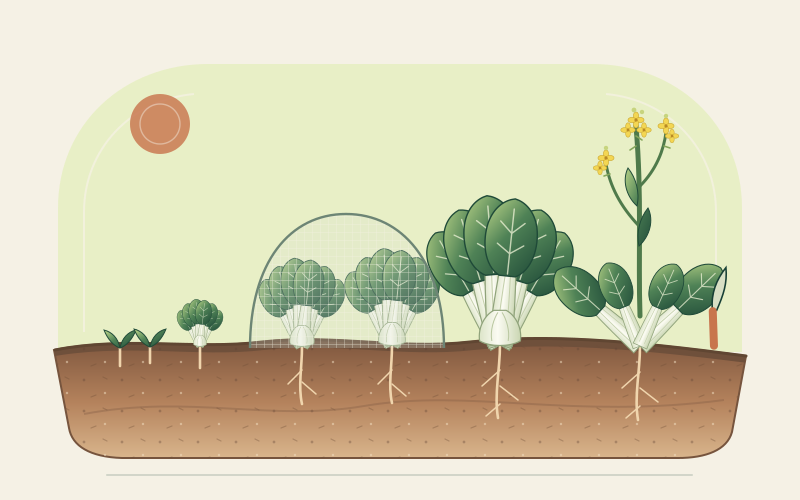
Use the cool windows and keep the planting small
Pak choi or bok choy, Brassica rapa var. chinensis, is a non-heading member of the mustard family. Its broad leaf blades join smooth, thickened leaf stalks in an upright rosette. It is botanically a biennial, but gardeners grow it as an annual and harvest before the flowering stem extends. Do not confuse it with the larger, barrel-headed Chinese cabbage, another form of Brassica rapa.
Rooted gives an indicative 30–60 days from sowing to first harvest. Baby leaves can be ready in about 30 days, while many full-sized plants need 45–60 days. The RHS notes a wider 45–75-day range for semi-mature and full plants. Cold, heat, cultivar and spacing all shift the date, so use size and condition rather than treating the packet as a countdown.
Cool, damp growing conditions generally produce better plants than hot, dry midsummer weather. Choose an open, sunny site for early and late crops, and light shade where summer warmth is unavoidable. The soil should be fertile and moisture-retentive but not waterlogged. A container at least 30 cm wide can support baby or compact plants, but it will need close attention to watering.
Small successional sowings every one to two weeks spread the harvest and reduce the cost of losing a batch to bolting. There is little value in sowing a whole bed at once when every plant may reach its best stage within the same few days.
Sow for the harvest size and avoid a root check
-
Choose seed for the intended crop
Baby-leaf, compact and full-size selections are not interchangeable at every spacing. Many are dual-purpose, but read the packet for final size and season. Where spring or summer bolting has been a problem, choose a cultivar described as bolt-resistant; resistance lowers risk rather than making heat and drought harmless.
-
Direct-sow or use clean modules
Pak choi germinates quickly in suitable conditions. Sow thinly into a fine, moist seedbed at the supplier’s recommended depth, or place one or two seeds in a module and retain the strongest seedling. Modules reduce root disturbance when full plants are wanted. Bright light and moderate temperatures produce stockier seedlings than a dim, warm windowsill.
-
Harden off and keep roots intact
Gradually acclimatise protected plants to outdoor wind, sun and temperature before transplanting. Water the modules, lift each root ball whole and set the plant at its previous depth without burying the central growing point. Firm just enough to support it and water in. Planting during a cool, still part of the day reduces immediate stress.
-
Thin decisively and eat the thinnings
RHS starting spacings are 8–10 cm for baby leaves, about 20 cm for semi-mature plants and 25–30 cm for full-sized pak choi. Rows need enough access for weeding and harvest. Remove crowded seedlings gradually rather than leaving competition to slow the whole row; sound thinnings can be washed and eaten.
-
Water for uninterrupted growth
Check moisture below the surface, then water thoroughly when needed rather than repeatedly wetting only the top. Containers and young plants dry especially quickly. Mulch around established larger plants on damp ground, keeping material clear of the stems. Base nutrient additions on soil need and local guidance; a short crop does not benefit from indiscriminate feeding.
-
Weed without disturbing the shallow crop
Remove weeds while small so they do not compete for light and water or shelter slugs. Hand-weed close to the plants and avoid deep hoeing near roots. Record the sowing date, cultivar, pest pressure and actual harvest stage so the next short succession is better timed.
Prevent bolting by reducing stress, not by chasing flowers
Bolting is premature flowering. Pak choi can respond to hot or dry conditions, cold snaps, root disturbance and day-length changes. No single calendar date prevents every trigger. Sow in locally mild windows, choose bolt-resistant cultivars for full-size crops, keep moisture even and avoid allowing seedlings to become old and root-bound.
In warm weather, light shade and a baby-leaf harvest are safer than trying to hold large rosettes for weeks. In a cool spring, protect seedlings from a forecast cold snap with an appropriate cover that does not crush them. Ventilation and frost protection still need local judgement.
When a central stalk begins to elongate, harvest the rest of the plant promptly while it remains sound. Young flower buds and stalks can be cooked, but removing them does not turn the plant back into a long-standing leafy rosette. Other plants from the same stressed sowing may follow, so check the entire batch.
Exclude flea beetles and get ahead of slugs
Flea beetles leave many small round “shot-holes” in brassica leaves. Light surface damage can be cosmetic, but severe feeding checks seedlings and makes baby leaves unattractive. Fit fine insect-proof mesh immediately after sowing or transplanting, before beetles arrive. Support it above the foliage, allow for growth and seal every edge to the soil. During weeding, open only the working area, check that pests are not inside and close it again.
Mesh works as a barrier, not as a cure for an existing infestation. Rotate away from other brassicas where practical, remove badly infested crop residues and preserve a healthy, rapidly growing plant. If considering any pesticide, use only a legally available product for the crop and pest, exactly as its label directs; a fast food crop may have a specific pre-harvest interval.
Slugs and snails can destroy tender seedlings and rasp holes in succulent leaves, especially in damp weather. Reduce nearby hiding places, inspect after dusk or rain and protect plants at their most vulnerable stage. Traps, barriers or baits require local, label-compliant use; mesh alone does not remove slugs already beneath it. Morning watering can avoid leaving the surface newly wet overnight.
Other brassica pests, including caterpillars, aphids and root fly, may occur locally. Inspect leaf undersides and stems during routine care. Correct identification and local extension advice are more useful than treating every hole with the same product.
Harvest at the chosen size and keep it cold
For repeated baby pickings, snip a few outer leaves from each plant with clean scissors and leave the centre and enough foliage to regrow. Stop when growth weakens or flowering begins. For semi-mature or full plants, cut through the base with a clean knife while the rosette is compact and the stems crisp. Do not leave a full-size crop standing simply to grow larger.
Pak choi is a fresh, short-keeping crop rather than a storage brassica. Refrigerate sound, unwashed leaves or whole plants promptly in a vented bag or container; avoid sealing them wet. Use within several days for best texture, inspecting and removing decayed leaves. Wash under clean running water just before preparation, separating the base enough to remove trapped soil. Do not use soap, detergent or household disinfectant on produce.
No special processing is required before cooking. Because thick stems and thin blades cook at different rates, separate them and start the stems earlier when the recipe benefits. Refrigerate cut produce and cooked dishes promptly in clean containers. Freezing, fermenting or canning requires a suitable tested process; plain pak choi should not be assigned an improvised room-temperature canning method.