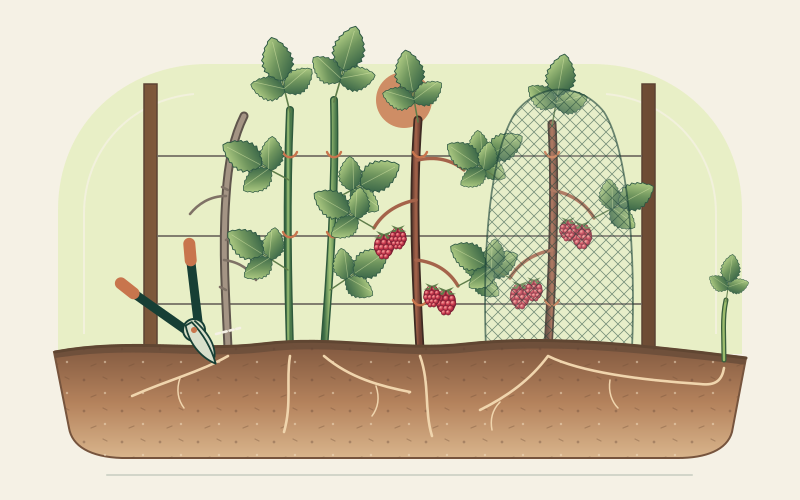
Start with the crown-and-cane cycle
Red raspberry, Rubus idaeus, has perennial roots and crowns but individual above-ground canes normally live for two growing seasons. A first-year cane is a primocane. In its second year it becomes a floricane, fruits, and then dies. New primocanes continue to emerge from below ground. This overlap explains why a row can persist while its canes need regular replacement.
The two main garden types use that cycle differently. Summer-fruiting raspberries produce their crop on floricanes: buds on last year’s cane develop fruiting side shoots in early to midsummer. Autumn-fruiting raspberries produce near the tips of current-season primocanes in late summer and autumn. Both types still have biennial canes; “autumn” does not mean a different species or an annual plant.
A first useful harvest usually takes one to two years from planting a young cane. Autumn types can produce in their first season. Summer types usually need to overwinter a cane and fruit in their second summer. Long-cane nursery stock, local systems and plant condition can alter early picking, while winter injury or an ill-timed hard prune can remove a summer crop. This is not a seed-to-harvest estimate.
Choose healthy stock and a site that drains
Buy certified virus-free or otherwise health-certified stock where available. Raspberries can carry viruses that reduce vigour and yield, and a healthy-looking sucker from an old row is not equivalent to certified planting material. Select cultivars for local winter survival, heat and chilling conditions, ripening season and named disease resistance. Resistance is specific and never immunity.
A sunny, sheltered position generally gives the strongest crop, although light shade can be useful where afternoons are hot. Avoid frost pockets and soil that stays saturated, especially in winter. Raspberries have shallow roots and need moisture during establishment and fruit development, but constant wetness damages them. Raised beds can improve drainage; they do not remove the need to water during dry spells.
Clear perennial weeds and test soil before making major pH or nutrient corrections. The RHS suggests slightly acidic soil around pH 6–6.7, with organic matter used to improve poor soil and mulch. Avoid planting straight back into a site where an unhealthy raspberry row has just been removed; local replant advice and rotation matter. Excess nitrogen can produce crowded soft growth rather than a better-managed crop.
Plant shallowly and build support first
Set out a working row
Install sound end posts, intermediate posts as needed and strong wire before the canes become tangled. A common garden spacing is 40–60 cm between plants, with roughly 1.5–2 m between rows, but cultivar vigour and local systems take priority. Leave room to pick, prune, net and remove suckers safely.
Plant at the nursery soil mark
Plant dormant bare-root stock while soil is workable and neither frozen nor waterlogged, following supplier timing for container-grown plants. Spread the roots and set the upper roots no more than about 5 cm deep; use the old stem soil mark as a guide. Deep planting can damage establishment. Water in and mulch, keeping material clear of the stem bases.
Match support to the type
Summer types commonly grow to about 1.8 m and benefit from individual canes tied loosely to wires. Keep fruiting floricanes and replacement primocanes distinguishable where the system allows. Autumn types are often shorter and can be held between parallel wires or simple supports, reducing the need to tie every cane.
Water and weed the shallow root zone
Check below the surface and water thoroughly when needed rather than sprinkling a little every day. Maintain even moisture through fruit swelling without saturation. Hand-weed or cultivate very shallowly to avoid cutting roots. Containers dry faster and need a suitably large pot, drainage, support and regular feeding and watering.
Prune the right canes at the right time
Summer-fruiting: remove floricanes after harvest
Once summer picking ends, identify the old woody canes that carried fruit and cut them at ground level. Retain strong, healthy current-season primocanes for next year. The RHS suggests about six to eight per plant, spaced roughly 10 cm apart on support, removing surplus young canes. Tie retained canes loosely and shorten excessively long growth at the locally recommended time, not so severely that fruitful wood is lost.
Do not remove every green cane after summer harvest: those are next year’s crop. Equally, leaving all dead floricanes creates congestion and makes the two age groups harder to distinguish. A label and two coloured soft ties during the season can help a new grower follow the cycle.
Autumn-fruiting: reset for a single late crop
For one autumn crop, cut all canes to ground level in late winter before new growth, using the locally appropriate dormant window. New primocanes then grow and fruit later that year. Thin very weak, crowded shoots where local guidance recommends so light and air can enter. Avoid copying the summer routine and retaining all old canes; that changes the crop pattern.
Double-cropping is a separate option, not the default. On suitable vigorous primocane cultivars, only the upper fruited part of selected canes is removed, leaving lower buds to produce a smaller summer crop before those canes are removed. New canes then crop in autumn. The system needs cultivar-specific guidance and can reduce or delay the autumn crop. Do not improvise halfway between methods.
Contain suckers and inspect the whole row
Raspberry roots naturally send up suckers away from the original plant. Define the row and remove shoots outside it while small, slicing them below soil level or digging them out with minimal disturbance to retained plants. Repeat through the growing season. A mowing strip or bed edge can help only if it is maintained; a barrier alone is not a substitute for inspection. Never propagate suckers from declining or virus-suspect plants.
Inspect leaves, cane bases, flowers and ripening fruit regularly. Aphids and other sap feeders can spread viruses; cane blights, spur blight, rust, grey mould and root problems differ by climate. Birds and raspberry beetle can also reduce harvests. Netting should be supported, secured against gaps and checked so wildlife cannot become trapped. Pick out mouldy fruit and maintain airflow, but get a local diagnosis before treating ambiguous symptoms.
If a legally available plant-protection product is justified, its label must cover raspberries and the target problem, including timing and pre-harvest interval. Do not improvise doses or sprays close to harvest. Remove badly infected stock when local guidance calls for it, and clean tools between plants where cane infection could spread.
Harvest into shallow trays and chill without delay
Raspberries are ready when fully coloured for the cultivar, plump and easy to detach from the pale central receptacle, or plug. The plug normally stays on the cane. Pick every day or two during peak ripening, preferably when fruit is dry and temperatures are cool. Wet berries mould quickly, and underripe berries will not become a good equivalent of tree-ripened fruit after picking.
Support each berry gently rather than squeezing it, and place it in a clean shallow punnet only two or three berries deep. A deep bucket crushes the lower layers. Leave mouldy, leaking, insect-damaged or badly soiled fruit behind; do not pour damaged berries into a preserving batch. Protect picked fruit from sun and refrigerate promptly. For best quality use fresh berries soon rather than expecting a long storage life.
Wash gently under clean running water just before use, then drain and pat dry if needed. Do not use soap or household disinfectant. The National Center for Home Food Preservation recommends fully ripe, firm, well-coloured berries for freezing, with immature and defective fruit removed. Its dry-pack method washes and drains berries, packs them with headspace, and seals and freezes; tray freezing before packing reduces clumping. Sugar and syrup packs change sweetness and are quality choices, not requirements for freezing safety.
For jam, jelly or canned products, use a current tested recipe and its specified jar filling, heat processing, cooling and storage steps. Cooking crushed fruit in a pan does not by itself make a shelf-stable preserve. Refrigerator or freezer products must remain at the stated temperature. Discard food with mould, fermentation, broken seals or other spoilage according to the preservation guidance rather than tasting to test it.