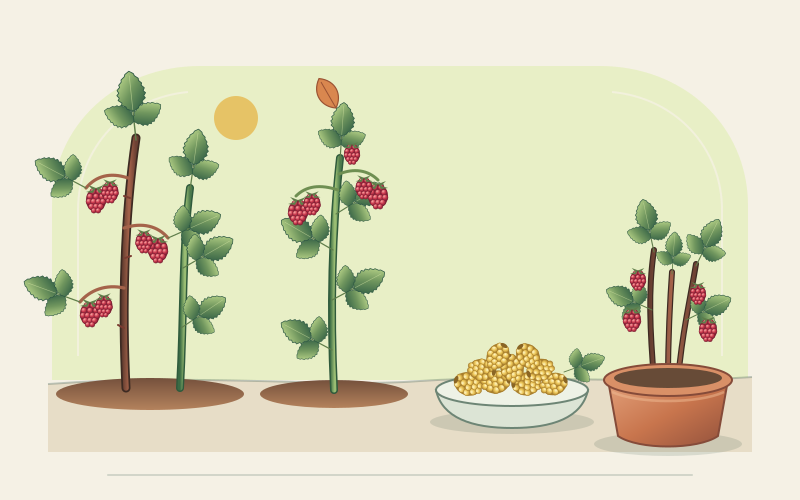
Read fruiting type before colour or cultivar fame
This guide centres on red raspberry, Rubus idaeus. Within the species and its cultivated selections, the most consequential garden choice is whether a cultivar crops mainly on second-year canes or current-season canes. Fruit colour, size and flavour come after that practical distinction. A beautiful catalogue description cannot compensate for removing the canes that were meant to carry the crop.
Summer-fruiting cultivars are commonly called floricane types. They produce flower and fruiting shoots on canes that grew the previous year. Autumn-fruiting cultivars are primocane types, fruiting near the tips of canes produced during the current growing season. The names describe their usual temperate-season harvest, not permission to translate months unchanged into tropical highlands or the southern hemisphere.
Both are perennial plants with biennial canes. The primocane type is not replanted annually, and the floricane type is not pruned to the ground every winter. Label new plants and keep the supplier’s instructions with the row marker.
Summer and autumn types offer different garden rhythms
| Feature | Summer-fruiting / floricane | Autumn-fruiting / primocane |
|---|---|---|
| Fruiting cane | Second-year cane, grown the previous season | Current-season cane, mainly near its tip |
| Usual first useful crop | From the second summer after ordinary planting | Can crop in the first year |
| Basic pruning | Cut fruited floricanes down after harvest; retain strong new primocanes | For one autumn crop, cut all canes down in late winter |
| Typical stature | Often taller, around 1.8 m in many garden types | Often shorter, around 1.2–1.5 m |
| Support | Usually tied to durable posts and wires | Parallel wires or simpler support often suffice |
| Winter risk | Winter damage to floricanes can remove the coming crop | New canes avoid fruiting-cane winter injury, but late fruit can meet frost |
A mixed planting can extend harvest, but keep the groups physically and administratively separate. Interplanting makes pruning errors likely and can complicate support and sucker removal. In short growing seasons, an early primocane cultivar may mature more reliably than a late one; in severe-winter climates it can also avoid relying on overwintered fruiting wood. That does not make every autumn cultivar cold-climate proof: crown survival and local recommendations still matter.
Summer cultivars spread one season’s harvest
Within summer types, early, midseason and late cultivars fruit at different relative times. Exact order can shift with site and weather. Choosing more than one can spread picking, but each still needs the same careful retention of next year’s primocanes. Local trials are a better basis for selection than a universal “best” list.
Glen Ample is a widely grown summer example valued for large berries and productive, spine-free canes. Tulameen is known for large, flavoursome fruit on a later-ripening summer type. Malling Jewel is an older, less vigorous summer example useful when a very tall or rampant plant is undesirable. These descriptions are reference points, not promises of yield, disease resistance or suitability outside their proven conditions.
A summer cultivar may be offered as special “long-cane” stock with a predeveloped cane intended for earlier fruiting. That is a planting-material system, not a new fruiting category. Follow its specific planting and pruning instructions: the standard initial cut for ordinary canes may remove the very growth you paid for.
Autumn cultivars simplify pruning but not timing
Autumn Bliss is a familiar relatively early, compact primocane example. Polka and Joan J are widely offered autumn types with large fruit; the RHS also identifies them as candidates for a carefully managed double-cropping system on vigorous plants. Their performance still depends on enough frost-free weather to ripen the intended crop. “Autumn-fruiting” does not guarantee berries before the first local frost.
The simple late-winter cut for one autumn crop is attractive in small gardens and where floricanes suffer winter injury. It also makes cane ages easier to manage. Double-cropping retains the lower part of selected canes for a summer crop and new canes for autumn. It can lengthen harvest but adds complexity and may reduce the autumn yield, so choose it deliberately rather than treating it as free extra fruit.
Autumn types still need support, water, sucker control and annual removal of old growth. Their shorter habit reduces work; it does not turn the planting into a no-maintenance pot of annual berries.
Use colour, spines and habit as practical labels
Red and yellow fruit
Red is the familiar colour of R. idaeus, while yellow or golden cultivars have much less red pigment in ripe fruit. All Gold is a yellow autumn-fruiting example. Yellow fruit can be less conspicuous to some birds, but losses still occur and protection may be needed. Colour does not establish higher nutrient density, lower acidity, better sweetness or disease resistance. Judge ripeness by the cultivar’s full colour, plumpness and easy release rather than waiting for yellow berries to turn red.
Purple and black raspberry crops often involve Rubus occidentalis or hybrids with different cane habits and pruning needs. Do not assume that every dark “raspberry” in a catalogue is a colour variant of R. idaeus. Confirm the botanical identity and follow its own pruning guidance.
Spines, compactness and containers
Spine-free or nearly spine-free cultivars can make tying, pruning and picking more comfortable, but leaves and the row still need normal care. Compact or dwarf selections such as Ruby Beauty are better candidates for containers than vigorous full-height rows. Use a sufficiently large, drained pot and sturdy support, and expect more frequent watering and feeding than in open ground. “Compact” does not mean no support or no suckers.
Make the final choice from local evidence
Confirm identity and health status
Buy from a reputable nursery and seek certified virus-free stock where available. Record species, cultivar, fruiting type and whether stock is ordinary, container-grown or long cane. Do not accept a vague “red raspberry” label where pruning instructions are absent.
Match climate before catalogue claims
Check winter minimums, spring frost, summer heat, chilling requirements and autumn frost against local experience. “Hardy” and “early” are relative terms. A cultivar successful in northwestern Europe may not receive suitable chilling or avoid heat injury in a Mediterranean lowland.
Ask which diseases resistance covers
Resistance can apply to one named disease or strain and may vary with local conditions. It never removes the need for healthy stock, drainage, airflow, sanitation and observation. Seek local extension or grower evidence rather than treating a catalogue badge as immunity.
Plan space, support and picking capacity
Choose a manageable number of plants and a harvest period when you can pick every day or two. A long row of soft fruit that cannot be picked promptly becomes mouldy fruit and excess suckers. Start with one clearly labelled summer group or autumn group, then expand from observed performance.
Record emergence, cane survival, ripening dates, fruit firmness, flavour, disease and yield. Note how berries handle a day of rain and how soon they spoil after picking. Those observations help refine the next cultivar choice more than colour alone. The growing guide gives the pruning routine for whichever type you select.