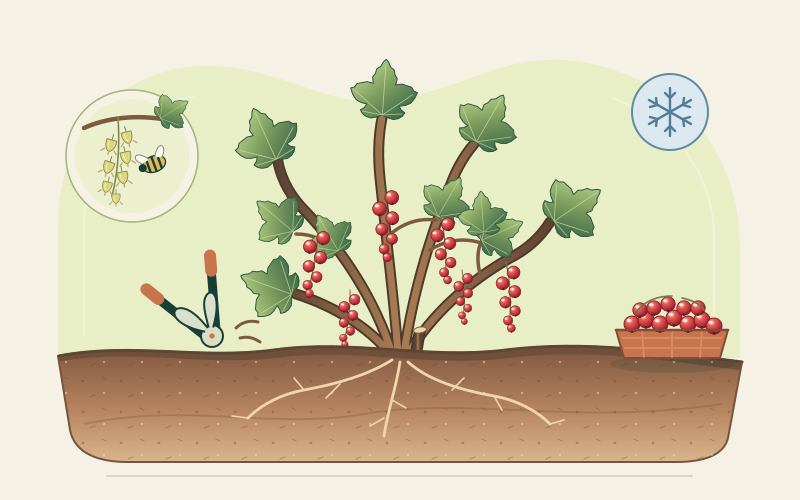
Name the species before planning the pruning
Red currants and white currants are forms of Ribes rubrum. White fruit is a colour selection, not a separate black-currant species. Black currant is Ribes nigrum, with strongly aromatic foliage, darker berries and a greater emphasis on fruiting from vigorous young wood. Both are woody, deciduous perennials in the currant family, Grossulariaceae.
The botanical distinction has practical consequences. Red and white currants fruit at the base of the previous year’s shoots and on spurs that develop on older wood. A mature bush can therefore keep a lasting branch framework. Black currants crop especially well on strong young growth, so established bushes need more active removal of old stems to encourage replacements from the base.
Do not confuse either fruit with a dried Zante currant, which is a tiny dried grape. Nor should gooseberries and jostaberries be treated as interchangeable cultivars: they have their own identities, growth habits and, in some jurisdictions, planting rules.
Check winter chill, summer heat and local restrictions
Currants are adapted to cold-temperate climates. They need winter dormancy and sufficient accumulated chilling for even budbreak, followed by a growing season without excessive heat. There is no single defensible chill-hour figure for every cultivar: requirements and measurement methods vary. Ask a local fruit specialist which named cultivars flower and crop reliably under conditions comparable to yours.
A cool tropical highland is not automatically suitable. Near the equator, altitude can lower temperature without supplying the seasonal winter chill these shrubs expect. Uneven or delayed budbreak and repeated failure to flower are warning signs. In Mediterranean and other warm districts, cool uplands and afternoon shade may help, but they cannot guarantee adequate chilling.
Check the law before buying or moving plants. Ribes species can alternate-host white-pine blister rust, Cronartium ribicola, which also needs susceptible five-needle pines to complete its life cycle. Black currants and eastern white pine are highly susceptible; red currants vary. The former United States federal ban was lifted in 1966, but state or provincial restrictions can remain. Rules can differ by species, cultivar resistance, location and plant certification. Resistance does not automatically make a plant legal.
Plant and establish the perennial framework
Buy healthy, named stock
Choose certified virus-free plants from a reputable local nursery. Select cultivars for local chill, ripening season, mildew or rust resistance where independently verified, and the training space available. A bush, cordon and standard need different starting material and pruning; do not force every young plant into the same shape.
Choose sun or light shade with moving air
Full sun suits cool districts; light or afternoon shade is useful where summers are hot. Avoid deep shade, exposed wind tunnels, frost pockets and stagnant, damp corners. The soil should hold moisture without remaining saturated. Remove perennial weeds and use a soil test rather than guessing at fertiliser or large pH corrections.
Plant at the locally suitable dormant time
In cool-temperate regions, plant bare-root stock from late autumn to early spring when soil is unfrozen and not waterlogged. Container plants can be planted at other times but need more watering. Set red/white bushes about 1.2–1.5 m apart and vigorous black currants around 1.5–1.8 m apart; cordons can be closer. Follow the supplier for grafted standards and unusual cultivars.
Water, mulch and sacrifice first flowers
Firm soil around spread roots without burying grafts, then water thoroughly. Apply an organic mulch around the root zone while leaving a small clear circle at the stems. Water new plants through dry spells for their first couple of years. Removing first-season flowers sacrifices an early taste in favour of root and shoot establishment.
Expect a crop in years, not weeks
Under favourable conditions, a light crop can arrive in the second year after planting, with fuller production by the third; Oregon State also notes that mature production can extend into the fourth year. Nursery-stock age, planting-time pruning and climate shift the schedule. “2–3 years” is an establishment guide, not an annual days-to-harvest interval.
Keep flowers accessible and prune for fruiting wood
Red currants are generally self-fruitful, so one plant can crop. Cross-pollination from another cultivar may improve fruit size. Some black currants are self-sterile and need a compatible second cultivar; read the supplier’s pollination note rather than assuming every black currant behaves alike. Insects pollinate the small flowers. Avoid broad-spectrum insecticide during bloom and never leave frost fleece or netting over the flowers throughout the day.
Prune during dormancy with clean, sharp tools. At any age, remove dead, broken, diseased, rubbing and ground-level growth first. Then follow the species pattern below rather than reducing every stem to an arbitrary height.
| Crop | Best fruiting wood | Renewal approach |
|---|---|---|
| Red and white currant | Base of one-year shoots and spurs on two-, three-year and older wood | Keep an open framework; Oregon State suggests 9–12 canes across one-, two- and three-year ages, removing four-year and older canes |
| Black currant | Vigorous one-year growth and young stems carrying it | On established bushes, cut up to one third of the oldest stems to the base each winter to stimulate replacements |
Cordons, fans and standards need a more specific sequence of leader and sideshoot pruning, including summer cuts for trained red/white forms. Follow a training guide for that exact shape. Newly planted black currants may also be cut low to stimulate basal shoots, but that deliberately delays early fruit. Never remove a large fraction of healthy wood simply because a neighbour does so.
Harvest by colour and taste, then chill quickly
Currants ripen over roughly two weeks and can hang for a short period after colouring, allowing flavour to develop. Sample a berry rather than treating colour alone as proof of sweetness. Cut whole red or white clusters—called strigs—with scissors or snips. Modern black-currant cultivars often ripen evenly enough to harvest whole strigs; older types may require selective picking. Handle the soft fruit gently and protect it from birds using taut netting or a fruit cage that cannot trap wildlife.
Refrigerate sound fruit promptly in a shallow container; avoid deep piles that crush lower berries. Use fresh currants within a few days, removing mouldy or leaking fruit. Wash under clean running water just before eating or processing, strip out stems and damaged berries, and use clean hands, utensils and work surfaces. Do not use soap or household disinfectant on fruit.
For freezing, spread clean, sound, thoroughly drained berries on a tray so they do not freeze in one block, then pack into suitable airtight freezer containers. Currants also suit juice, syrup, jam and jelly; their natural acidity and pectin are useful in preserves. Added sugar changes the final food, and water-bath canning requires a tested recipe with the correct jar, acidity and processing instructions. Refrigerate opened preserves and perishable cooked mixtures promptly.
Diagnose poor cropping before reaching for a treatment
No fruit can reflect youth, inadequate winter chill, spring frost, deep shade, missing pollinizers or pruning away the productive wood. Curled, blistered young leaves may harbour aphids; sawfly larvae can strip foliage; swollen black-currant buds can indicate big bud mite; white surface growth can indicate powdery mildew. Brown leaf spots and early leaf fall have several possible causes. Confirm the pest or disease locally before acting.
Favour certified stock, suitable spacing, sanitation, resistant cultivars and accurate dormant pruning. Remove diseased or infested wood only as local guidance recommends, and do not compost material that should be destroyed or contained. If a legally available pesticide is justified, its label governs the crop, target, timing, protective equipment and dose; homemade mixtures are not a safe substitute. Check five-needle pines and Ribes together where blister rust is a concern, and involve plant-health authorities when required.
Sources and further guidance
- Cornell University Fruit Resources: Currants and gooseberries
- Oregon State University Extension: Growing currants and other minor berry crops
- Royal Horticultural Society: How to grow redcurrants
- Royal Horticultural Society: How to grow whitecurrants
- Royal Horticultural Society: How to grow blackcurrants
- US Food and Drug Administration: Selecting and serving raw produce safely