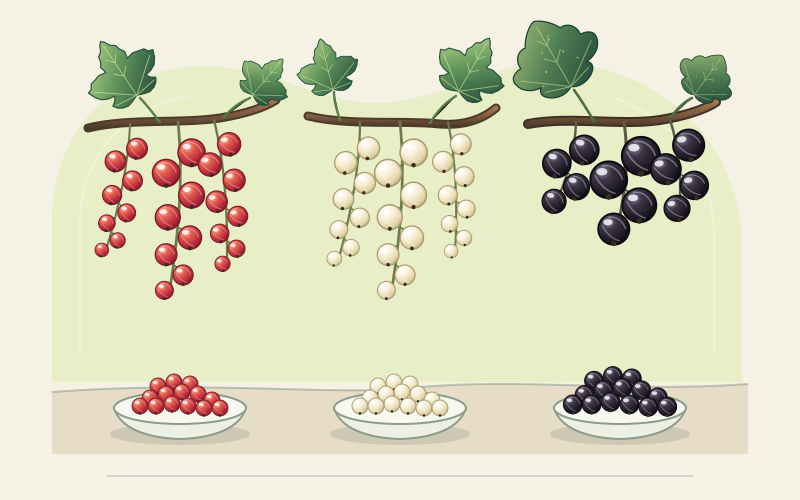
Two species, three familiar fruit colours
Red currants are Ribes rubrum. White currants are pale-fruited forms of that same species, not albino black currants and not a distinct botanical species. Their translucent cream-to-yellow berries often taste milder, but colour does not guarantee sweetness. Pink-fruited selections also occur within this red/white-currant group.
Black currant is Ribes nigrum. Its leaves and fruit have a characteristic strong aroma, and the berries are commonly used for juice, jam and other cooked preparations as well as eaten fresh when fully ripe. Its bush habit and fruiting pattern differ from red/white currant, so pruning advice must travel with the species name.
Both are long-lived deciduous shrubs. A first light crop is realistic around the second year after planting, with fuller cropping around year three under favourable conditions. This is a perennial establishment period: once mature, the bush does not take another two or three years between harvests.
Choose the pruning future as well as the berry
Red and white currants fruit on older spur systems. They bear at the base of one-year shoots and on short spurs arising from two-, three-year and older wood. A free-standing bush is normally kept open-centred with a mixture of ages; Oregon State describes 9–12 main canes across one-, two- and three-year classes, removing older wood. These currants also adapt to cordons, fans and standards because their permanent framework can carry fruiting spurs.
Black currants favour strong young growth. Vigorous one-year shoots and younger stems bearing them are especially productive. On an established bush, remove up to one third of the oldest, darkest stems at ground level during dormancy to make room for replacements. This is a more renewal-heavy system than red/white-currant pruning.
| Feature | Red and white currant | Black currant |
|---|---|---|
| Botanical identity | Ribes rubrum | Ribes nigrum |
| Main fruiting pattern | Base of young shoots and spurs on older wood | Strong young growth, especially one-year wood |
| Pollination | Generally self-fruitful; another cultivar can improve fruit size | Many crop alone, but some cultivars are self-sterile and need a pollinizer |
| Training | Bush, cordon, fan or standard | Usually multi-stemmed bush; standards need specific management |
| Harvest | Whole coloured strigs after flavour develops | Whole strigs for even-ripening types or selective picking for uneven types |
Use named cultivars as examples, not universal winners
Red: long strigs and a spread of ripening dates
‘Red Lake’ is a familiar cultivar with large dark-red berries on a vigorous bush; RHS notes its later ripening. ‘Rovada’ is valued for long, heavy strigs and late-season fruit. ‘Jonkheer van Tets’ represents the earlier end of the season. These examples can help a buyer ask about ripening sequence, but availability and performance differ by country. A local trial or nursery record is more useful than a universal flavour ranking.
White and pink: pale fruit with the same basic pruning
‘Blanka’ is a productive white selection with large, pale berries. ‘Primus’ and ‘White Imperial’ are other names encountered in nursery catalogues. Their translucent colour can make ripeness less obvious than on a scarlet cultivar, so taste before harvesting the whole bush. White currants are grown and pruned like red currants; they do not need a black-currant renewal regime.
Black: harvest habit, compactness and disease resistance
‘Ben Sarek’ is relatively compact and bears large fruit on short strigs. ‘Ben Connan’ and ‘Big Ben’ are examples of modern cultivars with comparatively even ripening, making whole-strig harvest easier. ‘Titania’, ‘Consort’ and ‘Crusader’ are widely described as resistant to white-pine blister rust. Resistance is one selection criterion, not a promise of immunity from every disease or automatic legal permission to plant.
For any black-currant cultivar, check its self-fertility. Oregon State notes that some are self-sterile. If a compatible second cultivar is required, both must flower at an overlapping time and be permitted in your area. Buying two random black currants is less reliable than following an explicit pollination recommendation.
Check resistance claims, certification and local law
Currants and other Ribes can alternate-host white-pine blister rust. The fungus requires both a susceptible Ribes host and a susceptible five-needle pine at different stages of its life cycle. Black currant is particularly susceptible, while red-currant reactions vary. This matters most where valued or vulnerable five-needle pines occur, and local plant-health authorities may regulate planting, sale or movement.
The old United States federal prohibition was rescinded in 1966, but it did not erase every state or local restriction. Other countries and provinces can have their own plant-health requirements. Ask the authority responsible for your actual planting site, not just the nursery’s location. Keep the cultivar label and certification paperwork.
Buy certified virus-free stock where a scheme exists. “Virus-free,” “rust-resistant” and “self-fertile” are separate claims; one does not prove the others. Likewise, a plant sold as simply “currant” does not provide enough information for correct pruning. Request the full botanical and cultivar name before purchase.
Match the harvest to the kitchen without mixing the records
Red currants bring bright acidity and colour to fresh desserts, sauces and clear jellies. White currants offer similar versatility with a pale garnish. Black currants have a more assertive aroma and are often cooked, juiced or frozen, although ripe berries can be eaten fresh. These are culinary tendencies, not rules about which fruit is “best.”
Do not confuse fresh currants with dried Zante currants. Those small dried fruits come from grapes and behave like raisins in baking. They have a different plant identity and nutrient profile. Nor should the USDA red-and-white raw-food record be applied to black currants: the two have separate entries and markedly different vitamin-C values.
For a small garden, one well-labelled red or white bush may be enough because these are generally self-fruitful. Add another cultivar for a longer season or cross-pollination only when space and local rules allow. For black currants, resolve pollination and legal questions first, then choose bush size, harvest habit and flavour.
Sources and cultivar references
- Royal Horticultural Society: Redcurrant forms and cultivars
- Royal Horticultural Society: Whitecurrants as a form of Ribes rubrum
- Royal Horticultural Society: Blackcurrant cultivars and harvest habits
- Cornell University: Species, cultivars, legalities and pruning
- Oregon State University Extension: Pollination, fruiting wood and cultivar selection