Choose the crop before choosing the support
Cucumber, Cucumis sativus, is a frost-tender annual vine in the gourd family. It is harvested while the fruit is still immature. Slicing types are selected primarily for fresh eating, while pickling types are picked at small sizes for their shape, skin and texture. A dual-purpose cultivar can be useful, but a giant overripe slicer does not become a good pickle simply by adding vinegar.
Also read the growing-system and flower description. Outdoor or ridge cucumbers are suited to open beds; greenhouse types often prefer protected warmth. Parthenocarpic cultivars set fruit without pollination, while many outdoor types need pollen moved from male to female flowers. Some modern cultivars are predominantly female or gynoecious and may include a small proportion of pollinator seed. The packet, not fruit shape, is the place to confirm these details.
Rooted uses an indicative 50–70 days from sowing to first harvest for many cultivars in favourable warmth. This applies whether seed stays in its final position or spends about 3–4 weeks in a protected nursery. Small pickling and mini types may be earlier; cool nights, heat stress and inconsistent water can delay any crop.
Direct-sow or transplant without a long pot-bound pause
Wait for warm soil and settled weather
Cucumber seed and roots are checked by cold, saturated soil. Direct-sow after local frost danger, when the soil has warmed and the forecast no longer returns to cold wet conditions. A cloche may moderate an exposed bed, but it cannot make an out-of-season sowing reliably warm. Use a locally suited early cultivar where the frost-free season is short.
Sow at the packet’s depth and spacing
A common starting depth is about 1–2 cm. Place seeds at their final stations or in rows, keep the seed zone moist rather than flooded, and thin surplus seedlings to leave strong plants at the supplier’s spacing. Follow the mature cultivar’s spread: a compact bush plant and a full-sized climbing vine do not need the same footprint.
Keep any nursery period short
For transplants, sow into individual pots roughly 3–4 weeks before the intended planting date. Give seedlings bright light immediately after emergence and suitable warmth. Pot on only if genuinely needed, and do not hold plants until roots circle tightly. Harden them off gradually to outdoor light, wind and temperature before planting.
Plant with intact roots and support ready
Choose full sun and fertile, moisture-retentive but free-draining soil. Water the pot, slide out the root ball gently and plant at its original depth. Avoid burying the stem. Put the trellis or strings in place at planting so later stakes do not pierce the root zone, then water at soil level and protect young plants from locally identified slugs or other pests.
Train a trellis that can carry wet vines and fruit
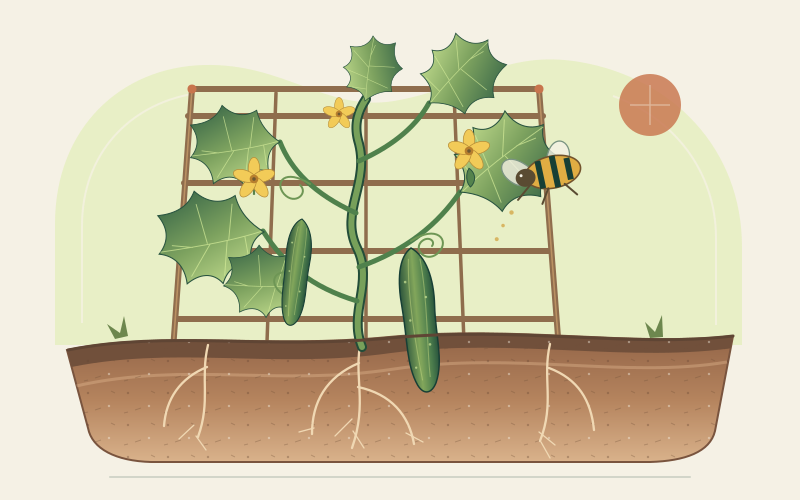
Cucumbers can scramble over the ground, but a secure trellis saves space, improves access and keeps fruit away from wet soil. Use rigid mesh, stout netting, a frame with twine or another system rated for the mature load. Anchor posts against wind and heavy rain. Thin unsupported string tied to a fragile greenhouse component is not a safe substitute for a proper load-bearing fixing.
Guide the main stem loosely to its support until the coiled tendrils begin holding it. Check ties as stems thicken and redirect wandering growth without snapping it. Trellising can improve airflow, but crowded foliage still stays humid; avoid packing plants together in the name of vertical growing. Pruning systems differ between greenhouse and outdoor cultivars, so follow supplier or local extension instructions rather than removing every side-shoot.
Read the flowers before removing any
A female flower has a small immature fruit between its petals and the stem; a male flower has only a slender flower stalk. On a pollen-dependent plant, bees or other suitable pollinators must move pollen from male to female blooms. Poor pollination can leave fruit underdeveloped or distorted. Planting pollinator-friendly flowers nearby can support visits, but does not compensate for killing or excluding insects at bloom.
Do not use broad-spectrum insecticide on blooming cucumbers, and identify any pest before considering a legally permitted, crop-specific control. Temporary insect netting used on seedlings must be opened when a pollen-dependent cultivar flowers. Avoid unnecessary handling or spraying during pollinator activity.
Some all-female parthenocarpic greenhouse cucumbers are grown without pollination and may become seedy, misshapen or bitter if fertilised. Remove occasional male flowers only when the cultivar instructions call for it, and isolate these plants from outside pollen where the supplier recommends. Never apply that rule to an ordinary outdoor monoecious plant: its male flowers are essential.
Water steadily and address bitterness honestly
Check moisture below the surface and water the root zone thoroughly when needed, especially during flowering and fruit expansion. Containers and covered crops can dry rapidly. Mulch warm soil to buffer evaporation, leaving a gap around the stem, and avoid alternating severe drying with flooding. Use soil tests and local recommendations for nutrients; excessive nitrogen can favour lush growth without solving fruit-set problems.
Bitterness comes from naturally occurring cucurbitacins. Genetics strongly influence the risk, while drought, high temperatures and other severe stress can encourage it in susceptible plants. Compounds may be more concentrated at the stem end and in or just beneath the skin, but distribution varies. Taste a small slice from the stem end before preparing a batch; if it is distinctly bitter, discard the fruit rather than assuming peeling, salting, cooking or pickling will reliably make it acceptable.
Powdery mildew, downy mildew, aphids, beetles and soil problems vary by place. Choose resistance for the named local disease, rotate away from related cucurbits where practical, water at the base and inspect leaf undersides. Seek local diagnosis for spreading or unusual damage rather than treating every leaf spot with an improvised mixture.
Harvest young, wash fresh food and keep pickling tested
Inspect plants every day or two in peak production. Use clean secateurs or a knife to cut the short fruit stalk rather than tearing the vine. Pick at the size listed for the cultivar: small gherkins, mini cucumbers and full slicers are not ready at one universal length. Firm, evenly coloured fruit generally has better texture; yellowing, swelling and coarse seeds indicate an aging fruit. Regular harvest encourages continued production.
For fresh use, wash hands and clean preparation surfaces first. Rinse whole cucumbers under clean running water and scrub firm skin with a clean produce brush, even if you plan to peel them. Do not use soap, detergent or unapproved produce washes. Dry with a clean towel, keep cut cucumber separate from raw meat and its utensils, and refrigerate cut or prepared produce promptly. Discard rotten produce rather than washing it into a salad.
Cucumbers are a low-acid food. An acidified pickle becomes suitable for its stated storage only when the complete recipe and process have been tested together. Use a current recipe from the National Center for Home Food Preservation, USDA or a university extension service. Follow the specified cucumber preparation, vinegar acidity, ingredient proportions, jar filling, headspace, heat process and storage conditions. Do not dilute vinegar, substitute a lower-acid ingredient, reduce acid, change jar size or invent a processing time.
Refrigerator pickles are not shelf-stable unless a tested recipe explicitly says so; keep them refrigerated and observe its storage limit. Shelf-stable acidified pickles require the tested heat process where specified. Do not water-bath plain cucumbers, and do not treat an old family brine, a pH strip reading or a vacuum-sealed lid as validation of an untested recipe.
Sources and further guidance
- Royal Horticultural Society: How to grow cucumbers
- University of Minnesota Extension: Growing cucumbers
- Purdue University Consumer Horticulture: Cucumbers bitter during hot, dry weather
- US Food and Drug Administration: Selecting and serving produce safely
- National Center for Home Food Preservation: Tested pickling guidance and recipes