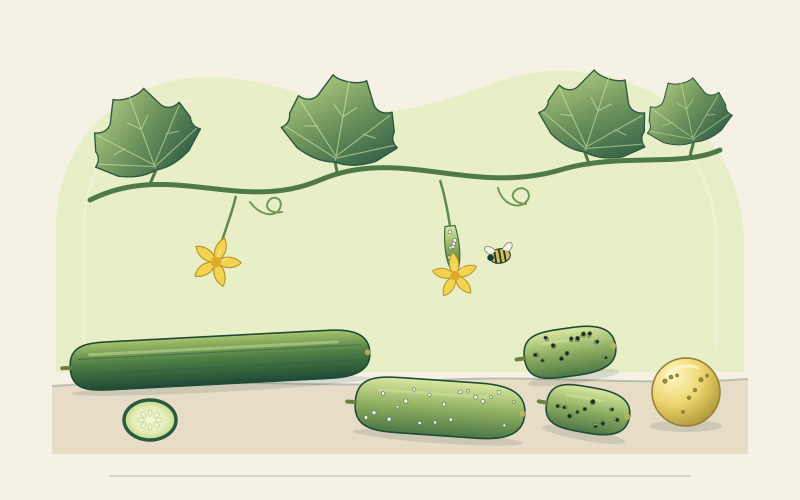
One species, several useful selections
Slicing cucumbers, small pickling gherkins, long greenhouse fruit, compact container plants and yellow lemon-shaped cucumbers are all cultivated forms of Cucumis sativus. “Gherkin” can mean a small cucumber or its pickle; it does not identify one universal cultivar. Armenian cucumbers, often sold beside them, are botanically a melon, Cucumis melo, and are outside this comparison.
A type is only a starting point. Within slicing or pickling groups, cultivars differ in days to harvest, vine size, disease resistance, skin texture, flower pattern and tolerance of heat or cool weather. Read the full seed description and prioritise local trials over a catalogue colour photograph.
Rooted’s 50–70-day first-harvest guide runs from sowing. Small-fruited types may mature earlier, while a protected transplant usually spends 3–4 weeks indoors before planting out. No type can compress an inadequate frost-free season indefinitely.
Slicing and pickling describe intended use
Slicing: fresh texture at a larger size
Slicing cucumbers are selected for fresh salads and sandwiches. Fruit may be short and thick-skinned, long and smooth, miniature, striped or otherwise distinctive. Many are harvested around 15–25 cm, but mini and specialty types have their own targets. Thin skin does not automatically mean better flavour, fewer seeds or lower bitterness; compare the actual cultivar and harvest at its recommended stage.
Pickling: small, uniform fruit at frequent harvests
Pickling cucumbers are commonly blockier, smaller and thinner-skinned, with a shape and flesh selected for processing. They can produce heavily over a short period and need frequent picking at the precise size required by the tested recipe. Small size is a harvest stage, not permission to leave the crop until seeds become hard. Some cultivars are labelled dual purpose: pick them young for processing and larger for fresh use.
| Selection | Useful traits to compare | Harvest and handling |
|---|---|---|
| Fresh slicer | Texture, skin, vine size, local disease resistance | Pick at the stated fresh size; chill cut fruit promptly |
| Mini or snack type | Small mature size, plant habit, production pattern | Pick before fruit outgrows its intended tender stage |
| Pickling type | Uniform small fruit, skin, cavity and concentration of yield | Harvest frequently; process with a complete tested recipe |
| Dual purpose | Quality at both stated harvest sizes | Match each fruit to its use; do not process old, seedy fruit |
“Burpless” is a marketing and selection term associated with mild eating quality, not a botanical category or a guarantee against every bitter fruit. Likewise, an heirloom or organic seed label does not establish sweetness or safety. Good growing conditions and timely harvest still matter.
Match the habit to the actual growing space
Greenhouse or indoor types often produce long, relatively smooth fruit in protected warmth. They may be all female and parthenocarpic. Outdoor or ridge types are selected for open-ground conditions and commonly produce both male and female flowers that require insect pollination. Neither group is universally superior: an outdoor cultivar may frustrate a greenhouse grower expecting parthenocarpic fruit, while a long greenhouse type may struggle in an exposed short-season bed.
Vining types climb with tendrils and repay a sturdy trellis. Compact or bush types suit smaller beds and containers but still need enough root volume, drainage, water and sunlight. “Patio” does not mean no support or no feeding. Grafted plants may offer vigour or resistance to particular soil problems, but cost more and still require suitable scion cultivar traits and local care.
Choose resistance for diseases actually named in local guidance. Resistance to one mildew or virus does not imply resistance to every cucumber disease. A cultivar that excels in a dry greenhouse may perform differently in humid monsoon weather or a cool coastal garden.
Pollination terms change how you manage flowers
Monoecious cucumber plants produce separate male and female flowers on the same plant. Pollen must usually move between them for fruit development. Gynoecious cultivars produce predominantly female flowers; seed packets may include a pollinator cultivar to supply male flowers. Read and sow that proportion as directed rather than discarding the different-looking seeds.
Parthenocarpic cultivars form fruit without fertilisation. They are valuable where pollinators are absent or excluded. Some all-female greenhouse types produce seedy, swollen or bitter fruit if pollinated; follow supplier instructions on excluding pollen and removing any male flowers. Parthenocarpy and gynoecy are different traits: predominantly female flowers do not by themselves prove fruit will set without pollen.
This distinction prevents two opposite mistakes: removing all male flowers from an outdoor plant and getting poor fruit set, or allowing pollinated fruit on a greenhouse cultivar selected to remain seedless. If the packet is unclear, ask the supplier before planting rather than applying a universal flower-plucking rule.
Choose against bitterness, then grow against stress
Bitterness is associated with cucurbitacins and has a strong genetic component. Cultivars described as bitter-free or non-bitter can reduce risk where that claim comes from a reputable supplier, but no label makes severe stress desirable. Heat, drought and irregular growing conditions can contribute in susceptible plants.
Buy seed suited to your use and site, water evenly, protect roots and harvest young. If a fruit tastes distinctly bitter at the stem end, discard it; do not assume the other end, peeled flesh or a vinegar brine will necessarily be free of bitterness. Saving seed from bitter fruit is also a poor selection strategy for the next generation.
Read hybrid, open-pollinated and seed-saving labels separately
An F1 hybrid results from controlled crossing of selected parents and may provide useful uniformity, vigour or resistance. Saved seed will generally produce a variable next generation rather than recreating the original hybrid. Hybrid does not mean genetically engineered, unsafe or unable to reproduce.
An open-pollinated cultivar is the practical starting point for seed saving, but cucumbers cross with other compatible Cucumis sativus. Use locally recommended isolation by distance, time or controlled hand pollination, and save from enough suitable plants to maintain diversity. Parthenocarpic fruit may contain few or no viable seeds because it developed without fertilisation.
“Heirloom” usually refers to an older open-pollinated selection, not a guarantee of adaptation or disease resistance. “Non-GMO,” organic and hybrid answer different questions. For a home seed crop, learn the cultivar’s flower system and isolation needs before planting several types together.
Sources and variety references
- Royal Horticultural Society: Cucumber types, protected cultivation and flower handling
- University of Minnesota Extension: Growing cucumbers
- Purdue University Consumer Horticulture: Cucumbers bitter during hot, dry weather
- University of Maine Cooperative Extension: An introduction to seed saving
- US Food and Drug Administration: Science and history of GMOs and other food-modification processes