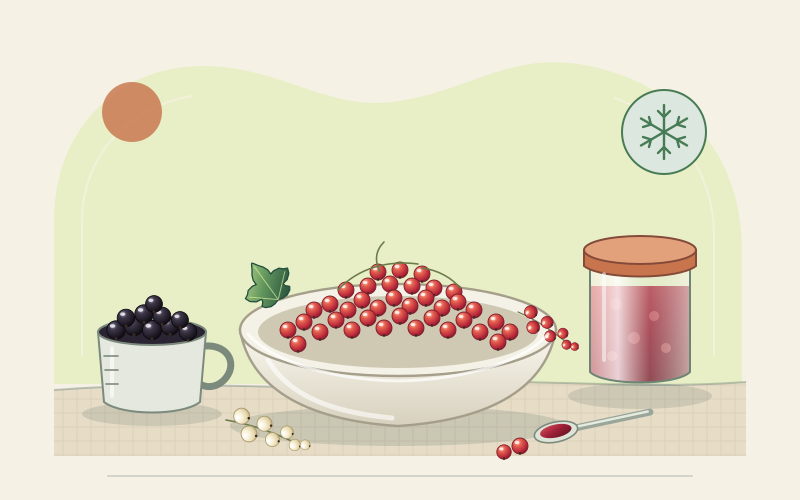
Begin with two exact raw-food records
The USDA entry used for Rooted’s crop profile is “Currants, red and white, raw,” FoodData Central SR Legacy 173964. Values below are approximate amounts per 100 grams of the raw edible fruit. They do not describe cooked fruit, jam, juice or black currants.
| Nutrient | Amount | Context |
|---|---|---|
| Protein | 1.4 g | Currants are fruit, not a primary protein food |
| Dietary fibre | 4.3 g | Intact berries retain their plant structure; straining changes the product |
| Folate | 8 µg | A modest contribution compared with many other foods |
| Iron | 1 mg | Amount eaten and the wider meal determine intake |
| Potassium | 275 mg | A mineral contribution within the overall diet |
| Vitamin C | 41 mg | Raw red/white value, not the black-currant value |
The separate USDA entry “Currants, European black, raw,” SR Legacy 173963 lists 1.4 g protein, 1.54 mg iron, 322 mg potassium and 181 mg vitamin C per 100 g. It does not list a total-dietary-fibre value in that legacy record, so it would be misleading to fill the gap with the red/white figure. Different records can also have different levels of analytical detail.
Rooted places currants in its High, qualitative rank 3 editorial category. That category considers protein, fibre, folate, iron and potassium density across crop profiles; it is not an official nutrient-density score and does not erase the differences between species. It is also not a health claim or a reason to prefer currants over every other fruit.
What vitamin C does—and what a number cannot tell you
Vitamin C, or ascorbic acid, is a water-soluble vitamin involved in collagen formation and other normal body processes. It also acts as an antioxidant in biological systems. The NIH Office of Dietary Supplements explains requirements, food sources and groups at risk of inadequate intake; an individual’s needs are not determined by a single berry serving.
A 100-gram database amount is a comparison unit, not a mandatory serving. A handful, a full dessert bowl and a spoonful used as garnish contain different amounts. Actual fruit composition also varies with cultivar, ripeness, growing conditions, storage and laboratory method. Database figures therefore provide useful reference points, not a precise analysis of the currants on your bush.
The difference between 41 mg in raw red/white currants and 181 mg in raw European black currants is substantial. It does not justify promising prevention or treatment of colds, cardiovascular disease or any other condition. Food composition is not evidence of a guaranteed clinical outcome, and concentrated supplements are a separate question requiring appropriate professional advice.
Vitamin C can enhance absorption of non-heme iron from plant foods when consumed in the same meal. That does not create iron or make currants a treatment for iron deficiency. Use beans, lentils, grains, vegetables and fruit as parts of a varied diet, and seek qualified care for a diagnosed deficiency.
Cooking, juice, jam and drying are different foods
Vitamin C is sensitive to heat, oxygen and storage and can move into cooking water. Gentle preparation and using the liquid in a sauce or soup can retain more of what would otherwise be discarded, but there is no single retention percentage for every recipe. Fibre and minerals do not simply vanish when berries are heated, although straining and dilution alter their concentration in the final food.
| Preparation | Nutrition consideration | Kitchen consideration |
|---|---|---|
| Fresh raw berries | The two raw USDA entries belong here | Tartness varies; wash just before use |
| Cooked sauce or compote | Heat, water and added ingredients change the profile | Use the cooking liquid when the recipe allows |
| Strained juice or jelly | Removed pulp changes fibre; added sugar may be substantial | A spoonful of jelly is not 100 g of raw fruit |
| Frozen plain currants | Useful for later use; thawing and later cooking still matter | Freeze clean, dry, sound fruit and protect from freezer burn |
| Dried Zante currants | A different food entirely: dried grapes | Common in baking, but not dried Ribes berries |
Jam and jelly can be practical ways to preserve a glut, but recipes commonly add considerable sugar. The fruit’s acidity and pectin help some preserves set; that does not make the finished jar nutritionally equivalent to a bowl of raw berries. Compare labels or recipes and be clear about serving size.
Build an ordinary, varied meal around tart berries
Fresh currants work with plain yogurt, skyr or a fortified soy alternative, adding fruit and acidity to a food with protein and other nutrients. Fortification differs between products, so read the label rather than assuming all alternatives match dairy. Oats or another grain can make the combination more substantial and add their own fibre and micronutrients.
For a savoury option, fold white or red currants through a grain salad with beans or lentils, herbs, vegetables and toasted seeds. Their acidity can balance soft cheese or a nut-based dressing. None of these is a required “nutrient pairing”; they are flexible ways to include fruit in meals with different textures and nutrient profiles.
Whole berries, sauces and baked goods all have a place. The useful question is not whether a food earns a health halo, but what portion is eaten, what else came with it and how often it appears in the overall diet.
Store fresh and prepared currants as perishable food
Handle the harvest gently
Pick dry, sound berries and avoid leaving them in a warm, deep harvest container. Refrigerate promptly in a shallow container. Do not wash long before storage if you cannot dry the fruit well; excess surface moisture can accelerate spoilage. Discard mouldy, fermented, badly damaged or doubtful berries rather than trying to rescue them in jam.
Wash before use
Wash hands and clean the sink, utensils and preparation surface. Rinse berries under clean running water and remove stems and debris. Do not use soap, bleach or household disinfectant on produce. Prevent contact with raw meat, poultry or their juices, and refrigerate cut or prepared fruit promptly.
Freeze a sound surplus
Spread clean, well-drained berries in a single layer on a tray and freeze until firm before transferring to moisture-resistant freezer packaging. Label and date the container, leave no more air than necessary and keep the freezer at a safe temperature. Thaw in the refrigerator or use directly in cooking; do not leave a large container to thaw all day at room temperature.
Use tested preserving instructions
For shelf-stable jam, jelly or juice, follow a current tested recipe from a recognised food-preservation authority. Jar size, acidity, heat process and altitude adjustments matter. Freezer jam and refrigerator compote are not shelf-stable. Cool and refrigerate leftovers promptly, and do not taste preserved food showing mould, spurting, broken seals or other signs of spoilage.
Home-grown origin does not replace cleaning, chilling or safe processing. Fresh currants generally keep only a few days in the refrigerator; quality and storage life depend on ripeness and handling, so inspect them rather than relying on an exact deadline.
Sources and specialist references
- USDA FoodData Central: Currants, red and white, raw (173964)
- USDA FoodData Central: Currants, European black, raw (173963)
- NIH Office of Dietary Supplements: Vitamin C fact sheet for consumers
- NIH Office of Dietary Supplements: Iron fact sheet for consumers
- US Food and Drug Administration: Selecting and serving raw produce safely
- Oregon State University Extension: Harvesting and freezing currants