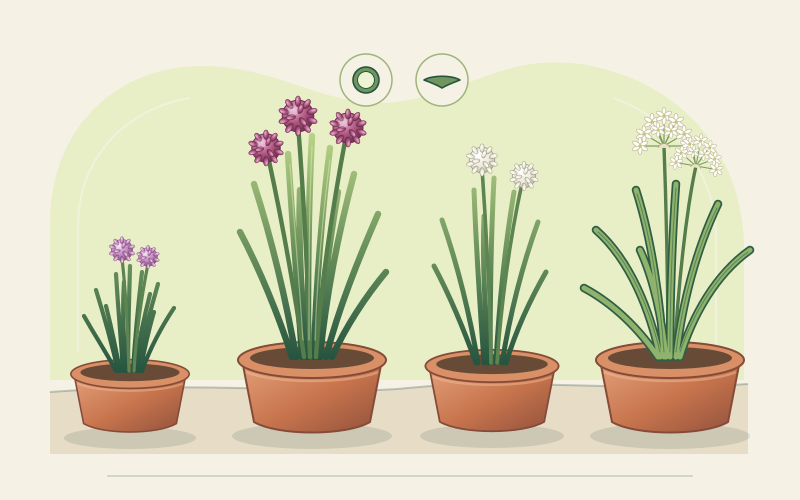
Start with the botanical identity
The common chive in this guide is Allium schoenoprasum. Kew Plants of the World Online places its native range across the temperate Northern Hemisphere. It forms a perennial clump of small bulbs, narrow hollow leaves and rounded heads of usually pink to pale-purple flowers. A packet labelled simply “chives” often means this species, but checking the botanical name prevents substitutions.
Garlic chives are not a cultivar of common chive. Allium tuberosum has flatter, broader leaves, a garlic-like flavour and white starry flowers, often at a different season. Siberian garlic chives, Allium nutans, are another related species with broad leaves and mauve or pink flowers. Ornamental Allium cultivars are not automatically interchangeable culinary herbs.
All true chive cultivars below remain A. schoenoprasum. Rooted’s 60–90-day window from sowing to first light harvest applies to this species under favourable conditions. Selection, temperature and establishment still shift timing. Divisions and transplants start with more plant mass but must establish before substantial cutting.
| Name | Botanical identity | Distinguishing features |
|---|---|---|
| Common chive | A. schoenoprasum | Hollow cylindrical leaves; usually mauve or pink globes |
| Garlic or Chinese chives | A. tuberosum | Flat leaves; garlic-like flavour; white starry flowers |
| Siberian garlic chives | A. nutans | Broad grey-green leaves; mauve or pale-pink flowers |
Choose culinary leaf strains for a workable clump
Species or unnamed common chives
An ordinary packet or division is often enough for a home garden. Expect the familiar mild-onion leaves and mauve flower heads, with some natural variation in seed-grown plants. This is a sensible baseline for a small local trial and avoids paying for a trait you do not need.
‘Dolores’ and ‘Polyvert’
Wisconsin Extension describes ‘Dolores’ as a culinary seed variety with narrow, dark-green leaves and a uniform, upright habit. ‘Polyvert’ is described as a vigorous seed strain with medium, dark-green foliage and uniform growth. Uniformity helps when several clumps are intended to grow and be harvested together; it does not prove superior flavour in every garden.
Fine leaves are easy to snip into a delicate garnish, while slightly broader or more vigorous foliage can be convenient for larger cuttings. Catalogue descriptions are not standardised measurements. Compare actual leaf thickness, mature height and days to harvest from the supplier, then judge regrowth in your own conditions.
Use size and flower colour as explicit selection traits
‘Forescate’ and other large forms
RHS and Wisconsin Extension describe ‘Forescate’ as larger than the species, with pink flowers. Wisconsin lists a height around 45–50 cm, making it a candidate for gardeners wanting substantial leaves and prominent blooms. Larger does not mean tougher or more nutritious by definition. Give it appropriate space and harvest green leaves before age makes them coarse.
‘Snowcap’ and white-flowered forms
‘Snowcap’ is a semi-dwarf, white-flowered cultivar listed by Wisconsin Extension. White-flowered material may also appear as A. schoenoprasum f. albiflorum, or under ‘Album’-type names. These are flower-colour and habit choices, not separate vegetable species. Verify the full name and supplier description rather than assuming every white-flowered allium is a chive.
‘Curly Mauve’ and compact habits
Wisconsin Extension describes ‘Curly Mauve’ as having foliage that curls as it emerges before becoming more upright, with grey-lavender flowers above short growth. Such a selection may suit edging or a decorative container where its habit can be seen. “Dwarf” still requires division when the bulbs become crowded.
| Selection | Documented tendency | Selection cue |
|---|---|---|
| ‘Dolores’ | Narrow, dark leaves; uniform upright habit | Culinary uniformity |
| ‘Polyvert’ | Vigorous, uniform medium-dark foliage | Productive leaf clumps |
| ‘Forescate’ | Larger plant and pink flowers | Height and prominent bloom |
| ‘Snowcap’ | Semi-dwarf; white flowers | Compact, pale-flowered display |
| ‘Curly Mauve’ | Young curled foliage; grey-lavender flowers | Decorative edging or pots |
Decide whether flowers are for food, insects or seed
Flower colour does not change the basic management: leave some newly opened heads for pollinating insects, harvest others as edible garnish and remove spent stalks where self-seeding is unwanted. A white or brighter-pink cultivar is not automatically more valuable to insects. Avoid treating bloom colour as a measure of nectar production without evidence.
A sterile selection may flower without producing viable seed, while ordinary chives can self-seed readily. Read this trait precisely. Sterility is useful only if it matches your goal; such a plant must be propagated by division. Seed-grown selections can be multiplied from packet seed, but seedlings from an open-pollinated garden may not remain identical to a named parent.
Division is the dependable way to preserve a particular clump’s traits. Lift and split it during locally suitable cool, moist conditions, retain several bulbs and roots in each section, and let it establish before heavy harvest. Label the new clumps immediately; hollow green shoots are difficult to distinguish after names are lost.
Run a small, fair local trial
Start with your constraints: container or open ground, available width, winter severity, summer heat, desired leaf quantity and whether flower display matters. Ask local gardeners or herb nurseries which selections persist well. A cultivar successful in a mild maritime trial may behave differently in a continental winter or a hot, dry lowland.
If space allows, grow two selections under the same soil, watering and harvest regime. Record sowing or division date, first light harvest, leaf thickness, regrowth, flowering period, self-seeding and flavour. Do not compare a large purchased division with a seedling and call the difference a genetic result. Repeat promising observations through another season.
Buy viable seed or healthy plants from reputable suppliers and reject material with rot, extensive rust or unexplained pests. Keep common and garlic chives labelled separately. The growing guide gives the shared method; the nutrition article explains why its raw-leaf reference should not be transferred to flowers or another species.