Know the perennial you are planting
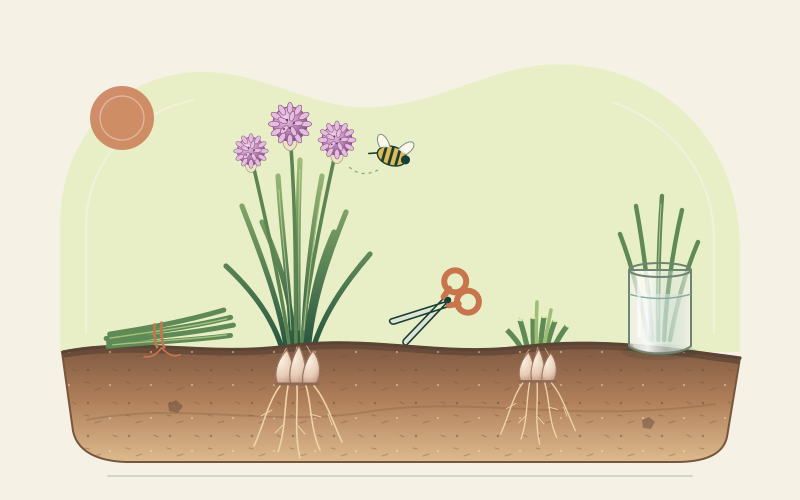
Common chive, Allium schoenoprasum, is a hardy, bulbous, herbaceous perennial in Amaryllidaceae, the onion family. Each dense clump contains many small bulbs and sends up narrow, hollow, cylindrical leaves. Rounded heads of pink to pale-purple florets stand above the foliage in late spring or summer. Both leaves and flowers are edible.
Rooted gives a 60–90-day first-harvest window from sowing, not a promise that a seedling can be cut hard on day 60. Begin lightly once leaves are about 15 cm long and the plant has enough growth to recover. Utah State University Extension reports harvest as early as 60 days after seeding or 30 days after transplanting; divisions need several weeks of new growth. Temperature, light and establishment shift every window.
A first-year plant benefits from restraint. Established clumps can supply repeated cuts during active growth and return after winter dormancy. Garlic chives, Allium tuberosum, have flat leaves and white flowers and are a different crop; do not use their timing or flavour as evidence about common chives.
Establish the clump without waterlogging it
-
Choose sun or partial shade and good drainage
Use fertile, moisture-retentive soil that does not remain saturated. Full sun supports strong growth, while light shade is useful in hotter districts. Weed thoroughly and add suitable mature organic matter if the soil is poor. Avoid packing wet soil around the small bulbs.
For a pot, choose a container at least 20 cm wide and deep with drainage holes. A larger vessel can hold several clumps but dries less evenly than a small pot. Use quality peat-free growing medium and never let the drainage holes remain blocked.
-
Sow shallowly and keep the seed zone moist
Sow indoors in early spring for an early start or outdoors in spring when soil is workable. Follow the packet first; roughly 0.5–1 cm deep is a common recommendation. A few seeds per module reduce transplant disturbance. Outdoors, sow thinly and protect the shallow seed zone from drying or washing together.
Harden off indoor-grown seedlings before planting out. Thin or set young clumps about 15–20 cm apart, allowing for local cultivar size. Plant at the same depth as before, firm lightly and water in. Seed-grown plants grow slowly at first and compete poorly with weeds.
-
Or plant a healthy division for a quicker start
A division is a piece of an existing perennial clump, not an onion set. Each section should contain several small bulbs, living roots and, if present, shoots. Replant promptly at the original depth and water. Let fresh roots and leaves establish for several weeks before taking more than a token harvest.
Use plants from a trusted source and avoid moving soil-borne pests or disease between gardens. A purchased pot may contain several crowded plantlets that can be separated gently. More divisions are not automatically better: very small fragments take longer to recover.
Maintain growth and renew congestion
Water seedlings, new divisions and containers to keep the growing medium evenly moist, not sodden. Established clumps in the ground tolerate some dryness but produce better with water during prolonged drought. Containers can dry rapidly in wind. A thin organic mulch can buffer moisture and suppress weeds, but keep it from burying the crowns.
Hand-weed carefully because chive roots are shallow. Chives have modest nutrient needs; excessive nitrogen is unnecessary. Remove yellowed leaves and clear old top growth before spring shoots emerge. In cold regions the foliage dies back naturally, while mild gardens may retain green leaves for longer.
Divide every three or four years, or sooner when a dense clump declines. RHS guidance favours spring or autumn; use the season when local soil is moist, workable and free of extreme heat or hard frost. Lift the whole clump, pull or cut it into sections with several bulbs and roots, replant at once and water well. Keep labels on selected cultivars because divisions preserve their characteristics, while self-sown seedlings can vary.
Aphids, thrips and orange pustules of leek rust can affect chives. Inspect leaves and identify the problem locally before acting. Encourage beneficial insects, remove badly affected growth where appropriate and rotate badly diseased allium ground. Never improvise pesticide doses or apply a product not labelled for culinary herbs. The presence of chives does not guarantee protection of neighbouring crops from pests.
Harvest leaves and flowers for people and pollinators
Use clean, sharp scissors to snip green, turgid leaves about 2.5–5 cm above the soil. Take a portion of a young clump rather than every leaf; regular moderate cutting encourages fresh growth. An established clump can be cut back more fully after flowering to stimulate a new flush, but it then needs several weeks to regrow.
Pick newly opened flowers for the kitchen and pull the head into small florets before scattering them over food. The stiff flower stalk is not the tender leaf harvest. Leave other heads open: RHS describes the small flowers as nectar-rich and attractive to bees and other pollinators, and Wisconsin Extension notes frequent visits by bumblebees and other bees. Avoid applying insecticide to open blooms.
After flowering, snip spent stalks at the base to tidy the plant and reduce self-seeding. If seed saving is wanted, leave selected heads until the capsules mature, keep the species identity clear and prevent unwanted volunteers. Deadheading is a choice about garden management, not a requirement to make every leaf edible.
| Harvest | When and how | Best use |
|---|---|---|
| Young leaves | After establishment; cut a few at a time | Fresh garnish, salads and dips |
| Established leaves | Snip 2.5–5 cm above soil; repeat moderately | Fresh use, freezing or thorough drying |
| Newly opened flowers | Pick clean heads; separate the florets | Salads and edible garnish |
| Spent flower stalks | Remove at the base after flowering | Compost if sound; do not use as tender leaves |
Refrigerate, freeze or dry—never improvise oil storage
Harvest clean, sound growth and keep it cool. Before eating, wash hands and rinse leaves or flowers under clean running water; do not use soap, detergent or disinfectant on produce. Dry with a clean towel. Keep ready-to-eat herbs away from raw meat and contaminated utensils, and discard slimy, mouldy or rotten material.
The FDA lists herbs among perishable produce to keep in a clean refrigerator at 4°C (40°F) or below. For short storage, wrap clean, dry chives loosely in a slightly damp—not wet—paper towel inside a reusable container or bag that limits drying but does not trap condensation. Wisconsin Extension gives up to a week of refrigerated storage for quality; inspect the actual herbs rather than treating that as a safety deadline.
For longer keeping, freeze chopped leaves in small labelled portions. They will soften after thawing, so use them in cooked or mixed dishes rather than expecting a crisp garnish. Drying is possible, though flavour declines substantially: dry completely using a method suited to your climate, condition only fully dry material in an airtight container in a cool, dry place, and discard anything mouldy or damp. Do not seal fresh, wet leaves in a dry-herb jar.
Fresh chives in oil are not shelf-stable. Moist, low-acid plant material in oxygen-limiting oil can permit botulism growth if stored without appropriate controls. Do not leave homemade herb-and-oil mixtures on the counter or preserve them by guesswork. Follow current food-safety extension directions for immediate refrigeration, short use or freezing, and use commercially prepared products according to their labels.
Sources and further guidance
- Royal Horticultural Society: How to grow chives
- Utah State University Extension: How to Grow Chives in Your Garden
- University of Wisconsin–Madison Extension: Chives, Allium schoenoprasum
- Royal Horticultural Society: Chive flowers and pollinator value
- US Food and Drug Administration: Selecting and Serving Produce Safely
- Oregon State University Extension: Herbs and vegetables in oil